Ukraine Tests 14 Jet Interceptors, but Scale Must Wait Until Late November
Ukraine now has 14 companies flight-testing jet interceptors with its Air Force, but only three have shown promising results, according to a readiness update published by Defense News. The Alexa Spatium, STING S and P1-SUN Jetkiller have made limited operational progress, yet Ukraine’s deputy Air Force commander said deliveries at the required scale are not expected before the end of November at the earliest.
The timing matters because jet-powered drones already represent approximately 40% of Russian drone launches, and the Ukrainian Air Force expects that proportion could reach 80%. A few successful interceptions demonstrate technical feasibility, but they do not yet provide the production volume or sustained field performance needed against thousands of incoming aircraft.
That distinction between a working prototype and a dependable defensive layer is becoming more important as launch volume rises. Ukrainian Air Force spokesperson Yuriy Ihnat said Russia launched approximately 350 jet-powered drones in June, 1,500 in July, 2,800 in August and more than 3,500 in September a tenfold increase in three months.
Ukraine’s reported results improved during the same period. Ihnat put the approximate jet-drone interception rate at 40% in July and 60% in August. By October 13, he said the rate had reached as high as 85% on some recent days, although that was not presented as a sustained average. The improving percentage therefore does not establish that defensive capacity is catching up with demand.
Production volume is now as important as interceptor speed
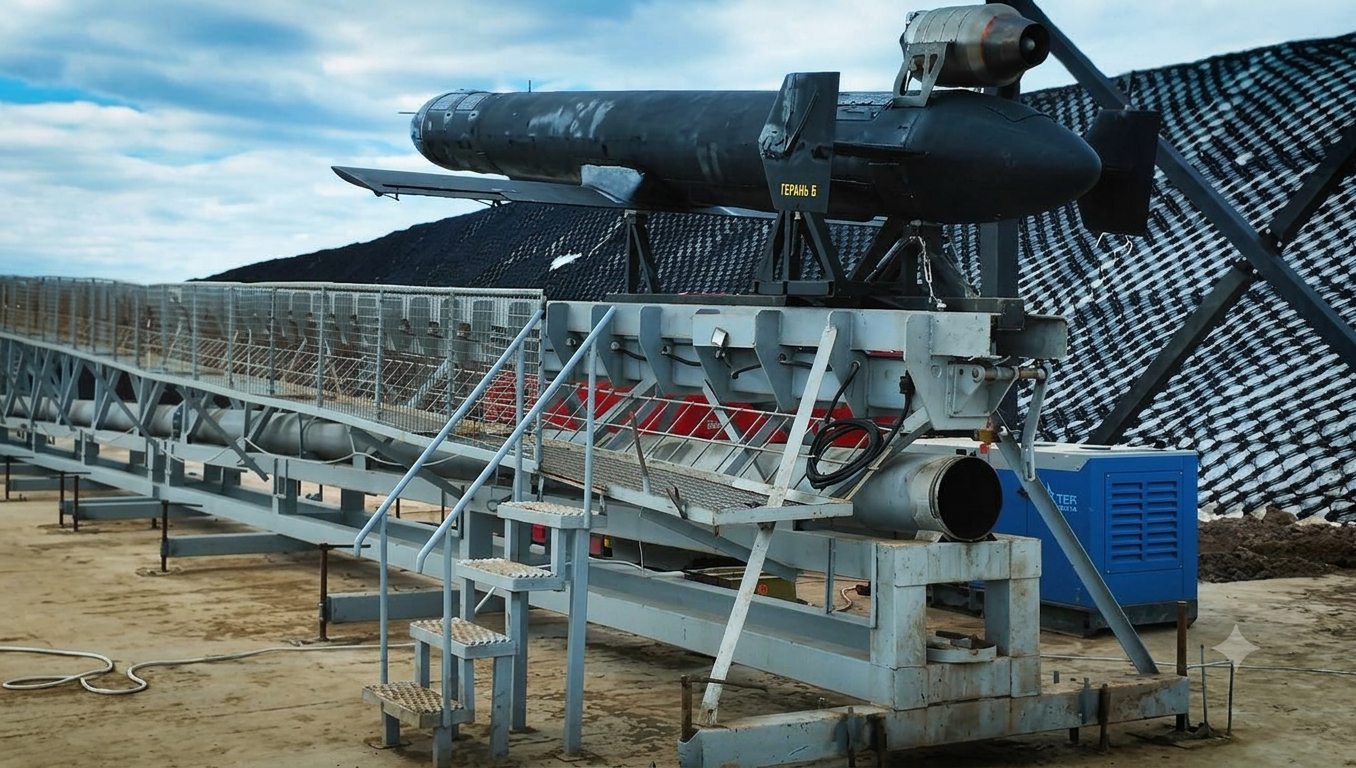
The Geran-5, the fastest named threat in this competition, reportedly cruises at 450 to 600 kilometers per hour. That is several times the typical 180-kilometer per hour cruising speed of the piston-powered Shahed-136. The speed difference shortens the time available for detection, tracking and engagement, but Ukrainian specialists say raw interceptor speed is not the only factor determining whether an interception is possible.
Earlier detection and accurate tracking can allow some propeller-driven interceptors to engage faster aircraft along a planned interception course rather than relying solely on a faster chase. At the system level, this makes radar, acoustic, visual and thermal sensors and the software connecting their observations part of the interceptor’s effective performance. Electronic warfare and multiple interceptor classes would provide additional layers rather than forcing one aircraft design to answer every target.
Even with those layers, industry must supply aircraft in numbers approaching the threat. One reported Geran-5 interception on October 8 involved a jet-powered interceptor supplied by the Serhiy Prytula Foundation. Other individual successes have been attributed to the Alexa Spatium, STING S and P1-SUN Jetkiller. These events are meaningful development milestones, but isolated results cannot show sortie availability, repeatability across units or the ability to replace expended interceptors quickly.
Engine cost illustrates why scaling is difficult. Ukraine’s Brave1 defense-technology organization estimates that small turbojet engines suitable for interceptor drones cost about $5,000 to $8,000 each. Electric ducted fans cost roughly one-eighth as much, creating a strong incentive to test several propulsion approaches rather than standardize immediately on the fastest and potentially most expensive configuration.
Six Ukrainian private companies were producing turbojet engines as of September, according to Brave1. Defense Minister Yevheniy Khmara said Ukraine was supporting about 20 domestic engine manufacturers across three engine categories, while projected demand for one type could reach 10,000 units per month in 2027. That projection shows the industrial scale under consideration, but it is not a statement that such output has already been achieved.
A higher interception rate can still leave a larger gap
At September’s reported volume of more than 3,500 jet-powered launches, even a high interception percentage could leave a consequential remainder. Those aircraft can threaten populated areas and infrastructure, while using medium-range missiles or fighter ammunition against relatively inexpensive drones can consume inventory reserved for more destructive missile threats.
Ihnat has warned that Ukrainian stocks of missiles and other interceptors are not growing sufficiently to match the rising number of attacks. That makes the jet-interceptor program a manufacturing and logistics problem as much as an aerodynamic one: the aircraft must be affordable, produced consistently, integrated with detection networks and available to operating units in large quantities.
Late November is consequently more than a delivery target. It is the earliest stated point at which Ukraine expects jet interceptors to begin arriving at the scale required, while the projected jet-powered share of Russian drone launches continues moving toward a majority. Until production closes that gap, three promising designs among 14 flight-test programs remain evidence of progress not yet evidence of adequate capacity.
| More aerospace and engineering stories, right in your MSN feed. Follow AMI on MSN |
By Stephen Wallace — Editor for AMI’s aerospace integration and unmanned mobility coverage, focused on drone manufacturing, VTOL systems, autonomous networks, and air-ground mobility links.