NASA’s Perseverance Breaks Mars Driving Record at 45.22 Kilometers
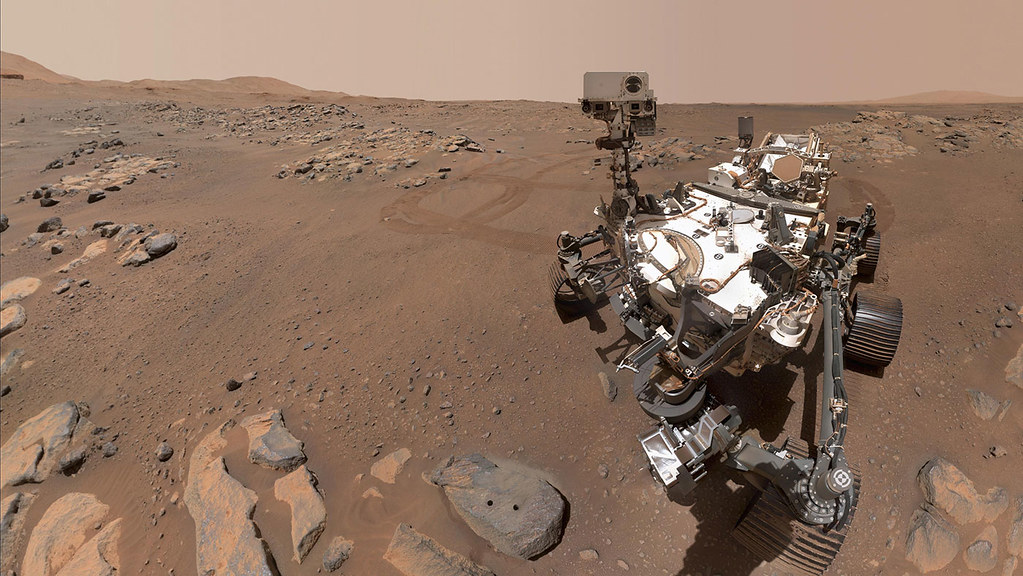
45.22 kilometers is the new distance to beat on another planet. NASA’s Perseverance rover reached that total on October 11, 2026, surpassing the 45.16 kilometers traveled by Opportunity and becoming the longest-driving vehicle beyond Earth, according to NASA’s Jet Propulsion Laboratory.

The record came on Perseverance’s 2,006th Martian day, or sol. It also carries an important engineering contrast: The rover’s original mission plan envisioned about 20 kilometers of driving. Perseverance has now covered more than twice that distance while crossing the floor, ancient river delta and rim of Jezero Crater.
Opportunity’s previous record had stood since 2018. It took that rover almost 15 years to travel 45.16 kilometers, while Perseverance reached 45.22 kilometers in roughly five and a half years after landing in February 2021. That difference does not reduce Opportunity’s achievement. Instead, it illustrates how later missions can convert lessons from earlier machines into greater surface mobility.
Autonomous navigation made the mileage practical
More than 90% of Perseverance’s total distance has been driven using AutoNav, its onboard autonomous navigation system. Human teams still choose science objectives, establish waypoints and develop the broader route. AutoNav handles the more immediate problem of moving through terrain that cannot be fully resolved in orbital imagery.
As the rover advances, the system images its surroundings, constructs a three-dimensional terrain map, identifies hazards and plots a path between the waypoints sent from Earth. NASA describes this as “thinking while driving.” Perseverance can perform that processing while moving at or near its top driving speed and has covered as much as 412 meters in one sol.
The scale of onboard terrain assessment has changed sharply across NASA’s rover generations. Sojourner, which landed in 1997, measured 20 points in the path ahead. Perseverance processes 600,000 points with each look. Opportunity and its twin Spirit carried earlier autonomous-navigation technology, but Opportunity completed only about 5% of its total driving distance under autonomous control.
This autonomy matters because Mars rovers cannot be driven like radio-controlled vehicles. Route instructions come from Earth, but the rover must deal locally with rocks, slopes and uneven ground. Allowing the machine to evaluate nearby terrain reduces its dependence on detailed, incremental driving commands and lets the operations team devote more of each planned traverse to forward progress and science.
AutoNav does not eliminate human judgment or make every landscape equally traversable. Orbital maps support long-range planning, and operators can mark areas the rover should avoid. The onboard system primarily evaluates terrain shape, while human planners can account for broader geological and surface characteristics. Perseverance also went about two months without using autonomy in more complex terrain while the team tuned parameters and developed software changes for conditions outside the crater.
Distance expands the available science
The mileage is useful because it connects geological settings rather than simply adding to an odometer. Perseverance has collected rock and regolith samples from the crater floor, an ancient river delta and the crater rim. Scientists believe Jezero once held a lake and river delta, making movement between those environments central to reconstructing the area’s history.
NASA has approved an extended mission supporting crater-rim exploration until approximately late 2028. The rover is now investigating terrain beyond Jezero’s western rim, including ancient rocks that may preserve evidence of geological processes no longer accessible on Earth because of erosion and plate tectonics.
Remaining life is not determined by driving software alone. Wheels, actuators, instruments, computing hardware, communications and power all have to remain functional in a cold, dusty environment. Perseverance’s plutonium-based power system is performing as expected, and NASA says it has “many years of useful energy still available.” That does not guarantee an operating lifetime, but it leaves power available for continued driving and science.
The next phase will test whether the mobility demonstrated across the first 45.22 kilometers can keep delivering access to distinct crater-rim geology through late 2028. The record is already secure; the operational value lies in how much new terrain that autonomy can still place within reach.
| More aerospace and engineering stories, right in your MSN feed. Follow AMI on MSN |
By David Whitaker — Associate editor for AMI’s aerospace and drone systems desk, translating flight systems, aircraft programs, spaceflight, and UAV developments into accessible technical stories.