


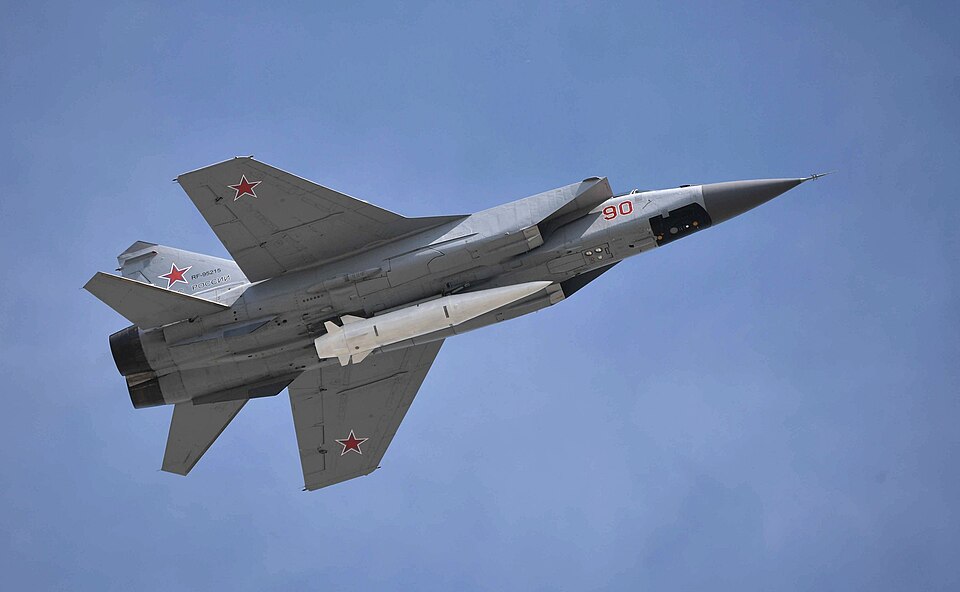
Ukraine Says 79% of Identified Kinzhal Electronics Are US-Origin
Seventy-nine percent is the figure that defines the electronics supply chain inside Russia’s Kh-47M2 Kinzhal missile. Ukrainian investigators say 155 of 197 identified electronic subassemblies were of U.S. origin, indicating that the air-launched weapon relies heavily on foreign computing, radio-frequency and power-management technology despite export controls intended to restrict Russia’s access.

The findings are recorded through Ukraine’s War and Sanctions portal, a public database operated by Ukrainian military intelligence. The component identifications and national-origin assignments remain Ukrainian government assessments, but their breadth provides a detailed view of the missile’s reported electronics stack rather than a conclusion based on one conspicuous chip.
American-origin hardware identified in the examination included a Geode microprocessor, memory chips, a field-programmable gate array, an analog to digital converter, a transceiver, a digital attenuator, an N-channel MOSFET and a power module. Together, those categories cover several essential electronic jobs: processing data, storing information, converting sensor signals, handling radio-frequency functions and regulating electrical power.
Japan ranked a distant second with 17 identified parts, including voltage regulators, integrated circuits, a broadband interference filter, an inductor and a Murata amplifier. Switzerland accounted for 10 components and Taiwan for seven. Investigators attributed one component each to Russia, Belarus and China; the sole Russian item identified was a BA996A1 transistor.
A foreign stack, not a single foreign dependency
The distribution suggests a broader industrial constraint than reliance on one irreplaceable processor. Russia reportedly sourced multiple functions from abroad, spanning general processing, programmable logic, memory, signal conversion, communications and power control. Replacing that mix domestically would involve more than producing nominal substitutes. New parts must fit electrical and software interfaces, meet performance and reliability requirements, remain available at production scale and pass whatever integration and qualification work the missile requires.
That makes component diversity important. A supply chain can sometimes absorb the loss of one commercial part through redesign or substitution. Pressure becomes harder to manage when foreign dependence extends across several electronic functions, because each change can introduce additional engineering work, cost and production risk.
Component origin alone, however, cannot measure how much production has been disrupted. Commercial semiconductors can pass through distributors and intermediaries, and a U.S.-origin designation does not identify the transaction through which a recovered part reached Russia. It also does not show whether the manufacturer knew its final destination.
The wider Ukrainian database reinforces the scale of the enforcement problem. The portal reportedly catalogs 6,181 foreign subassemblies across 284 Russian weapon systems. That total points to an industrial network drawing from globally traded dual-use electronics rather than a sourcing issue confined to Kinzhal.
Controls can raise costs without stopping output
Research summarized by the Center for Strategic and International Studies adds an important boundary to the component count. The Kyiv School of Economics found that export controls introduced since 2022 cut the value of Russia’s imports of Common High Priority goods by more than half. China nevertheless came to represent about 75% of reported exports of those goods to Russia, while the premium Russia paid China reached roughly 300% in 2025.
Those numbers describe friction: more concentrated supply, higher prices and pressure to substitute components. They do not by themselves establish that a weapon program has stopped. The practical test is whether restrictions make a capability slower to produce, costlier, less reliable or harder to scale and whether those effects persist as suppliers and designs change.
Kinzhal production was reported to have halted in April 2026, but the available assessment attributed that reported halt mainly to cost and limited combat advantage rather than a demonstrated shortage of foreign electronics. The system also requires a specially modified MiG-31K aircraft, adding a platform constraint beyond the missile’s component supply.
The 155 U.S.-origin subassemblies therefore reveal exposure, not a confirmed production cutoff. They show that an advanced Russian missile reportedly entered service with a deeply international electronics stack. For export-control authorities, the harder task begins after identifying those parts: determining which functions remain difficult to replace, whether substitution imposes lasting engineering penalties and how quickly supply networks adapt after restrictions tighten.
| More aerospace and engineering stories, right in your MSN feed. Follow AMI on MSN |
By David Whitaker — Associate editor for AMI’s aerospace and drone systems desk, translating flight systems, aircraft programs, spaceflight, and UAV developments into accessible technical stories.




