


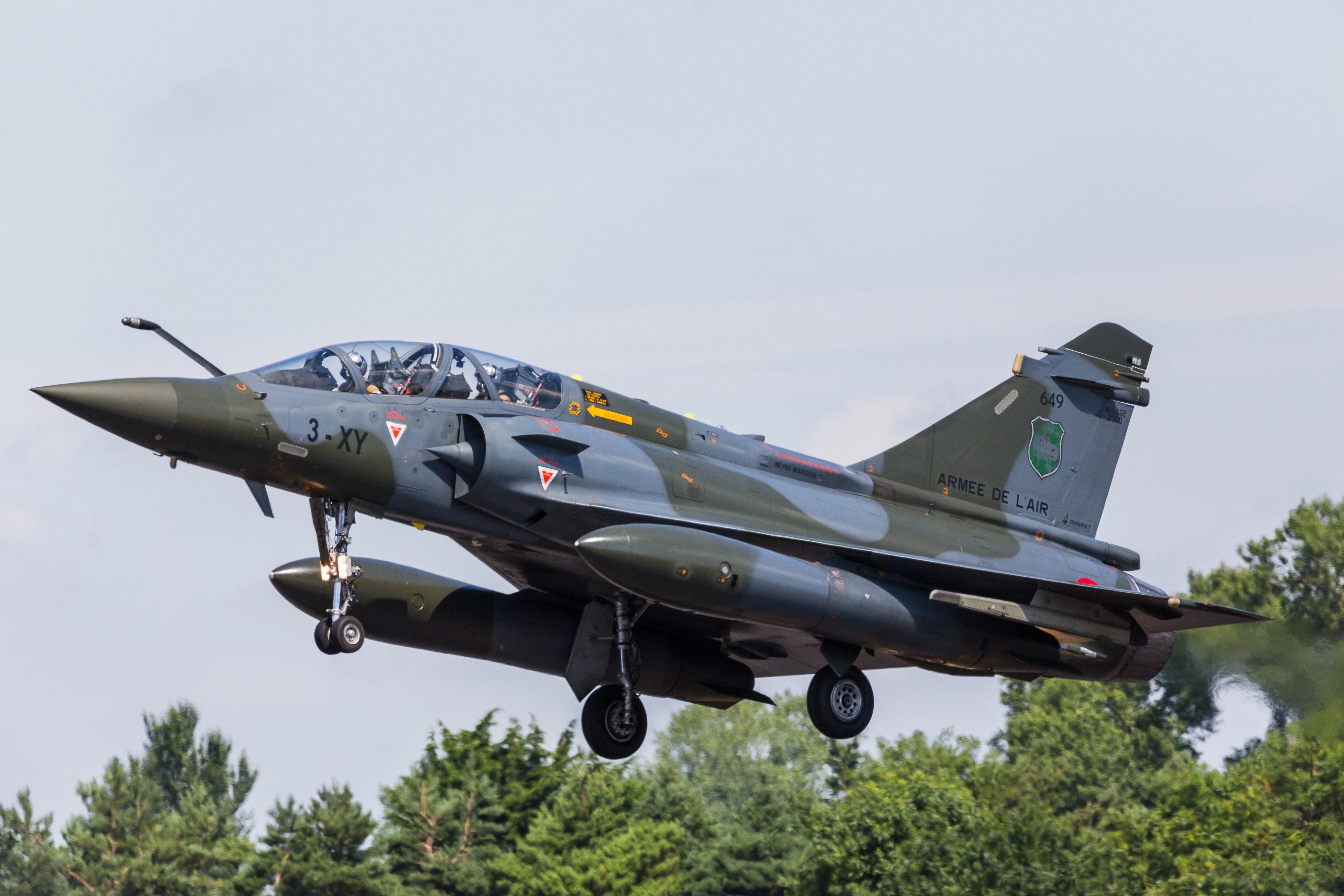
Mirage 2000D Final-Approach Crash Leaves One Missing, Opens Safety Investigation
French authorities have opened aviation-safety and judicial investigations after a French Air and Space Force Mirage 2000D crashed on final approach to Nancy-Ochey Air Base. One body had been recovered but was awaiting identification on October 21, while search teams continued looking for the second crew member.

The two-seat aircraft went down near Rogéville in northeastern France at approximately 10:40 p.m. local time on October 20. It belonged to Fighter Squadron 2/3 “Champagne” and was carrying a pilot and a weapons systems officer. Colonel Ludovic Humbert, the base commander, said air traffic control lost contact as the aircraft returned from a routine night training mission.
Those details establish the flight phase but not the accident sequence. “Final approach” covers a demanding period in which the crew is managing aircraft configuration, speed, descent, navigation, communications and the transition toward landing. Knowing that contact was lost during this phase helps investigators define the relevant records and systems to examine. It does not identify which technical, environmental or human factor if any initiated the loss.
Weather is context, not yet a finding
Humbert described the weather as unfavorable while cautioning against drawing conclusions before the investigation is complete. Investigators can compare recorded conditions with the aircraft’s path, crew communications, approach procedures and available airfield information. Until those sources are assembled, adverse weather remains an operating condition rather than an established cause.
That boundary is particularly important in a night approach. Reduced external visual references may increase reliance on instruments, but the available information does not establish visibility, cloud conditions, crew workload or spatial disorientation in this accident. Nor does it show whether the aircraft experienced a technical problem. The investigations must reconstruct the sequence instead of selecting an explanation from one known circumstance.
Recent renovation raises records questions, not an answer
Humbert also said the aircraft had been renovated relatively recently. He did not explicitly identify it as a Mirage 2000D RMV, the designation associated with France’s mid-life upgrade, so the exact configuration of the lost aircraft remains unconfirmed in the available account.
Renovation is relevant because it gives investigators another defined set of configuration, maintenance, testing and acceptance records to review. It is not itself evidence of a modification-related failure. A modernization program can change cockpit displays, mission computers, software, navigation equipment and other installed systems while the underlying aircraft continues under established structural-integrity and maintenance programs. Investigators will need the individual airframe’s records to determine what work was completed, when it returned to service and whether any item warrants closer examination.
The broader Mirage 2000D mid-life renovation was designed to update the aircraft for service beyond 2030. France’s Directorate General for Armament delivered the 50th and final upgraded aircraft on June 16, 2026, four months before this crash. The program included modernized cockpit, mission-computer, navigation and attack systems, but no available finding connects those changes to the loss near Rogéville.
For an aging combat-aircraft fleet, modernization and airworthiness management also address different questions. New mission equipment can preserve operational usefulness, while inspections, life tracking and maintenance manage fatigue, corrosion, wear and other age-related concerns. The fact that an aircraft has received new systems therefore cannot establish the condition of every component, just as the age of its basic design cannot establish that age contributed to an accident.
No fleet-wide action has been reported
The immediate operational effect is the loss of an aircraft and its two-person crew during peacetime training. Firefighters, military firefighters, gendarmerie personnel, a helicopter and drone support were deployed to the response and search. No civilian-airport disruption, grounding of the Mirage 2000D fleet or other fleet-wide corrective action had been reported in the latest account.
Previous French fighter investigations illustrate why the current case must stand on its own. A 2019 Mirage 2000D crash was attributed most likely to spatial disorientation, while investigators examining a 2024 Rafale collision identified simultaneous opposing control inputs during an attempted evasive maneuver. Those were aircraft-specific findings developed from their respective records; neither supplies a cause for the Rogéville crash.
The next substantive milestone will be an investigative finding that connects physical evidence, aircraft data, communications, weather and maintenance history into a supported sequence. Until then, the confirmed picture remains narrower: a recently renovated Mirage 2000D was lost on final approach after routine night training, with one body recovered and the search continuing for the second crew member.
| More aerospace and engineering stories, right in your MSN feed. Follow AMI on MSN |
By David Whitaker — Associate editor for AMI’s aerospace and drone systems desk, translating flight systems, aircraft programs, spaceflight, and UAV developments into accessible technical stories.



