


Unofficial 2028 Prowler Render Adds Hemi Power, but Revival Remains Fiction
The Plymouth Prowler always looked ready for a V8, yet the production roadster never received one. An unofficial digital concept now imagines a 2028 SRT Prowler with Hemi power, apparently correcting the performance-image mismatch that followed the original car. No official revival has been announced, however, and making this idea roadworthy would require far more than placing a larger engine beneath its pointed hood.

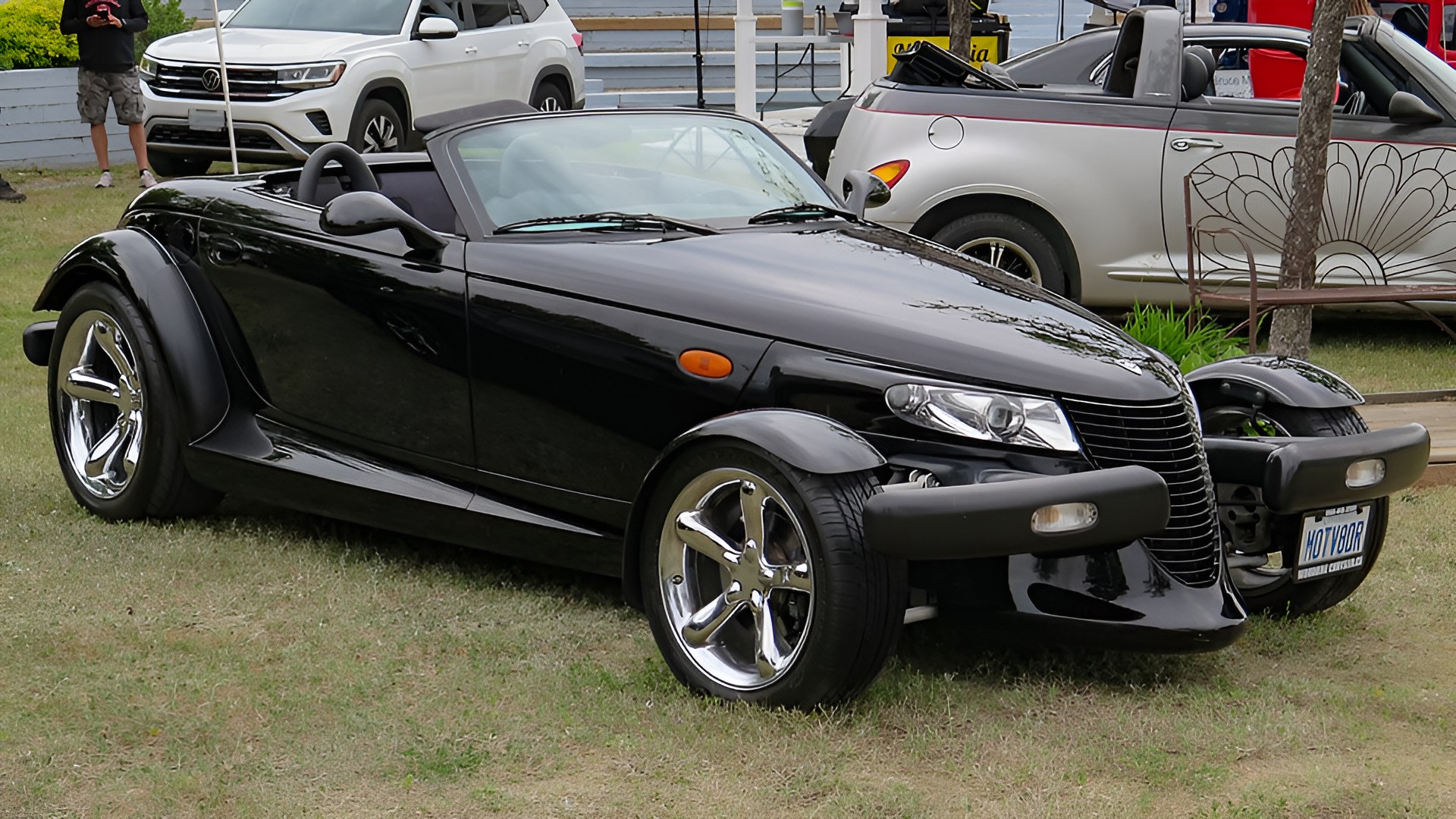
The render preserves the recognizable Prowler formula: exposed front suspension, a low windshield, an open two-seat cockpit and a tapered nose. LED-style lighting, oversized chrome wheels, a wider tail, an SRT badge, twin exhaust outlets and a black rear diffuser update the design vocabulary. It is a compelling visual exercise, but it remains only a digital concept rather than a Stellantis product announcement.
Why the V8 idea is so persuasive
The production Prowler arrived for 1997 with rear-wheel drive, aluminum-intensive construction and unconventional hot-rod proportions. Its initial 3.5-liter V6 produced 214 horsepower and 221 pound-feet of torque. Power traveled through a four-speed AutoStick automatic; Plymouth offered no manual gearbox. Early cars needed roughly seven seconds to accelerate from zero to 60 mph.
Those figures were respectable for the period, but they did not fully support the expectations created by the Prowler’s dramatic bodywork. A 1999 update raised output to 253 horsepower and 255 pound-feet, reducing the approximate zero to 60-mph time to 5.7 seconds. The improvement made the car quicker without changing the central perception that its powertrain was less theatrical than its appearance.
A naturally aspirated 6.4-liter Hemi provides the obvious hypothetical correction. The engine used in the Challenger R/T Scat Pack was rated at 485 horsepower, nearly twice the output of the updated Prowler. A supercharged 6.2-liter V8 could exceed 700 horsepower, but that option would turn an already difficult integration project into a substantially more demanding one.
Power would reshape the entire vehicle
The Prowler’s narrow nose and exposed-wheel layout leave limited room for a large engine, its accessories, exhaust routing and cooling hardware. A supercharged V8 adds further volume and heat from the supercharger, charge-cooling circuit and associated plumbing. Hellcat development required strengthened internal components, dedicated charge coolers, an engine-oil cooler and extensive validation an indication that the headline power figure brings supporting-system demands with it.
Transmission integration would be equally consequential. The original Prowler placed its four-speed transmission at the rear to improve weight distribution. Preserving that configuration with a modern high-output powertrain would require a transmission and driveline capable of handling much greater torque, along with new electronic controls, mounting structures and thermal management. Abandoning it would change the vehicle’s mass distribution and could alter the handling character engineers were trying to preserve.
Braking and chassis capacity would also have to rise with performance. More acceleration means more kinetic energy for the brakes to absorb, particularly during repeated high-speed stops. Larger brakes, suitable tires and revised suspension tuning would be expected engineering companions to a V8 conversion. Those changes can add unsprung mass, require different wheel geometry and place new loads into an aluminum-intensive structure originally developed around a much less powerful engine.
Modern stability control, traction management and powertrain calibration would be essential rather than optional refinements. Delivering several hundred additional horsepower through a short, rear-wheel-drive roadster would require the engine, transmission, differential, brakes and chassis controls to operate as one system. A convincing production Prowler could not rely on engine output alone.
A new platform faces a difficult business case
Any production version would also need contemporary crash testing and emissions compliance. The exposed-wheel shape, low open cockpit and distinctive structure would leave engineers with a specialized vehicle rather than an easy derivative of a mainstream platform. Developing that architecture for a low-volume roadster would spread substantial engineering and certification costs across relatively few vehicles.
The nameplate itself has been dormant for more than two decades. Plymouth was discontinued in 2001, and the Prowler’s final production year was 2002 under the Chrysler name. Its potential market would also be smaller than those supporting the Ford Mustang or Chevrolet Corvette, making a dedicated platform harder to justify.
The digital 2028 Prowler therefore resolves the original car’s most persistent criticism only on screen. Hemi power fits the image, but accommodating it would force changes to the cooling system, transmission, brakes, controls, structure and safety package the very work separating an evocative render from a certifiable production car.
| More aerospace and engineering stories, right in your MSN feed. Follow AMI on MSN |
By Thomas Caldwell — AMI’s senior editor for mechanical and mobility engineering, covering vehicle electronics, systems integration, electrification, chassis systems, propulsion, and safety policy.




