


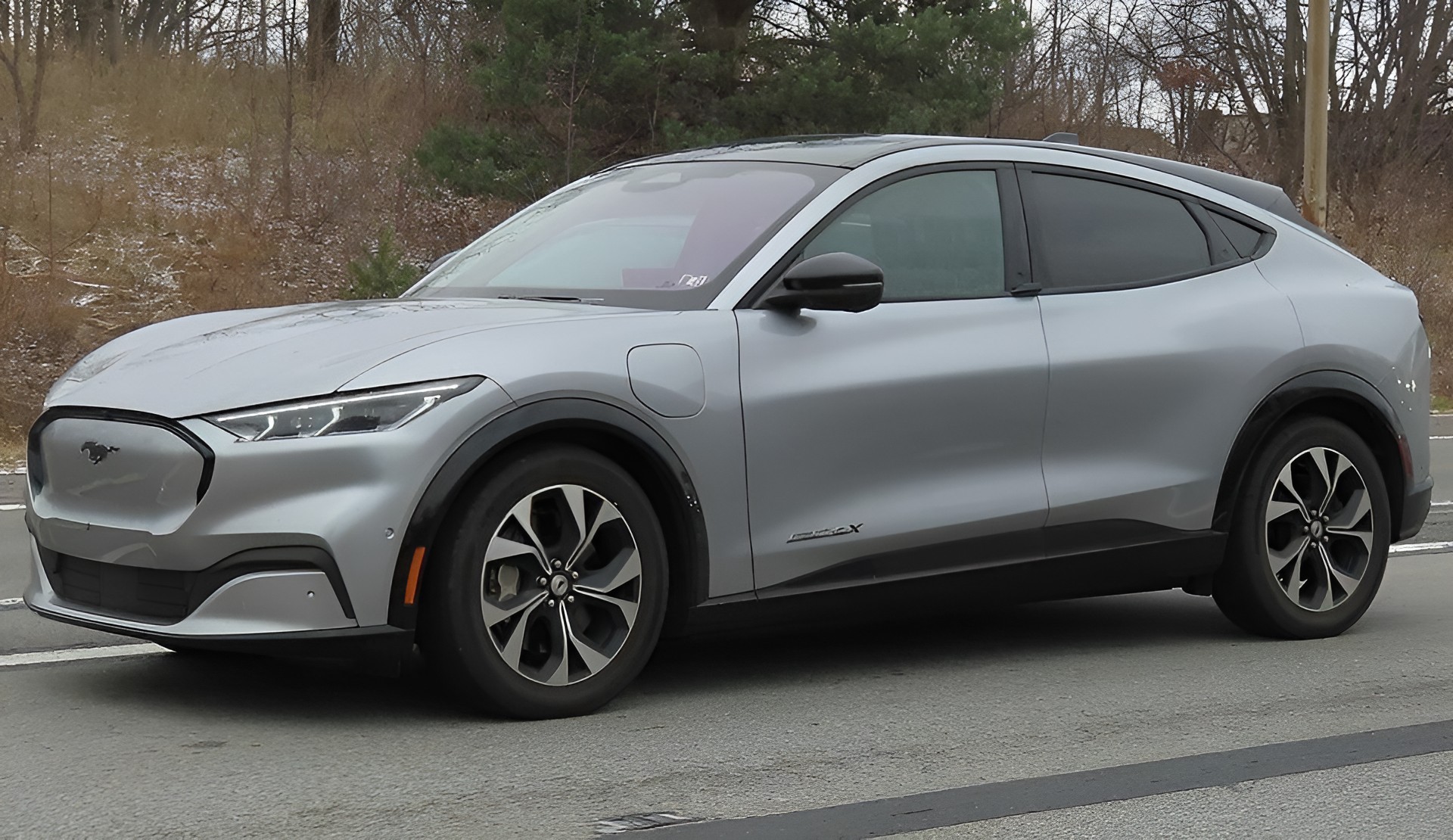
2027 Ford Mustang Mach-E Gets Larger Battery but Costs $2,200 More
The least expensive 2027 Ford Mustang Mach-E comes with substantially more battery capacity and a higher price of entry. Ford has eliminated the smaller 73-kilowatt-hour pack previously standard on Select and Premium models, leaving an 88-kWh battery as their only choice. The rear-wheel-drive Select now starts at $42,040 including destination, $2,200 more than the outgoing small-battery version.

In practical terms, the added money buys 15 kWh of usable battery capacity and greater range potential, while removing the lower-cost configuration from the lineup. Ford has not yet announced final 2027 EPA range estimates, so previous extended-range figures cannot be treated as confirmed ratings for the new model year. U.S. dealer order books are open, according to Ford’s 2027 model announcement.
More capacity replaces the cheaper battery choice
The clearest comparison comes from the outgoing configurations. The listed estimate for a 2026 Mach-E with the smaller battery was 260 miles with rear-wheel drive and 240 miles with all-wheel drive. Extended-range versions were listed at 320 and 300 miles, respectively. Those figures show the potential scale of the benefit 60 additional miles in either drivetrain configuration but they remain 2026 estimates rather than finalized 2027 ratings.
Battery capacity often works as a trade between convenience and cost. More stored energy can reduce charging frequency and provide a larger margin for long trips, cold weather or other conditions that raise consumption. It also adds material, mass and expense. In this case, Ford has standardized the larger pack rather than asking entry-level customers to make that choice. Buyers gain the capacity, but those who would have accepted less range no longer have the cheaper small-pack option.
The battery strategy differs at the top of the range. Mach-E GT and Rally models retain their 91-kWh packs, so the principal change affects Select and Premium the models that previously used the smaller battery as standard. The result is a more uniform battery lineup without making every version mechanically identical.
A cheaper front motor helps offset battery cost
All-wheel-drive Mach-E models also receive a redesigned front electric motor. Ford says the secondary drive unit provides the same performance as the previous motor but costs less to manufacture. That is an important systems-level change even though it does not promise additional output: reducing cost in one subsystem can help absorb the expense of making a larger battery standard.
The new motor does not apply to the base rear-wheel-drive Select because that configuration has no front drive unit. Its $2,200 increase is therefore most directly understood as the price step from the outgoing small-battery entry model to a new entry model with the 88-kWh pack.
Trail sits between the standard Mach-E and Rally
Ford is also adding a $2,295 Trail package, available only on the Select with dual-motor all-wheel drive. It combines specially tuned suspension, 19-inch wheels, Michelin CrossClimate2 tires and selected steering hardware from the Rally. Ride height increases by 0.4 inch at the front and 0.6 inch at the rear.
Those are modest changes intended for pavement, gravel and dirt-road access rather than a transformation into a dedicated off-roader. The continuing Rally provides the useful comparison: it has a one-inch suspension lift over the standard Mach-E, while Trail uses a smaller, uneven front to rear increase. Trail is therefore the less specialized package, aimed at added clearance and all-season traction on roads leading to campsites, trailheads and similar destinations.
The package also includes Pro Power Onboard, supplying as much as 400 watts through two household outlets. That output is suited to personal electronics and smaller accessories rather than high-demand equipment. A Thule clamp-on crossbar kit and an interior-protection package are available separately.
Ford plans to open its online Build & Price tool early next year, with the first Trail-equipped vehicles expected to ship in the first quarter of 2027. Final range ratings will provide the remaining key measurement: how much of the previous extended-range model’s advantage carries into the revised 2027 configurations.
| More aerospace and engineering stories, right in your MSN feed. Follow AMI on MSN |
By Thomas Caldwell — AMI’s senior editor for mechanical and mobility engineering, covering vehicle electronics, systems integration, electrification, chassis systems, propulsion, and safety policy.




