


Saab Backlog Jumps 80%, Loading Factories With Work Beyond 2029
Saab has secured years of additional work, but the resulting aircraft and naval systems will not roll out all at once. The Swedish aerospace and defense manufacturer ended the third quarter of 2026 with a record order backlog of SEK 364.2 billion, or about US$36.8 billion an 80% increase from a year earlier. Its third-quarter results show that contracted work now stretches beyond 2029, requiring production investment well before much of it becomes reported sales.

The scale of that timing gap is the central industrial story. Saab booked SEK 65.8 billion in orders during the quarter, more than three times the SEK 20.9 billion recorded in the same period of 2025. Sales rose a substantial 29.5%, but reached only SEK 20.6 billion. In other words, Saab added future work far faster than it converted existing contracts into current revenue.
That produced a quarterly book to bill ratio of 3.2. The measure compares new orders with sales over the same period; a figure above one indicates that the backlog is expanding. At 3.2, Saab was booking more than three kronor of new work for every krona of quarterly sales.
Gripen led the order surge
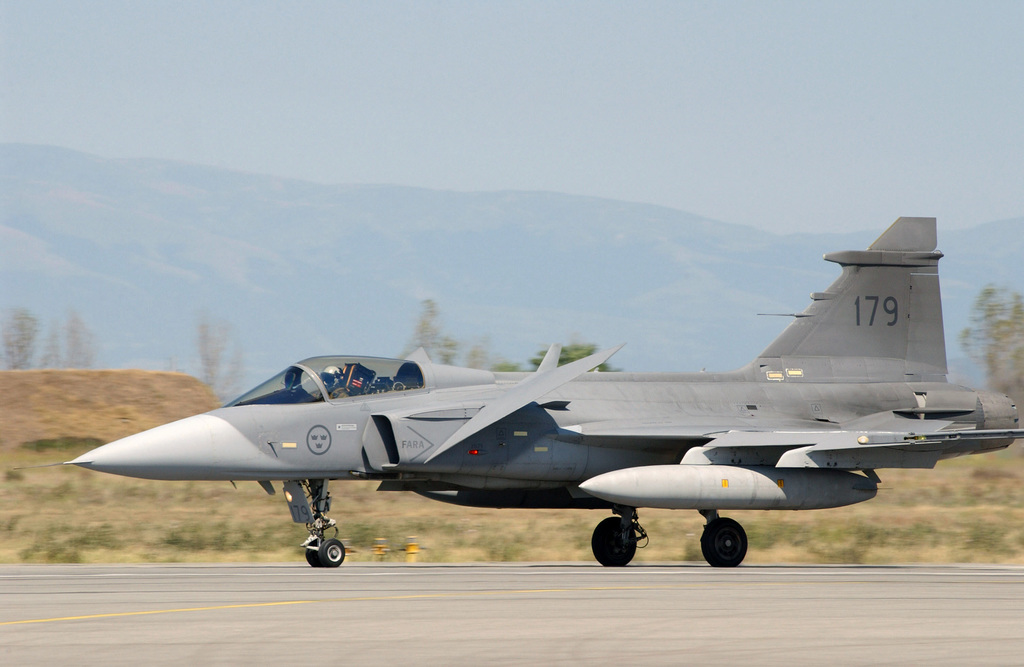
The largest award was a SEK 24.6 billion contract covering 16 Gripen E fighters for Ukraine. That single agreement represented about 37% of Saab’s quarterly orders. It includes spare parts and associated equipment, while Saab’s deliveries to Sweden’s Defence Materiel Administration are scheduled for 2029 and 2030.
Two other major contracts broadened the factory load beyond combat-aircraft production. Saab received a SEK 10.1 billion order for two GlobalEye airborne surveillance and command aircraft for an undisclosed customer. It also booked SEK 8.7 billion for systems serving four new German Navy frigates.
Together, those awards load several distinct production operations: Gripen assembly, GlobalEye manufacturing and integration, and naval-system work. Saab is increasing capacity across those areas, as well as at its missile facilities. The challenge is broader than finding final-assembly floor space. Large aerospace and naval programs require engineering, testing and supplier output to advance in sequence, while customers accept equipment according to contract schedules rather than when an order is signed.
Aeronautics makes the mismatch particularly visible. The business area received SEK 28.8 billion in quarterly orders, about 85% of it associated with the Gripen contract. Yet Aeronautics sales increased just 9% to SEK 4.84 billion. Its backlog reached SEK 102.5 billion, while the T-7 trainer program continued to weigh on the division even as project execution and business mix supported higher operating income.
A backlog is a production schedule, not immediate sales
Saab’s backlog is divided across several future reporting periods. The company schedules SEK 102.1 billion for revenue recognition in 2027, followed by SEK 89.2 billion in 2028 and SEK 62 billion in 2029. Another SEK 83 billion is assigned to years after 2029. Those amounts illustrate why a record order book creates an immediate need for capacity but only a staged financial and delivery result.
The longer horizon can also give Saab greater visibility when planning facilities, staffing and program resources. At the same time, it commits the company to execute several complex programs in parallel. Production expansion must support current deliveries while preparing for aircraft and naval work that will remain in the system for years.
The buildup did not begin in a single quarter. Saab’s backlog stood at SEK 274.5 billion at the end of 2025, meaning the company added almost SEK 90 billion in net contracted work during the first nine months of 2026. Orders over that period reached SEK 152.5 billion, up 123% from a year earlier, with large contracts contributing SEK 105.3 billion.
Current sales are already growing as delivery volumes and program progress increase, particularly in Saab’s Surveillance and Naval businesses. Operating income rose 42% to SEK 1.95 billion in the third quarter, while net income increased 47% to SEK 1.43 billion. But those results remain much smaller than the increase in contracted work.
For customers, the record backlog represents secured production slots as much as purchased hardware. For Saab, it represents a long execution queue that must be converted through manufacturing, integration, testing and delivery. The clearest marker of that timetable is the quarter’s largest contract: the 16 Gripen E fighters booked in 2026 are not scheduled for delivery to Sweden’s procurement agency until 2029–2030.
| More aerospace and engineering stories, right in your MSN feed. Follow AMI on MSN |
By David Whitaker — Associate editor for AMI’s aerospace and drone systems desk, translating flight systems, aircraft programs, spaceflight, and UAV developments into accessible technical stories.



