HAARP Radio Test Detects Aircraft Beyond Alaska’s Radar Horizon, Reliability Unproven
An experimental Alaska surveillance system detected military aircraft beyond the reach of conventional ground radar by pairing the existing High-frequency Active Auroral Research Program transmitter with a newly developed, low-cost receiver array. The September 2026 live-flight event completed three years of testing, but the Pentagon’s account of the experiment says broader analysis is still needed to establish reliability and operational utility.

That leaves the project at an important boundary: Researchers have demonstrated that the arrangement can produce beyond-line-of-sight detections under real operating conditions, but they have not established a deployable surveillance capability. No operational decision or implementation timetable has been announced.
One transmitter and a distant receiver
Conventional ground radar is constrained by Earth’s curvature, surrounding terrain and the altitude of the aircraft being observed. Those limits become particularly significant in Alaska, where roughly 663,000 square miles, remote coastlines, mountains, severe weather and sparse northern infrastructure complicate the construction and maintenance of continuous sensor coverage.
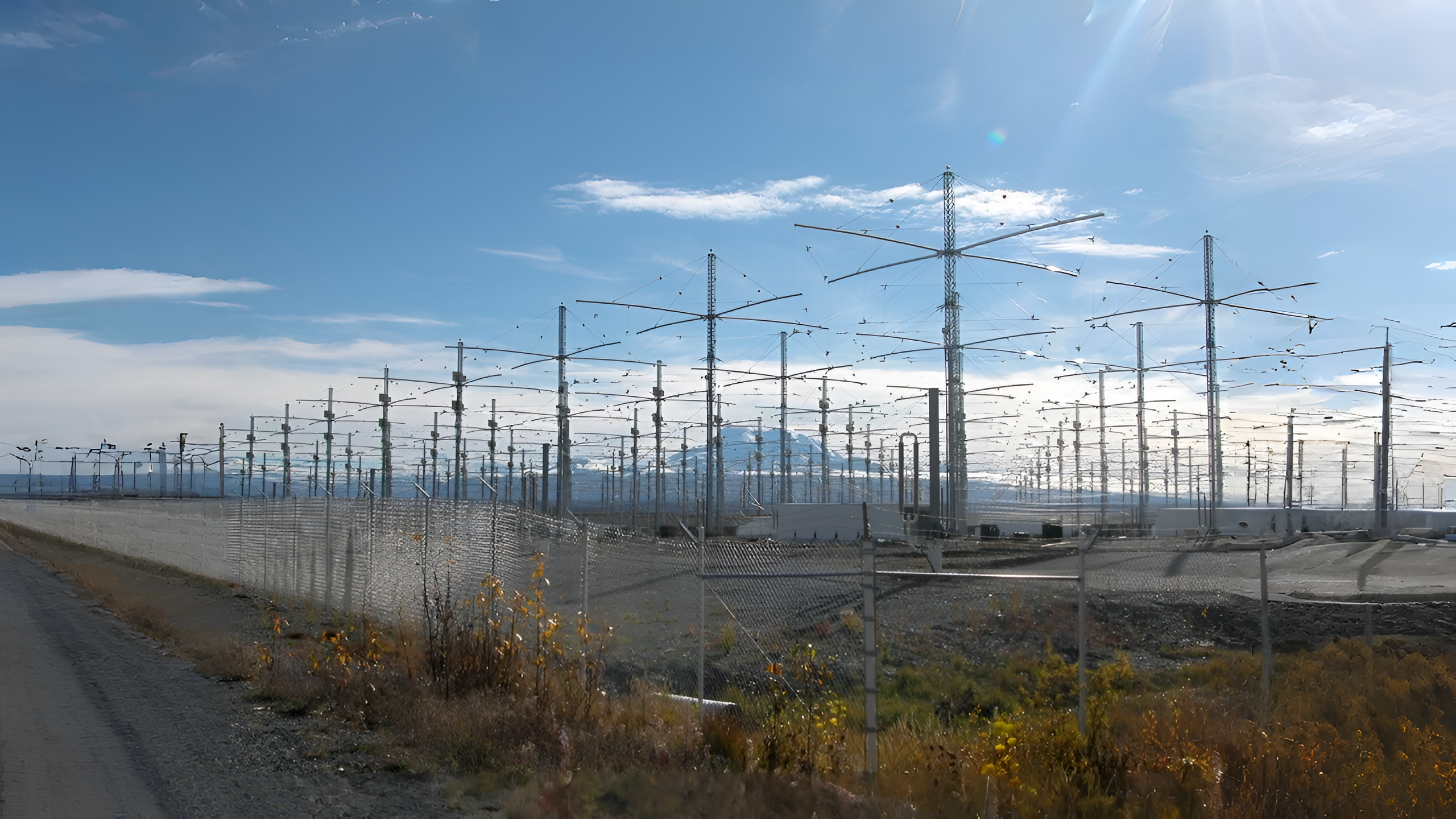
The experiment approached that geometry differently. HAARP’s transmitter in Gakona sent high-frequency radio signals toward the ionosphere, while an inexpensive receiver array at Cold Bay near the Aleutian Peninsula collected observations associated with aircraft over the Gulf of Alaska and Bering Sea. Because the transmitter and receiver occupied separate locations, the arrangement was a bistatic detection system rather than a conventional radar with transmission and reception concentrated at one site.
HAARP provided a major piece of existing infrastructure instead of requiring researchers to construct a dedicated transmitter for the experiment. The University of Alaska Fairbanks has operated the facility solely since 2015. Industry partners developed the remote receiver array, while U.S. military organizations, scientists, operational units and Defence Research and Development Canada participated in the broader effort.
This combination is the project’s central engineering proposition. Reusing a powerful transmitter and installing a lower-cost receiver could offer another way to collect data across areas that are difficult to cover with conventional long-range radar sites. The receiver’s description as low-cost, however, applies to that component; the available results do not establish the cost of an operational network, its staffing needs or its long-term maintenance burden.
Known aircraft provided a controlled comparison
The participating aircraft were cooperative targets whose positions were known to researchers. They included an E-3 Sentry airborne warning and control aircraft, HC-130J Combat King II aircraft and KC-135 Stratotankers. That allowed the team to compare experimental observations with the aircraft’s actual locations instead of evaluating unidentified returns without a reference.
Initial findings showed successful beyond-visual-line-of-sight detections correlated with the targeted flights. The Pentagon also said the event met or exceeded its test-execution objectives. Those results confirm that the transmitter-receiver geometry generated useful observations during the test, which is a meaningful step beyond a laboratory or modeling exercise.
The controlled setup also defines what remains unresolved. Detecting cooperative aircraft during planned flights answers whether the concept can work under those test conditions. Operational surveillance requires confidence that a sensor will perform dependably across the conditions and coverage areas assigned to it. The Defense Department is now conducting a more comprehensive analysis to determine whether the collected data supports that level of reliability and practical utility.
A supplement rather than an immediate replacement
The experiment was framed as a possible complement to current surveillance capabilities, not as a replacement for Alaska’s existing sensors. That distinction fits the design: A beyond-horizon system could extend awareness into areas where line-of-sight radar geometry becomes restrictive, while conventional radars would continue serving the coverage and tracking roles for which they were built.
The potential procurement advantage is similarly bounded. An inexpensive remote receiver and an already available transmitter can lower the hardware barrier for experimentation. A fielded system would still have to justify its performance, coverage contribution, support requirements and integration with the wider surveillance architecture. None of those decisions follows automatically from an initial detection.
For now, the three-year effort has produced a completed live-flight result rather than a new operational sensor. The next consequential milestone is the Pentagon’s analysis of whether the detections were reliable and useful enough to turn HAARP and the Cold Bay receiver from an experiment into a practical supplement for Alaska’s difficult-to-monitor approaches.
| More aerospace and engineering stories, right in your MSN feed. Follow AMI on MSN |
By David Whitaker — Associate editor for AMI’s aerospace and drone systems desk, translating flight systems, aircraft programs, spaceflight, and UAV developments into accessible technical stories.