


California High-Speed Rail Loses $4 Billion as Funds Shift Nationwide
California’s high-speed rail program is losing $4 billion in federal support just as it must convert years of construction into an operating passenger line. The U.S. Department of Transportation withdrew the grants following a Federal Railroad Administration compliance review and began redirecting the money to other rail investments around the country.
The review, which exceeded 300 pages, identified a major funding gap, no credible path to completion on schedule and overstated ridership projections. Federal officials said the California High-Speed Rail Authority had two opportunities to respond but did not satisfy the grant terms. California sued to retain the money and later dropped the lawsuit.
The withdrawal does not immediately stop construction. Federal money represents 18% of the program’s funding, leaving California able to continue work with state and other resources. It does, however, reduce financial flexibility on a project described as substantially behind schedule and now estimated by California’s Legislative Analyst’s Office to cost $231 billion, an increase of 83%.
Visible construction and a complete railway are different milestones
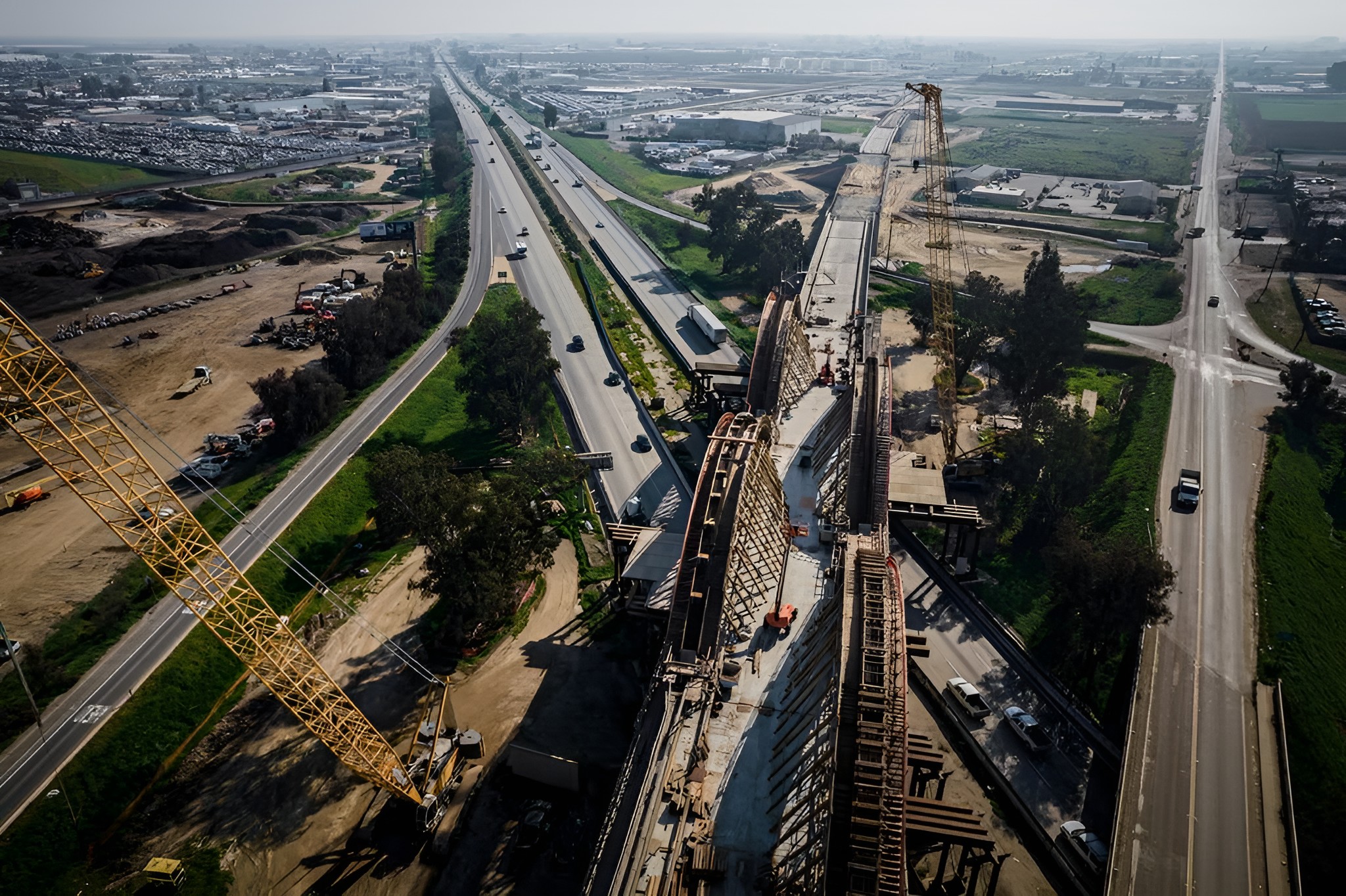
California points to substantial physical progress. The governor’s office says 171 miles between Bakersfield and Merced are under construction, 94% of the planned route is environmentally cleared and construction-ready, and more than 19,000 jobs have been created. Those measures establish that the program is active, but they represent different stages of delivery.
Environmental clearance allows a defined route to advance through legal and planning requirements; it does not fund or complete its civil works. Likewise, bridges, guideways and earthworks become a passenger railway only after track, electrical power, signaling, stations, trains, testing and operating procedures are integrated across a useful route. The financing challenge is therefore not merely keeping crews employed. California must fund enough connected infrastructure to begin service and support the ridership assumptions behind that investment.
Package-level records show how ordinary engineering dependencies continue to add cost and schedule exposure while the larger funding dispute proceeds. The authority’s official Central Valley change-order log includes $4.7 million for engineering services through a construction package’s substantial-completion deadline. Other entries document compensation associated with utility relocation, railroad coordination, soil testing, revised requirements and schedule effects.
Among the larger listed changes are $79.864 million for guideway drainage and piping revisions, $55 million added to a provisional sum for utility relocation, $36.88 million for sewer reconfiguration and bypass work, and $21.226 million for overcrossing changes. Some amounts are provisional or supplemental rather than final projectwide spending, but the records illustrate the integration burden: utilities, local infrastructure and third-party railroad requirements can constrain a much larger transportation system.
Redistribution changes who carries the delivery risk
Moving the $4 billion elsewhere does not reduce federal rail spending by the same amount. It transfers opportunity and delivery risk from one statewide megaproject to competing projects around the country. Other communities may receive funding for narrower or more mature work, while California residents and prospective passengers face greater uncertainty over whether construction already completed will connect to an operating route.
The replacement projects and individual award amounts have not been identified here, so their value cannot yet be compared with what the same money might have delivered in California. Distributing funds can reduce dependence on one program and broaden geographic access to federal investment. Concentrating funds can produce a more consequential network, but only if the recipient can finance and integrate the complete system.
Cost comparisons also require care. An analysis discussing Government Accountability Office findings identified utility relocation, unexpected geology, procurement choices and the allocation of contractor risk as important cost drivers, while noting that differences among projects limit simple international comparisons. Those factors are examined in Eno’s discussion of the GAO work. They help explain why a construction package can remain active while its budget and schedule continue changing.
The dispute over motive is separate from those delivery constraints. Transportation Secretary Sean Duffy said federal grants require results and characterized the program as mismanaged. Gov. Gavin Newsom’s office called the withdrawal political and emphasized the construction, environmental-clearance and employment figures. Reason Foundation representatives likewise questioned the existing completion plan while saying political considerations appeared to have influenced the decision.
California can continue building, but physical progress alone will not resolve the program’s central exposure. The state now has to pair the structures already underway with committed financing for a serviceable route, while the federal government must show what operating benefits the redirected $4 billion produces elsewhere.
| More aerospace and engineering stories, right in your MSN feed. Follow AMI on MSN |
By Thomas Caldwell — AMI’s senior editor for mechanical and mobility engineering, covering vehicle electronics, systems integration, electrification, chassis systems, propulsion, and safety policy.



