


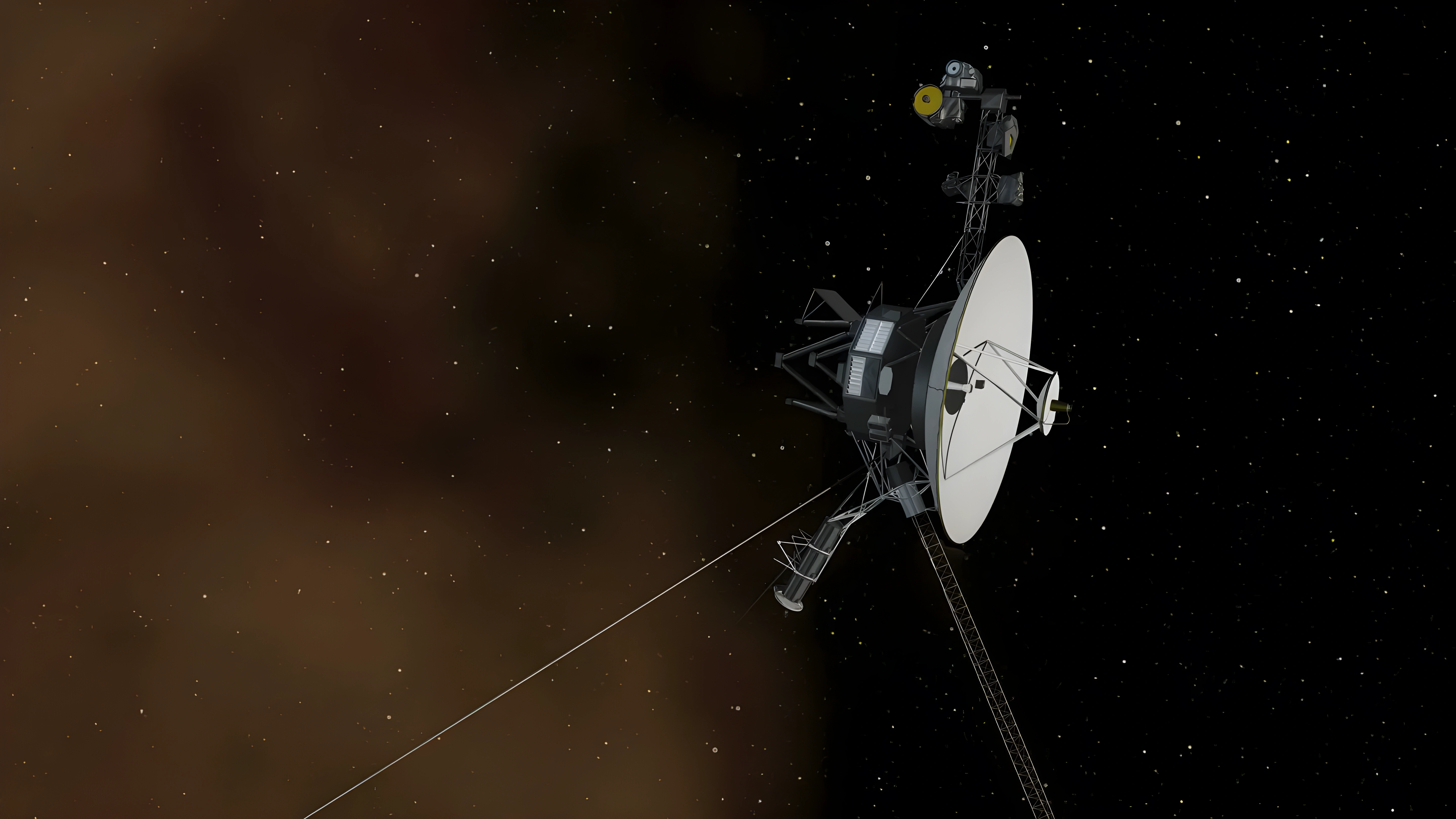
Voyager 1 Nears Distance Where Its Signals Take Over a Day
Twenty-four hours is about to become Voyager 1’s minimum one-way wait for a message home. The spacecraft is calculated to reach a distance of one light-day from Earth on November 18, 2026, at approximately 10:16:07 UTC, although the precise crossing time remains uncertain. After that threshold, every radio signal it transmits will need more than a full day to arrive.
The milestone turns an otherwise unwieldy distance into a human timescale. A transmission received on Tuesday will have left Voyager 1 on Monday. Any command sent in response then faces the same long trip outward, putting a basic command and reply exchange on a delay exceeding two days before processing time is counted.
One light-day is a measure of distance, not a new region of space or a physical boundary. Voyager 1 crossed the heliopause the outer edge of the bubble dominated by the solar wind in 2012. It has therefore been operating in interstellar space for more than a decade, even as the November milestone marks only how long its radio energy takes to reach a moving Earth.
Earth and the Sun produce different crossing dates
Voyager 1 is currently about 81 million kilometers, or 51 million miles, closer to the Sun than it is to Earth. Its signals consequently reach the Sun roughly four minutes before they reach Earth. The spacecraft will need almost another two months after the Earth-based milestone to become one light-day from the Sun.
That difference comes from Earth’s position in its orbit and helps explain why a light-day cannot function like a fixed line painted across space. The November 18 estimate refers specifically to Voyager 1’s changing distance from Earth. The more durable scientific boundary was the heliopause crossing, identified through changes in the particle and plasma environment around the spacecraft.
Scientists had expected the magnetic field to change direction at that boundary, but Voyager 1 did not detect such a turn. It did, however, encounter about 80 times as many electrons as before. Measurements from the two Voyager spacecraft have since shown that the interstellar medium is neither perfectly empty nor uniform: its density varies, it carries plasma waves, and it responds to major solar disturbances that travel far beyond the heliopause.
A shrinking spacecraft still measures interstellar space
Voyager 1’s science return now depends on managing declining electrical power. Its three radioisotope thermoelectric generators produce less power as their plutonium-238 fuel decays, forcing engineers to switch off instruments and other loads over time. NASA’s spacecraft overview describes a communications system built around a 3.7-meter high-gain antenna that must remain pointed toward Earth while the probe returns low-rate engineering and science data.
The plasma-wave instrument has provided one of the mission’s most direct views of the environment beyond the heliopause. Plasma oscillation frequencies reveal the number of electrons in the spacecraft’s surroundings, allowing researchers to infer local density. Voyager has detected both stronger disturbances associated with solar outbursts and a much fainter, persistent plasma “hum” between those events.
Solar activity can still reach the probe despite its interstellar designation. Ed Stone, the mission’s longtime project scientist, described interstellar space as normally resembling a quiet lake. A solar burst sends a shock wave outward, he explained, causing the plasma around Voyager to “sing” when the disturbance arrives roughly a year later.
Interstellar space also does not mean Voyager 1 has passed beyond every part of the Solar System. The heliopause marks the limit of the solar-wind bubble, while distant cometary orbits extend much farther. Their uncertain outer extent provides another possible definition of the Solar System’s edge, and both Voyager spacecraft are expected to fall silent long before reaching it.
The scale is severe. Voyager 1 has taken almost 50 years to approach one light-day from Earth, while the nearest star lies 4.3 light-years from the Sun. Its November crossing will not change the surrounding physics, but it will make the mission’s operating environment unmistakable: a functioning spacecraft can send a signal at light speed, and Earth still has to wait until the next day to hear it.
| More aerospace and engineering stories, right in your MSN feed. Follow AMI on MSN |
By David Whitaker — Associate editor for AMI’s aerospace and drone systems desk, translating flight systems, aircraft programs, spaceflight, and UAV developments into accessible technical stories.



