NASA Seeks Hubble Rescue as Reentry Risk Hits 30 Times Safety Limit
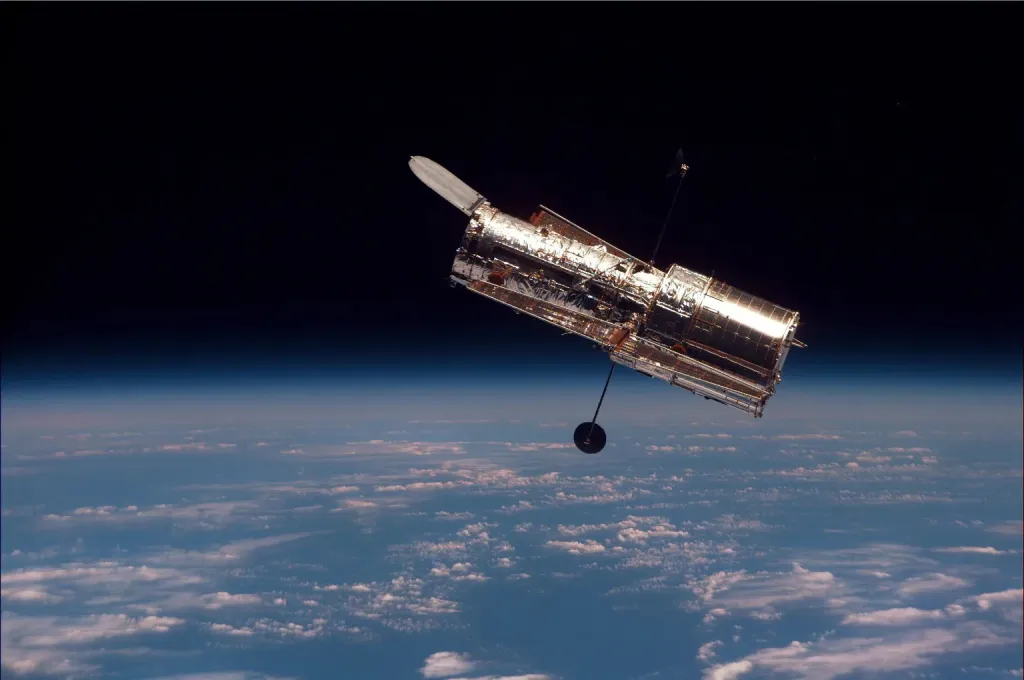
NASA is asking private companies how they could rescue, service or safely dispose of the Hubble Space Telescope before its declining orbit turns into a public-safety problem. The agency issued a formal request for information on Oct. 29, with responses due by 3 p.m. ET on Nov. 30.

For people who have followed Hubble’s discoveries for more than three decades, the inquiry carries an uncomfortable message: the telescope may need another rescue, but extending its scientific life cannot be separated from controlling how it eventually returns to Earth. A cited casualty analysis estimated the risk from an uncontrolled 2033 reentry at 1 in 330 approximately 30 times NASA’s maximum accepted probability of 1 in 10,000.
Hubble cannot maintain its own orbit
Hubble was deployed in April 1990 at an altitude of roughly 612 kilometers. Its latest cited orbit ranges from about 470 kilometers at its lowest point to 475 kilometers at its highest. The telescope has no propulsion system for maintaining that altitude, so the thin upper atmosphere is gradually pulling it downward.
The timing remains uncertain. Astronomer Jonathan McDowell’s analysis allows for reentry as early as 2028 without intervention, while the Space Telescope Science Institute’s median forecast is mid-2033 and places the probability of reentry before 2030 below 10%. NASA says an effective servicing mission would need to launch by 2032.
That uncertainty does not remove the disposal problem. Hubble has a mass of approximately 13 metric tons and was not designed to conduct a controlled atmospheric reentry. A 2022 casualty study estimated that about 20% of the telescope roughly 2.6 metric tons could survive the descent. Its modeled debris footprint extended between 350 and 800 kilometers along the ground track.
The risk is a probability across the population beneath Hubble’s 28.5-degree-inclination orbit, not a prediction that debris will strike a particular person or city. But the 1-in-330 estimate sits well above the accepted limit in NASA’s orbital-debris standard, giving the agency a concrete reason to seek a controlled outcome rather than wait for orbital decay to make the decision.
The orbital boost is the easier part
One option is to raise Hubble from approximately 470 kilometers to around 600 kilometers, extending its orbital and scientific life. The estimated velocity change is only about 70 meters per second. Supplying that push is not the mission’s central engineering difficulty; safely rendezvousing with, capturing and moving a large aging observatory is.
Hubble does have a purpose-built connection point. During the final shuttle servicing mission in May 2009, astronauts installed the Soft Capture Rendezvous System, including a standardized 76-centimeter docking ring on the telescope’s aft bulkhead. That interface gives a future spacecraft a defined capture target, but it does not eliminate the demands of close approach, docking and attitude control.
Contamination presents another constraint. NASA studied a proposed Polaris Program and SpaceX Dragon reboost before declining it in June 2024. NASA Astrophysics Division director Mark Clampin identified possible contamination of Hubble’s ultraviolet mirrors from spacecraft outgassing as a principal technical concern. A mission intended to preserve the observatory could diminish its scientific performance if its vehicle or operating environment deposits material on sensitive optical surfaces.
The recent failure of Katalyst Space’s LINK spacecraft reinforces the execution risk. LINK launched in July 2026 to capture and reboost NASA’s Swift observatory, but it lost attitude control and did not capture Swift. The outcome does not determine whether another company can reach Hubble, but it demonstrates that commercial proximity operations around aging scientific spacecraft remain demanding even when the basic objective sounds straightforward.
Three paths, one deadline
NASA is asking respondents to assess all three paths: reboosting Hubble, servicing or upgrading it, and conducting a controlled reentry or permanent disposal. The inquiry is an information-gathering step, not a mission award. Cost, contamination, capture reliability and the telescope’s remaining condition will shape whether extending operations is preferable to preparing for disposal.
Hubble still has a greater than 70% probability of retaining at least one functional gyroscope through 2035, according to project manager Patrick Crouse. That leaves a striking mismatch between scientific potential and orbital time: the observatory may remain useful after its declining altitude forces action. Commercial responses due Nov. 30 will begin showing whether NASA can buy more years of science without trading them for an uncontrolled return to Earth.
| More aerospace and engineering stories, right in your MSN feed. Follow AMI on MSN |
By David Whitaker — Associate editor for AMI’s aerospace and drone systems desk, translating flight systems, aircraft programs, spaceflight, and UAV developments into accessible technical stories.