China Assembles 1,056-Foot Carrier-Shaped Hull in Under Two Years
A vessel the length of a large aircraft carrier has taken shape with unusual speed at China’s Dalian Shipyard. According to a Centre for Strategic and International Studies assessment of recent satellite imagery, prefabricated sections first seen in a dry dock in early 2025 became a recognizable carrier-shaped hull in less than two years.
The unfinished vessel measures approximately 1,056 feet, or 322 meters, from bow to stern and about 150 feet, or 46 meters, across its beam. CSIS described it as substantially larger than any other class of surface combatant in China’s navy. Analysts have suggested it could enter the water in 2027 and might become China’s first nuclear-powered aircraft carrier, but neither its propulsion system nor its launch schedule has been officially confirmed.
What the imagery establishes
The strongest conclusion rests on the hull itself. CSIS found that its shape and arrangement do not match ultra-large container ships, tankers or other commercial cargo vessels. Instead, the structure resembles Chinese aircraft carriers photographed at comparable stages of construction.
That identification is significant because a ship’s broad role can become apparent before many of its defining systems are installed or visible. Hull proportions, internal subdivision and the developing flight-deck form provide stronger clues than speculation about equipment that may eventually be fitted aboard.
The construction pace is also directly observable. CSIS said components that appeared in the dry dock in early 2025 were assembled into a clearly recognizable hull in under two years, highlighting the speed and scale of China’s maritime industrial base. Modular construction can move fabrication into separate shops before large blocks reach the dock, shortening the period during which the complete vessel is visibly assembled.
What remains unverified
The vessel is commonly described outside official channels as the Type 004, but that designation has not been confirmed. The available information also does not establish a four-catapult layout. Claims that four catapults have appeared should therefore not be treated as an imagery-confirmed feature of the ship.
Catapult count would matter because launch equipment helps determine how a carrier can cycle aircraft and which aircraft configurations it can send from the deck. Yet an unfinished hull does not by itself reveal the completed launch system, its power supply or its eventual operating performance. Those answers require clearer imagery, official disclosure or evidence from later construction and testing.
Nuclear propulsion is the larger unresolved question. Nuclear power is well suited to vessels expected to remain at sea for long periods because it sharply reduces propulsion-fueling interruptions. The World Nuclear Association notes that more than 160 ships are powered by over 200 small reactors, mostly submarines but also including aircraft carriers and icebreakers.
A nuclear carrier does not literally operate without propulsion fuel. Its reactor contains nuclear fuel designed for a long service interval, potentially eliminating the frequent replenishment of conventional propulsion fuel. Aircraft, support equipment, crew provisions and other consumables still impose substantial logistics demands. Nuclear power changes one major endurance constraint; it does not make the carrier independent of a supply network.
It also purchases that endurance with considerable engineering obligations. A naval reactor requires specialized components, shielding, trained operators, rigorous maintenance and long-term support infrastructure. The U.S. Naval Nuclear Propulsion Program, for comparison, maintains dedicated research laboratories, engineering facilities, training organizations and prototype testing for the safe operation of naval reactors. China’s specific arrangements for this vessel are not publicly established.
Launch would be an early milestone
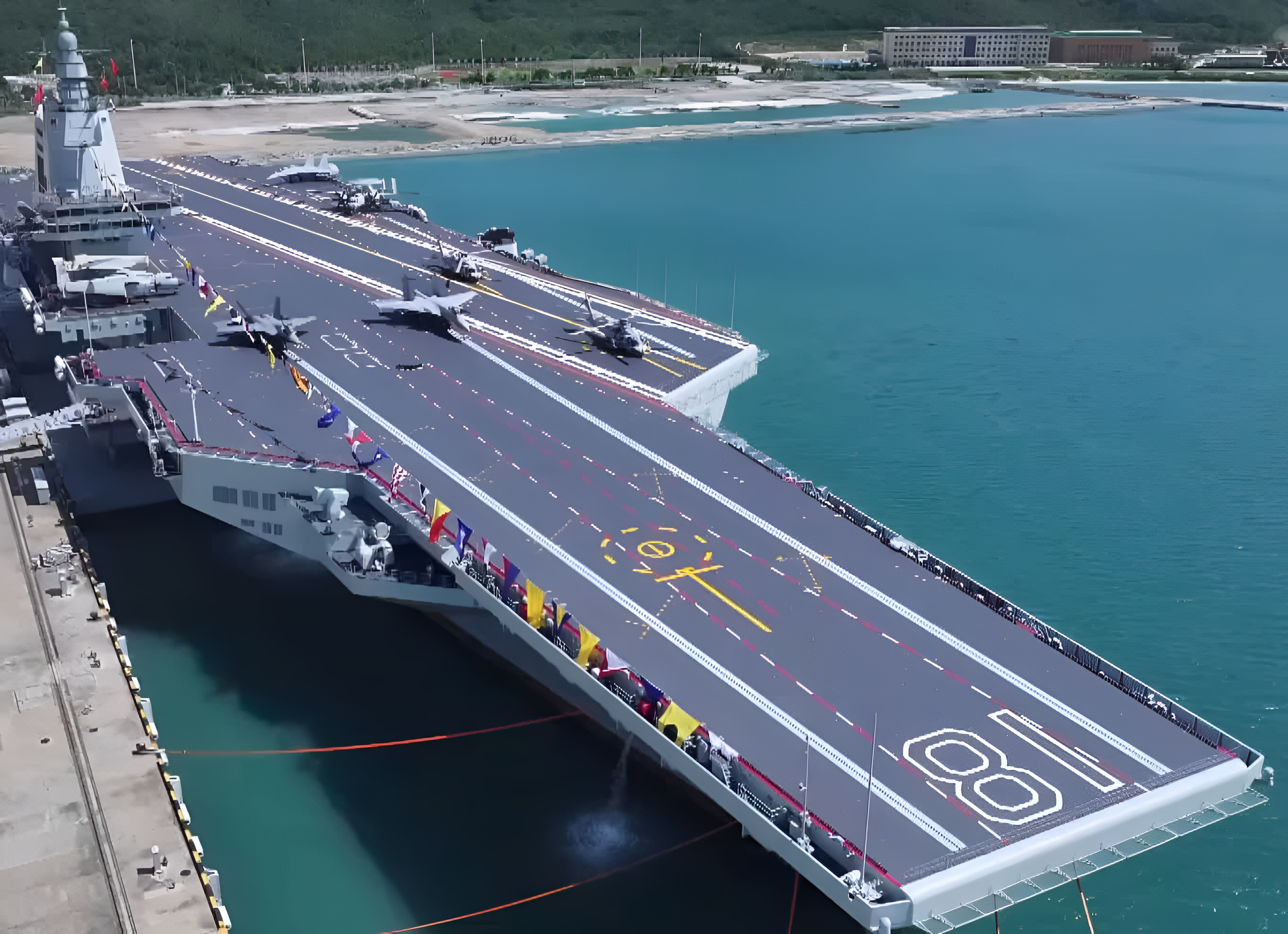
A 2027 launch remains an analytical estimate rather than a disclosed shipyard schedule. The comparison is partly based on China’s Fujian carrier, which was photographed at a similar construction stage roughly a year before its June 2022 launch. The new hull’s greater size and potentially more complex machinery could produce a different timeline.
Entering the water would also mark the start of another demanding phase, not operational service. Outfitting, system activation, harbor work, sea trials and aviation testing would still separate launch from fleet use. For now, the rapid appearance of the 1,056-foot hull is the confirmed development. Whether it carries four catapults, receives nuclear propulsion or reaches the water in 2027 remains the next layer of the investigation.
| More aerospace and engineering stories, right in your MSN feed. Follow AMI on MSN |
By David Whitaker — Associate editor for AMI’s aerospace and drone systems desk, translating flight systems, aircraft programs, spaceflight, and UAV developments into accessible technical stories.