NASA’s 1.5-Ton Swift Telescope Nears Reentry After Robotic Rescue Failed
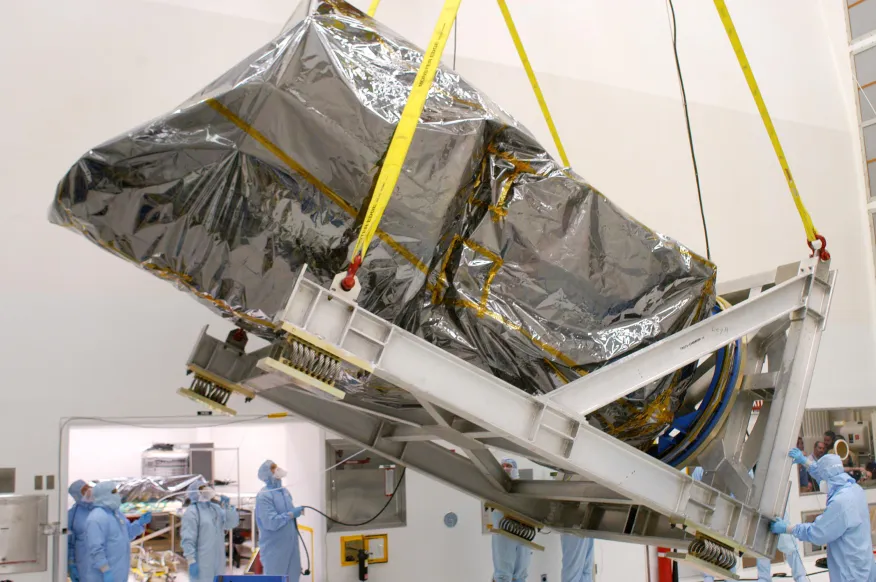
NASA’s 1.5-ton Swift space telescope is expected to reenter Earth’s atmosphere on or around Friday, according to a U.S. Space Force prediction, ending a productive 22-year astronomy mission after a robotic rescue failed to raise its orbit. NASA has concluded Swift’s operations, and the Space Force is tracking the observatory’s declining path.
Most of the spacecraft is expected to burn up during atmospheric entry. NASA mission chief scientist Brad Cenko said several tungsten pieces and mirror components could survive the heating and reach the surface. Any surviving debris is considered most likely to fall into the ocean, although the broad reentry zone includes parts of Africa, Australia, India, Southeast Asia, and Central and South America.
Solar activity accelerated Swift’s descent
Swift launched on Nov. 20, 2004, to detect gamma ray bursts, supernovas and other violent, high-energy events. It operated in low Earth orbit without a propulsion system capable of maintaining its altitude, leaving the mission dependent on its original orbital margin and careful management of the spacecraft’s orientation.
The upper atmosphere is extremely thin at orbital altitudes, but it is not empty. Its molecules exert drag that gradually removes energy from low-flying spacecraft. Solar activity can make that process substantially worse: energy from the Sun heats and expands the upper atmosphere, exposing satellites to denser air at a given altitude. NOAA notes that this increased density produces stronger drag and can alter satellite orbits.
Intense solar activity over the past several years pulled Swift down faster than anticipated. NASA’s team made operational changes intended to keep the telescope at least 185 miles above Earth, the altitude considered most favorable for a rescue attempt. Science observations were also paused to reduce drag and preserve time for that mission.
The rescue spacecraft never reached Swift
NASA awarded Katalyst Space a contract in September 2025 to design, build, test and launch a robotic servicing spacecraft in less than a year. The resulting three-armed robot, called Link, launched in July with the goal of capturing Swift and lifting it into a higher orbit.
The fast schedule reflected the shrinking intervention window. Swift was already descending, so a conventional multiyear spacecraft-development program would have arrived too late. The mission also carried substantial technical risk: Link had to approach, capture and reposition an observatory that had not been designed for robotic servicing.
Link developed an attitude-control problem after launch and never came closer than about 7 to 9 miles, or 12 to 15 kilometers, from Swift. NASA confirmed that the spacecraft would not capture or boost the observatory. The rescue was abandoned, and Link itself reentered in September.
Swift nevertheless had one final operational reversal. After the rescue ended, NASA restarted science observations, and the telescope examined hundreds of additional targets. Returning to its observing orientation increased drag, however, and the spacecraft again began losing altitude rapidly.
On Oct. 20, Swift reached an altitude of 171 miles. At that point, it could no longer compensate for the aerodynamic effects well enough to remain steady for observations and entered safe mode. Controllers at Penn State then sent the command that ended operations and prepared the spacecraft for reentry.
An alert capability disappears with the telescope
Swift detected more than 2,000 gamma ray bursts and 1,400 exploding stars during its mission. It also observed comets, asteroids and black holes tearing apart stars. Its value extended beyond its own instruments: Swift could turn rapidly toward a newly erupting object and alert Hubble, the James Webb Space Telescope and other observatories to begin follow-up work.
Scientists are still determining how to replace that rapid-alert role. Individual telescopes can continue studying gamma ray bursts and other transient events, but Swift combined detection, quick repositioning and coordination with other observatories in one platform.
John Nousek, the Penn State astronomer who led Swift’s control team, said the mission’s end had been understood since before launch because spacecraft in low Earth orbit eventually descend. Swift’s final months made that constraint unusually visible: solar-driven drag compressed the schedule, a rush servicing mission fell short, and the telescope briefly returned to science before it became too low to hold the stable pointing its observations required.
| More aerospace and engineering stories, right in your MSN feed. Follow AMI on MSN |
By David Whitaker — Associate editor for AMI’s aerospace and drone systems desk, translating flight systems, aircraft programs, spaceflight, and UAV developments into accessible technical stories.