USS Theodore Roosevelt Heads to Persian Gulf With 9,000-Person Buildup
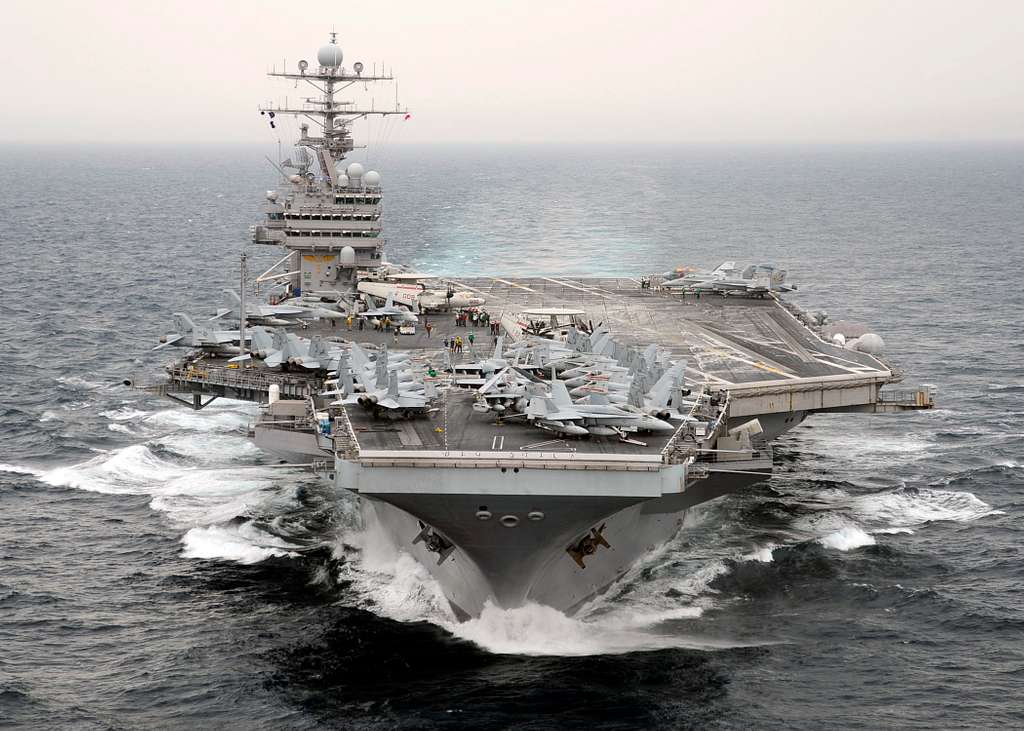
A large U.S. naval force is moving toward the Persian Gulf even though no decision to resume American strikes against Iran has been announced. The Pentagon deployed the USS Theodore Roosevelt and several amphibious landing ships carrying Marines from San Diego in late October, a force package totaling roughly 9,000 personnel.

One U.S. official said the deployment could lift the regional naval presence above 20,000 sailors and Marines, supported by hundreds of aircraft. The aircraft figure covers the broader regional force rather than the Theodore Roosevelt alone, but the concentration would still be unusual: a U.S. presence on this scale has occurred only a handful of times during the past two decades.
The buildup expands capacity before policymakers have committed to using it. Two diplomats briefed on U.S. warnings said several Middle Eastern countries and allies had been advised to prepare for possible renewed military action against Iran after the Nov. 3 elections, along with potential retaliation. The diplomats stressed that no final strike decision had been made, while the White House and other U.S. officials declined to comment on the warnings.
A carrier and amphibious ships add different capabilities
Theodore Roosevelt supplies the aviation center of the deployment. The Navy’s Carrier Air Wing 11, assigned to the carrier and Carrier Strike Group 9, comprises nine squadrons operating F/A-18E/F Super Hornets, EA-18G Growlers, E-2D Hawkeyes, V-22 Ospreys and MH-60R/S Sea Hawks.
At a high level, that mix gives commanders fighters, electronic-warfare aircraft, airborne command and control platforms, tiltrotor transports and helicopters within one embarked air wing. Amphibious ships add Marines and another aviation component. Together, the formations provide substantially more personnel, aircraft and command capacity than either could deliver independently.
That capacity also carries a heavy operating burden. A carrier-centered force requires ships, aviation maintenance, spare parts, fuel, munitions and a large support organization to remain available. Amphibious ships bring their own crews, aircraft and embarked Marine units. Concentrating the force can increase near-term options, but sustaining a large presence places continuing demands on personnel, equipment and the Navy’s deployment schedule.
The benchmark is recent but rare. In April, the Navy had three carrier strike groups in the Middle East for the first time since 2003. The new Theodore Roosevelt-led movement therefore follows another exceptional concentration rather than a routine regional rotation.
Readiness does not settle the decision
The deployment shortens the gap between a policy decision and the availability of forces, but it does not reveal whether another operation will be ordered or when the military would be ready to conduct one. The diplomats said a new round of U.S. military action could last several days and that retaliation by Iran or proxy groups could extend the conflict.
Regional governments are preparing for consequences beyond military operations. According to the diplomats, allies were urged to take precautions around energy facilities and other crucial infrastructure. Disruption to those systems could widen the civilian and economic effects of any renewed confrontation, which helps explain why force protection and infrastructure readiness are advancing before a final U.S. decision.
The cost of the existing campaign is already substantial. The Pentagon’s latest estimate to Congress put the cost to U.S. taxpayers at $47.1 billion. That figure provides a financial boundary around the buildup: adding carrier and amphibious capacity creates more operational flexibility, but deploying and sustaining large naval formations is an expensive commitment even if no new strikes follow.
Diplomatic channels remain open alongside the military movement. Iranian Foreign Minister Abbas Araghchi said Tehran “continues to give diplomacy a chance to succeed” while reviewing ideas with mediators. The United Arab Emirates urged the sides to “exercise wisdom and pursue political solutions to help contain tensions.”
For now, the clearest change is in available capacity rather than approved action. Roughly 9,000 personnel are moving with the Theodore Roosevelt and amphibious force, potentially pushing the regional naval presence beyond 20,000 sailors and Marines while the decision that could determine how long they remain and what mission they ultimately perform remains unresolved.
| More aerospace and engineering stories, right in your MSN feed. Follow AMI on MSN |
By David Whitaker — Associate editor for AMI’s aerospace and drone systems desk, translating flight systems, aircraft programs, spaceflight, and UAV developments into accessible technical stories.