Army’s Lighter, Shorter M8 Carbine Starts Fielding in December
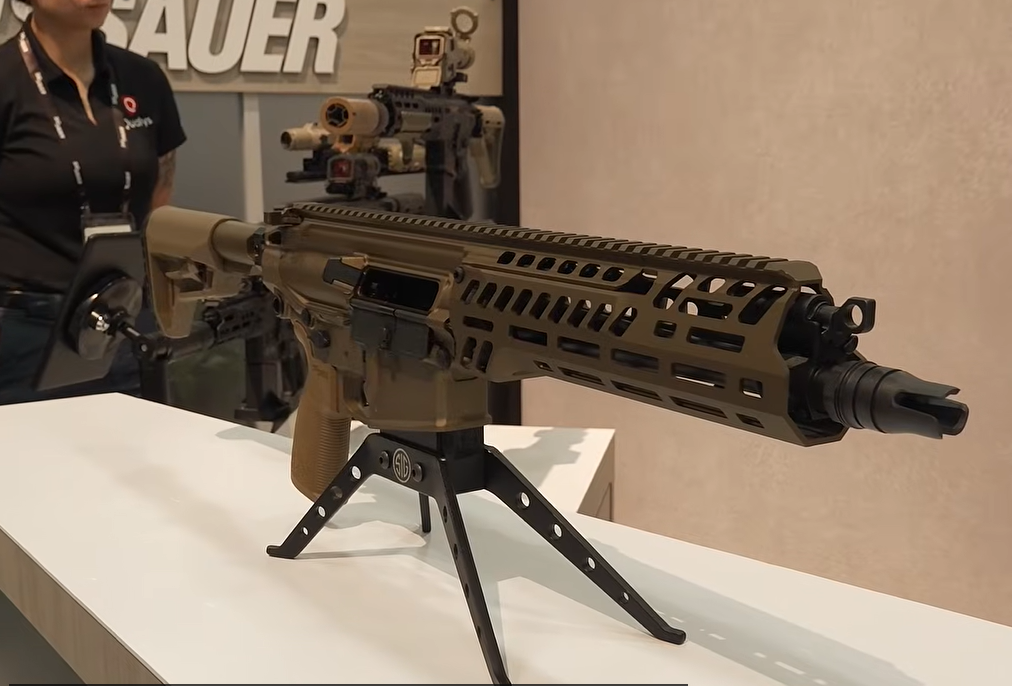
The Army’s new M8 carbine is heading to its first soldiers in December with a basic engineering promise: reduce the burden and bulk of the recently introduced M7. The M8 weighs 8.8 pounds with a suppressor, more than one pound less than the comparable 9.8-pound M7, and the Pentagon describes the complete weapon as approximately 3.5 inches shorter.
Initial fielding is scheduled for units at Fort Bragg, North Carolina, according to SIG Sauer information reported by Stars and Stripes. The weapon was previously designated XM8; dropping the “X” indicates it has moved beyond the experimental designation. The broader Pentagon schedule calls for fielding to the Army’s Close Combat Force beginning in fiscal 2027.
The transition carries an unresolved naming and procurement wrinkle. A Defense Department spokesperson said the M8 is set to replace the M4A1 in the Close Combat Force, while current program descriptions characterize it as the M7’s successor. Those statements can coexist if the M4A1 remains the legacy system being displaced and the M7 is the immediate configuration being superseded, but the Army has not publicly detailed the final disposition of every M7 already delivered.
A compact redesign within the same weapons program
The M8 retains the larger 6.8x51mm ammunition adopted for the Army’s Next Generation Squad Weapons program. It is therefore a redesign within that transition, not a return to the M4A1’s lighter 5.56mm architecture. SIG Sauer received a 10-year production contract in 2022 covering the rifle family and the M250 light machine gun, which is intended to replace the M249 in front-line infantry units.
The M8’s listed barrel is 11 inches, compared with 13.5 inches for the M7. A fixed buttstock replaces the M7 configuration’s folding stock, while the revised design also includes a more rigid handguard, heat shield and softer butt pad. The shorter barrel shifts the weapon’s balance rearward when a suppressor is installed, reducing the amount of mass carried at the front.
Removing that weight involved lightening cuts around the receiver and carefully reducing barrel mass. SIG’s product manager has said barrel reductions had to be evaluated against performance, heat and service-life constraints. That is the central mechanical trade: a smaller package can improve handling and reduce carried mass, but the Army still has to validate durability and performance across its required operating envelope.
Magazine capacity may also rise from the M7’s 20 rounds to 25. The larger magazine has been under soldier evaluation and still required full Army approval, so its availability with the first fielded M8s has not been confirmed. It would narrow, but not close, the capacity difference with the M4A1’s commonly used 30-round magazine.
Why one pound matters
A pound sounds modest until it is placed inside the complete soldier load. Body armor, ammunition, water, batteries, communications equipment and other mission gear all compete for the same limited carrying capacity. Army professional guidance says a fighting load should remain within 30% of a soldier’s body weight, while an approach load should ideally remain within 45%, although operational loads frequently exceed those levels.
A 2026 soldier load-carriage study compared three backpack systems during five-kilometer marches and found no significant performance or physiological differences among the packs. Its more useful conclusion for the M8 is that total load weight was the dominant factor affecting strain, regardless of pack design. Removing mass from the weapon addresses that burden directly, and the benefit is concentrated in equipment soldiers must continually handle rather than weight supported entirely by a pack.
The acquisition record also points toward a real transition rather than a limited experimental offshoot. Budget documents cited by Defense News show no additional M7 rifles requested for fiscal 2027 after approximately 50,000 had been delivered. The Army has not announced whether those rifles will remain with current units, move to training or reserve formations, or be converted to the compact configuration.
That inventory decision will define the scale and cost of the change. For now, December fielding establishes the immediate direction: the Army is retaining the 6.8mm weapon program’s core capability while cutting more than a pound and approximately 3.5 inches from the rifle its close-combat soldiers would otherwise carry.
| More aerospace and engineering stories, right in your MSN feed. Follow AMI on MSN |
By David Whitaker — Associate editor for AMI’s aerospace and drone systems desk, translating flight systems, aircraft programs, spaceflight, and UAV developments into accessible technical stories.