Ford Turns $800 1985 F-250 Into 575-Horsepower Raptor-Inspired Restomod
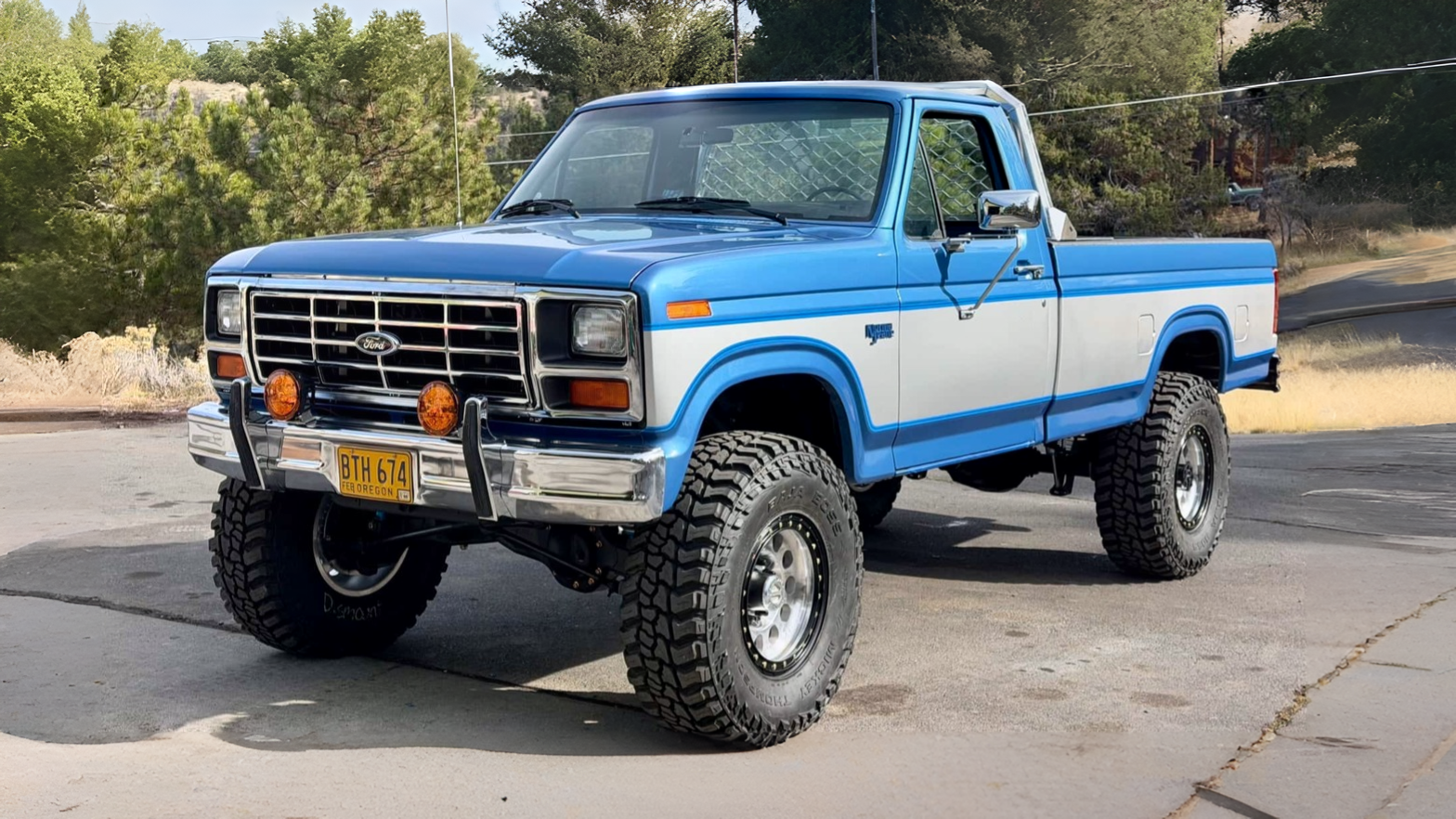
Ford and Oregon mechanic Matt Johnson have transformed an $800 1985 F-250 with a failed engine into a 575-horsepower, Raptor-inspired show truck. The one-off build, detailed in Ford’s account of the project, is scheduled to appear in the company’s display at the SEMA show in Las Vegas from November 3–6.
The concept is straightforward: imagine what Ford’s high-performance off-road truck might have looked like if the Raptor idea had existed in the 1980s. The resulting F-250 combines a Ford Racing Boss V-8 and six-speed automatic transmission with the squared-off body, hubcaps and other recognizable details of a 1985 pickup.
The project did not begin as a plan for an unofficial period Raptor. Johnson, a mechanic and former mechanical engineer based in Klamath Falls, Oregon, initially approached Ford Racing Parts about installing a 2.3-liter EcoBoost engine in an older Toyota Land Cruiser. Ford representatives suggested a small-block Heritage engine instead, but Johnson thought that engine belonged in a Ford.
He proposed the F-250 sitting behind his shop. Johnson had bought the former ranch truck for $800 to use as a shop vehicle, but it soon overheated, damaged its radiator and was left with an unusable engine. The neglected pickup, nicknamed Norma Jeane, consequently offered both a Ford platform and a practical reason for a complete powertrain replacement.
A much larger engine changes the project
Johnson removed the original engine and installed Ford Racing’s 460-cubic-inch Boss small-block V-8, rated at 575 horsepower and 575 pound-feet of torque. It is paired with what Ford identifies as an R680 six-speed automatic transmission. That combination is a dramatic departure from the truck’s original configuration and supplies the performance side of the Raptor-inspired premise.
The chassis was not discarded in pursuit of a modernized foundation. The truck retains its original frame, while a custom suspension package reworks its Twin Traction-Beam front layout. That approach preserves a defining piece of the older F-Series architecture while adapting the truck for the stance and suspension travel expected of a high-performance off-road concept.
This is the central engineering choice behind the build. A complete chassis replacement could have provided a newer starting point, but it also would have weakened the connection to the 1985 truck. Retaining the frame and basic suspension architecture allowed the project to remain visibly and mechanically rooted in its period, although substantial component development and refurbishment were still required.
The work extended beyond the engine and suspension. Johnson replaced deteriorated window weatherstripping and oversaw extensive restoration, paint and body work. Some tasks had to be sent outside his small home workshop because specialist resources were limited in Klamath Falls. Friends and outside collaborators helped complete portions of the build.
Ford’s involvement expanded the schedule
Johnson originally expected to finish the truck in 40 days for the Carlisle Ford Nationals. Roughly 11 or 12 days into the work, Ford proposed developing it into a more extensive SEMA build. The expanded target brought more work and a longer schedule, turning a relatively quick engine-swap project into a Ford-backed display vehicle.
The finished truck deliberately avoids erasing its origins. Its 1980s-style hubcaps remain, and the cabin uses a vintage-style stereo rather than presenting as a fully modern interior. Those choices provide the visual counterweight to the 575-horsepower engine: the mechanical capability has moved forward by decades, but the truck still reads immediately as a mid-1980s F-250.
Ford’s first Raptor appeared in off-road competition at the 2008 Baja 1000, making the 1985 pickup an exercise in alternative history rather than a recreation of a production model. It is also a specialty modified concept that Ford says will not be offered for sale. The company notes that its third-party components and modifications may affect compliance with applicable federal, state and local requirements.
That boundary helps define the project’s purpose. This is not a new factory package or a blueprint for converting every old F-250. It is a one-off demonstration of how far a classic truck can be modernized without surrendering the styling and underlying character that made it worth restoring in the first place.
| More aerospace and engineering stories, right in your MSN feed. Follow AMI on MSN |
By Robert McKinney — Editor-in-Chief for AMI’s automotive and mobility coverage, with a mechanical engineering background and a decade reporting on powertrain systems, EV innovation, and global vehicle manufacturing.