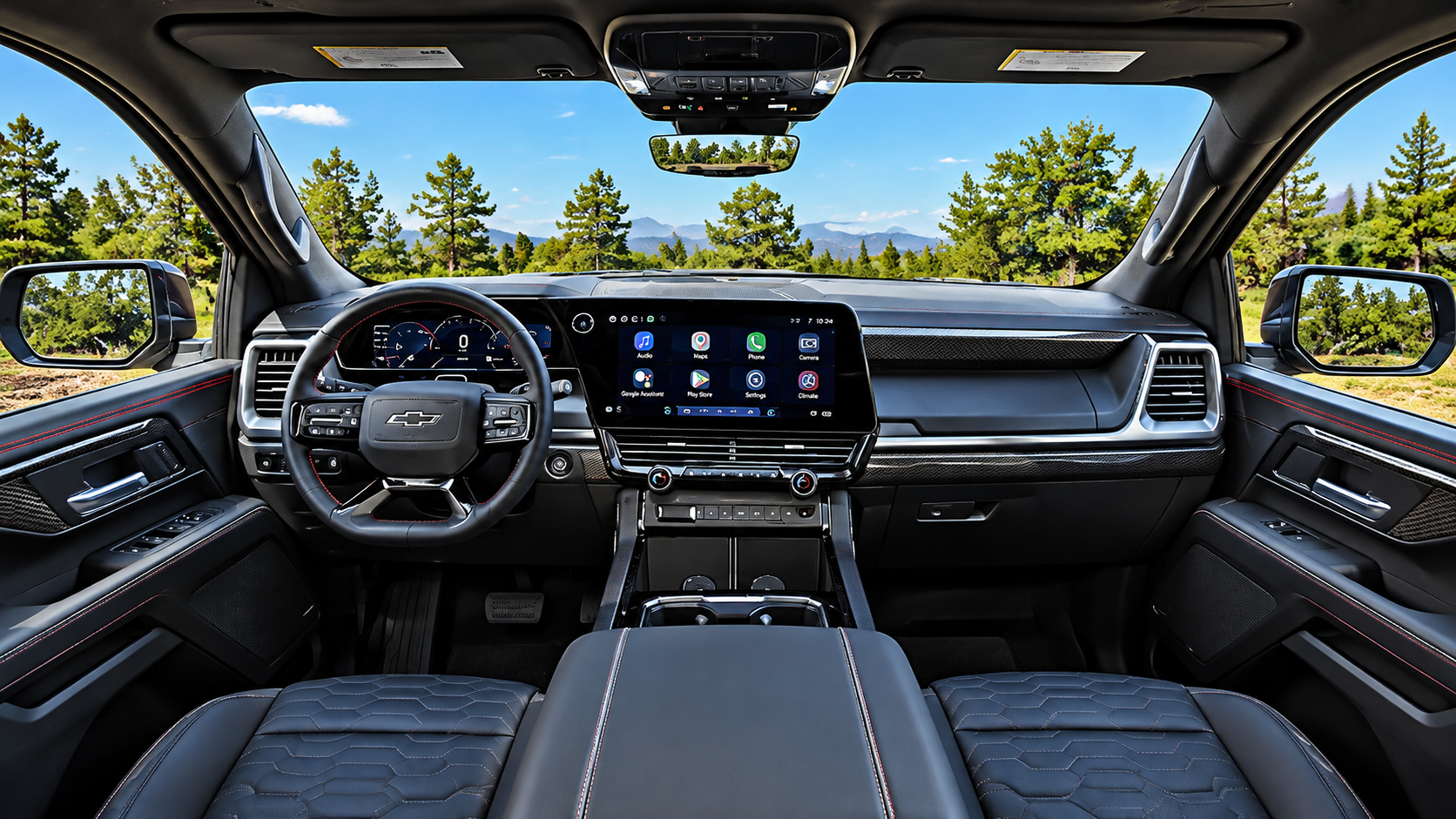
2027 Chevrolet Silverado Pairs 60-Plus Screen Inches With Physical Controls
More than 60 inches of available display space sounds like a recipe for a busier dashboard. General Motors is making the opposite argument with the redesigned 2027 Chevrolet Silverado: Its screen-heavy interface is intended to limit menu hunting, while physical controls remain for frequently used functions such as volume and climate settings.
The 2027 Silverado and its GMC Sierra 1500 sibling are beginning to reach customers with an all-new interface and infotainment platform. GM’s stated objective is to make the system simple, fast and predictable, but its ability to limit distraction has not yet been established through an independent real-world driving evaluation.
An official Chevrolet product update provides the dimensions behind the most prominent screens: a 16.3-inch center infotainment display and 12.2-inch driver information display are standard, while an 11.5-inch front-passenger screen is available. The larger combined figure counts the full available display installation across the redesigned instrument panel, so trucks without the optional passenger display do not have the same screen configuration.
Buttons define the practical boundary
The more consequential design choice is not the number of diagonal inches but which tasks require those screens. The center display manages navigation, media, smartphone connectivity and vehicle controls. It includes integrated Google Maps, and gasoline-powered trucks support Apple CarPlay and Android Auto. Drivers can also customize the central layout.
Volume, climate settings and other common functions retain hard buttons or physical switches. Those fixed controls offer a consistent location and tactile interaction rather than requiring the driver to locate a changing on-screen target. GM has not provided a complete function-by-function division between physical and touchscreen controls, but the retained volume and climate interfaces address two adjustments drivers may make repeatedly.
That approach is consistent with a 2026 review of 73 touchscreen studies. It found that touchscreens generally performed worse than physical controls or voice input for driving performance, visual attention and secondary-task performance, although outcomes varied by task. In one on-road climate-control comparison cited by the review, 41% of glances toward touchscreen controls lasted longer than two seconds, versus 27% for physical controls.
The review also cautions against treating screen size as a distraction measurement by itself. Information density, menu depth and the work required to complete a task can matter more than display area. Research on current large in-vehicle screens remains limited: Only 12 studies in the review examined displays of at least 12 inches, and most of the overall evidence came from simulators.
GM distributes information by driving task
The Silverado’s instrument cluster offers five views, including configurations for trailering, off-road use and Super Cruise. The Super Cruise view can depict nearby vehicles and show the system’s logic for an automatic lane change. Activation now uses a single steering-wheel button, while a head-up display places selected critical information closer to the driver’s forward line of sight.
GM has also reduced the visual prominence of at least one interruption. An incoming call appears as a small icon instead of taking over the screen as it does in current trucks. Sebastian Bauer, GM’s head of human-interface design, said the team assessed menus, icons and interactions by asking, “Does this actually help the driver in that moment?” He also said GM sought to remove screen content that did not need to be there rather than add displays for their own sake.
Federal guidance provides a useful benchmark for that objective. The U.S. Department of Transportation’s voluntary distraction guidance recommends that a visual-manual task require glances away from the road of no more than two seconds at a time and 12 seconds in total. The guidance evaluates task demand and eye-glance behavior, not the dashboard’s total display measurement.
International testing is also placing greater value on dedicated controls. Under Euro NCAP’s 2026 protocols, indicators, wipers, washers, hazard lights, the horn and emergency-call control should use direct physical inputs rather than touchscreen menus. That list does not evaluate every infotainment function, but it reflects a broader human-factors principle: Basic controls should remain immediately identifiable and operable.
The Sierra shares the overall interface strategy but adds a mechanical distinction: Its center screen can pivot to expose concealed storage, a feature the Silverado does not receive. For both trucks, however, the decisive test will be more ordinary how many glances and inputs drivers need to adjust climate settings, answer a call, change media or find vehicle information. More than 60 inches of displays creates the visual headline; task time and menu depth will determine whether GM’s design actually feels simpler on the road.
| More aerospace and engineering stories, right in your MSN feed. Follow AMI on MSN |
By Thomas Caldwell — AMI’s senior editor for mechanical and mobility engineering, covering vehicle electronics, systems integration, electrification, chassis systems, propulsion, and safety policy.