Lake Powell Decline Would Cut Access, Power and River Flow Before Drinking Water
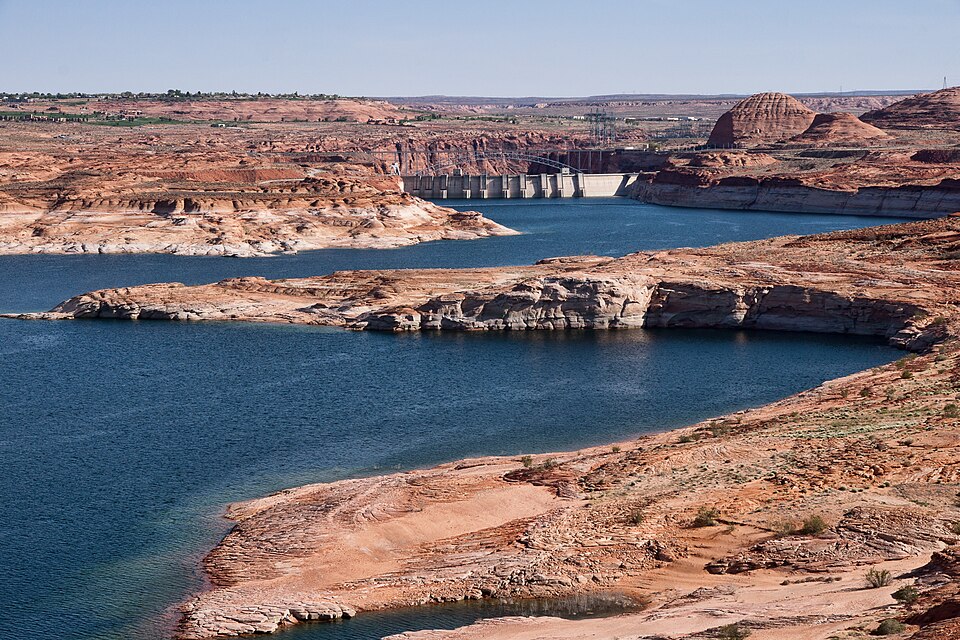
Lake Powell does not have one operating level at which every service around Glen Canyon Dam stops. Its launch ramps, hydroelectric turbines, river outlets and municipal-water connection occupy different elevations and have different hydraulic limits. If the reservoir fell to dead pool, Page, Arizona, would therefore lose nearby boat access, dam-generated electricity and downstream river releases in stages, while its newer drinking-water connection was designed to continue operating.

On October 29, 2026, the reservoir stood about 160 feet above dead pool, the level at which water can no longer pass through the dam. Reaching that point is not a forecast certainty. The Bureau of Reclamation’s October projections ranged widely with future hydrology, including a most-probable elevation of about 3,516 feet in February 2027 and a dry-case level near 3,497 feet by September 2027. Reclamation publishes updated conditions and projections on its Glen Canyon Dam operating page.
Boat access reaches its limit first
The first major cutoff near Page would be physical access to the lake. Every local launch ramp is listed or designed for water no lower than roughly 3,515 feet. The Stateline Auxiliary Ramp at Wahweap reaches that elevation, while a new Antelope Point ramp costing about $81 million is designed to reach water at 3,520 feet.
At dead pool, the water would be approximately 145 feet below the end of the Stateline ramp and 150 feet below the new Antelope Point facility. Extending pavement alone would not necessarily preserve access because falling water also changes shoreline geometry, approach grades and the location of usable channels. The National Park Service already adjusts ramp and facility status as levels change on its Lake Powell access page.
That cutoff would carry an economic consequence beyond recreational boating. Page has about 7,500 residents and serves an estimated 3 million tourists annually. Visitors to Glen Canyon National Recreation Area and Rainbow Bridge spent $518.2 million in nearby communities during 2024, although recreation-area visitation fell to 3.7 million in 2025 about 1.5 million fewer visits than in 2023. Dry-land Antelope Canyon tours could continue, but much of the lake-dependent activity would not.
Hydropower stops 25 feet lower
The next major threshold is 3,490 feet, where Glen Canyon Dam’s hydroelectric plant stops operating. Eight penstocks route water to turbines with a combined generating capacity of 1,320 megawatts. Page received about 40% of its electricity from the dam in 2022, so loss of generation would require replacement electricity from elsewhere rather than shutting off the city’s grid outright.
The plant’s cutoff does not immediately stop water from moving downstream. Below the power threshold, the dam has four 96-inch river outlet pipes, commonly called bypass tubes. Their intakes are centered at an elevation of 3,374 feet, but intake elevation is only part of the constraint. Available pressure falls with the reservoir, changing the pipes’ safe operating range before the water reaches their centerline.
River releases end before dead pool
Under Reclamation’s cited 2024 interim guidance, each bypass pipe is limited to about 1,200 cubic feet per second when the reservoir is at 3,400 feet. The allowed release falls to zero at 3,390 feet approximately 20 feet above dead pool because high-speed flow under those conditions can produce damaging cavitation inside the outlet system.
At that threshold, Lake Powell releases through Horseshoe Bend and the 15.5-mile Glen Canyon reach below the dam would stop. That reach supports a trout fishery and float trips, while Lees Ferry serves as the starting point for Grand Canyon river trips. In 2023, those trips carried 23,777 passengers on 1,050 launches.
Page’s drinking-water supply is the important exception. A connection completed in 2022 draws from two bypass tubes and can receive water down to approximately 3,362 feet. It was designed to supply Page and the neighboring LeChee Chapter at the roughly 3,370-foot dead-pool elevation. Municipal supply can therefore remain available after normal downstream releases and hydropower have reached their operating limits.
Reclamation has considered lower-elevation projects, including a new tunnel through the dam and modifications that could let the outlet works generate electricity. Those remain proposals, with cited costs ranging from $500 million to $3 billion. Without such changes, the existing elevation sequence is clear: launch access ends near 3,515 feet, power generation at 3,490 feet, safe bypass releases at 3,390 feet and ordinary passage through the dam near 3,370 feet while Page’s municipal connection reaches about eight feet lower.
| More aerospace and engineering stories, right in your MSN feed. Follow AMI on MSN |
By Thomas Caldwell — AMI’s senior editor for mechanical and mobility engineering, covering vehicle electronics, systems integration, electrification, chassis systems, propulsion, and safety policy.