Draining Lake Granby Would Take 18 Months, Raise Lake Powell 4–8 Feet
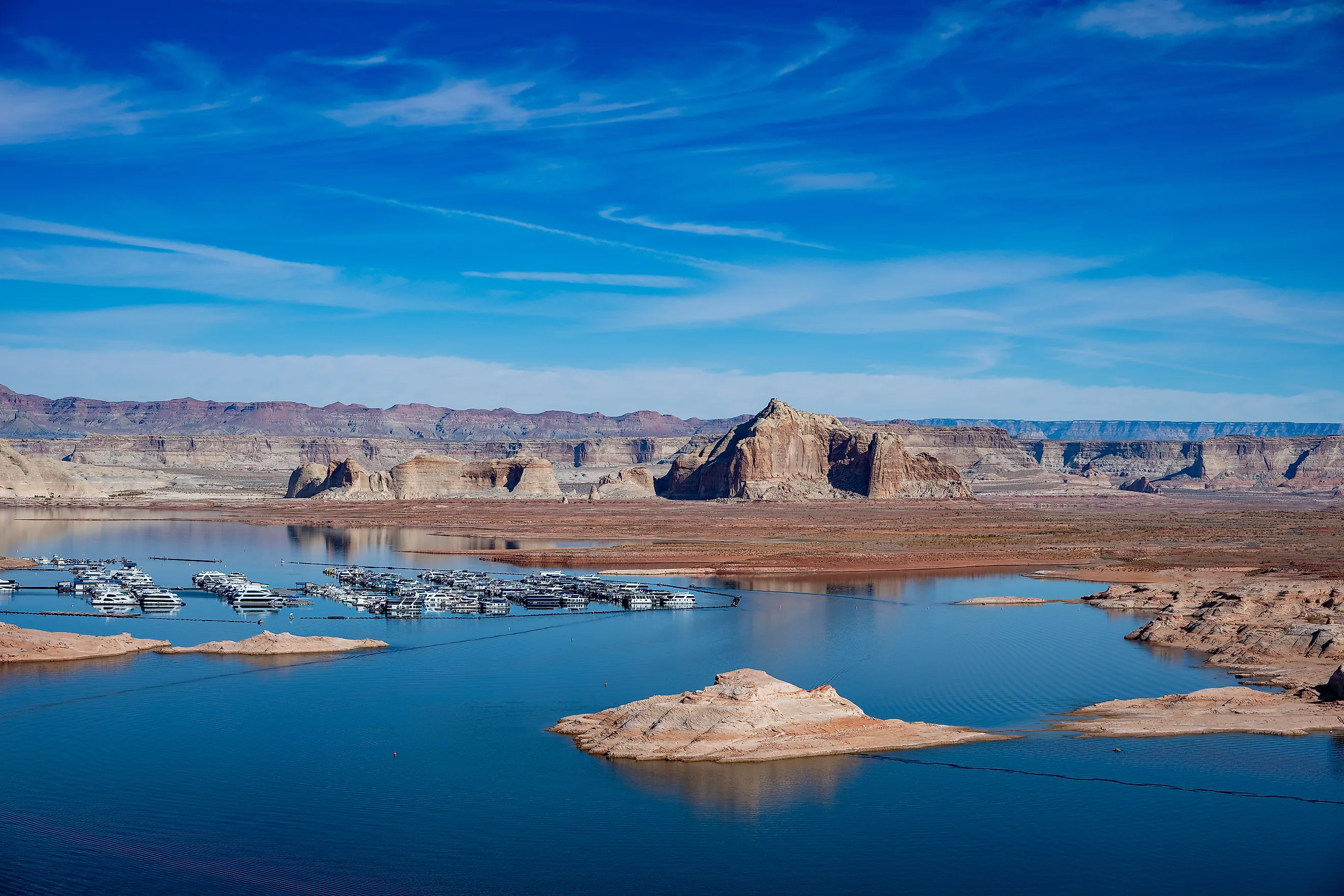
Emptying Colorado’s largest reservoir would impose an immediate and extensive loss upstream for a comparatively small gain downstream. A quantified transfer scenario indicates that draining Lake Granby would take at least 18 months and raise Lake Powell by about 4 feet with Granby’s August 2026 releasable storage or roughly 8 feet from a full reservoir under ideal delivery assumptions.

This is a hypothetical engineering scenario, not an announced federal plan. Its value lies in showing why reservoir capacity alone does not determine how much useful water can be transferred. Outlet limits, inaccessible storage, falling discharge rates, downstream diversions and evaporation all separate the water shown on a reservoir chart from water that could reach Lake Powell.
The outlet sets the pace
Lake Granby can hold 539,758 acre-feet, but 74,190 acre-feet is classified as normal minimum storage below its lowest outlet. That water cannot be released through the regular outlet works. From a full reservoir, approximately 465,000 acre-feet would be available above that elevation.
Granby Dam’s outlet works are rated for 435 cubic feet per second when the lake is full. Even if that maximum rate could be maintained, moving the releasable volume would require a long, sustained discharge. In practice, outlet capacity declines as the reservoir level and the hydraulic pressure behind the outlet fall. The resulting release period would be at least a year and a half.
That flow would also be far outside Granby’s ordinary minimum-release pattern. Required releases below the dam range from 20 cubic feet per second from September through April to 75 cubic feet per second from May through July. The outlet’s full rating is more than 20 times the winter minimum, illustrating the scale of the operational change that a rapid drawdown would require.
Four feet reflects the water actually available
Granby was not full at the end of August 2026. Its storage stood at 296,400 acre-feet, leaving about 222,000 acre-feet above the lowest outlet. Based on the observed effect of federal water-management moves at Lake Powell in 2022, that volume would add approximately 4 feet to Powell if it all arrived. A full Granby’s releasable storage could add roughly 8 feet under the same loss-free assumption.
Those figures are estimates, not guaranteed delivery. Any transfer would have to move through a river system with other water rights and diversions. Colorado law would require administrative protection, often described as shepherding, to reduce the risk that released water would be diverted before reaching Utah.
Evaporation creates another system-scale constraint. The Bureau of Reclamation’s research office estimates that Lake Powell loses about 500,000 acre-feet annually to evaporation, although other cited estimates range from 336,000 to 386,000 acre-feet. The higher estimate is greater than all the water available above Granby’s outlet when the reservoir is full.
Weather provides a useful comparison. Heavy rain in southeast Utah sent approximately 600,000 acre-feet into Lake Powell in October 2026, raising it 9.5 feet from its September 15 record low of 3,516.62 feet. Powell reached 3,526.1 feet on October 24, about 36 feet above Glen Canyon Dam’s minimum power pool and 156 feet above dead pool. Reclamation’s reservoir operations information shows why relatively small elevation changes still matter for power generation and infrastructure, but Granby alone cannot provide a large cushion.
The upstream cost would be immediate
A full drawdown would strand 74,190 acre-feet below Granby’s outlet and move the shoreline far from established marinas and ramps. Low water already affects access: the Forest Service reported that falling levels forced the Stillwater Boat Ramp to close for the season in August 2026, while the main concrete ramp at Sunset Point became unusable and a single-vehicle auxiliary ramp was needed.
The biological impact would extend beyond recreation. Granby has Colorado’s highest density of lake trout, according to Colorado Parks and Wildlife. Draining the accessible storage would confine the lake’s trout and kokanee salmon to roughly one-seventh of the reservoir’s full volume.
Granby is also the largest storage component of the Colorado-Big Thompson Project, which delivers an average of about 200,000 acre-feet annually to 32 municipalities and 615,000 acres of irrigated farmland. Horsetooth Reservoir and Carter Lake together can hold about 268,900 acre-feet, equivalent to roughly 16 months of average project deliveries, but that downstream capacity would not erase the loss of Granby’s storage role.
A slower alternative would be to reduce Front Range diversions and leave more water in the Colorado River rather than emptying Granby. Federal operating plans beginning in 2027 assume up to 200,000 acre-feet per year of voluntary Upper Basin conservation, with no mandatory Upper Basin cuts. That approach still requires agreements governing how conserved water is protected and managed, but it avoids trading Colorado’s largest mountain reservoir for an estimated 4- to 8-foot rise at Lake Powell.
| More aerospace and engineering stories, right in your MSN feed. Follow AMI on MSN |
By Thomas Caldwell — AMI’s senior editor for mechanical and mobility engineering, covering vehicle electronics, systems integration, electrification, chassis systems, propulsion, and safety policy.