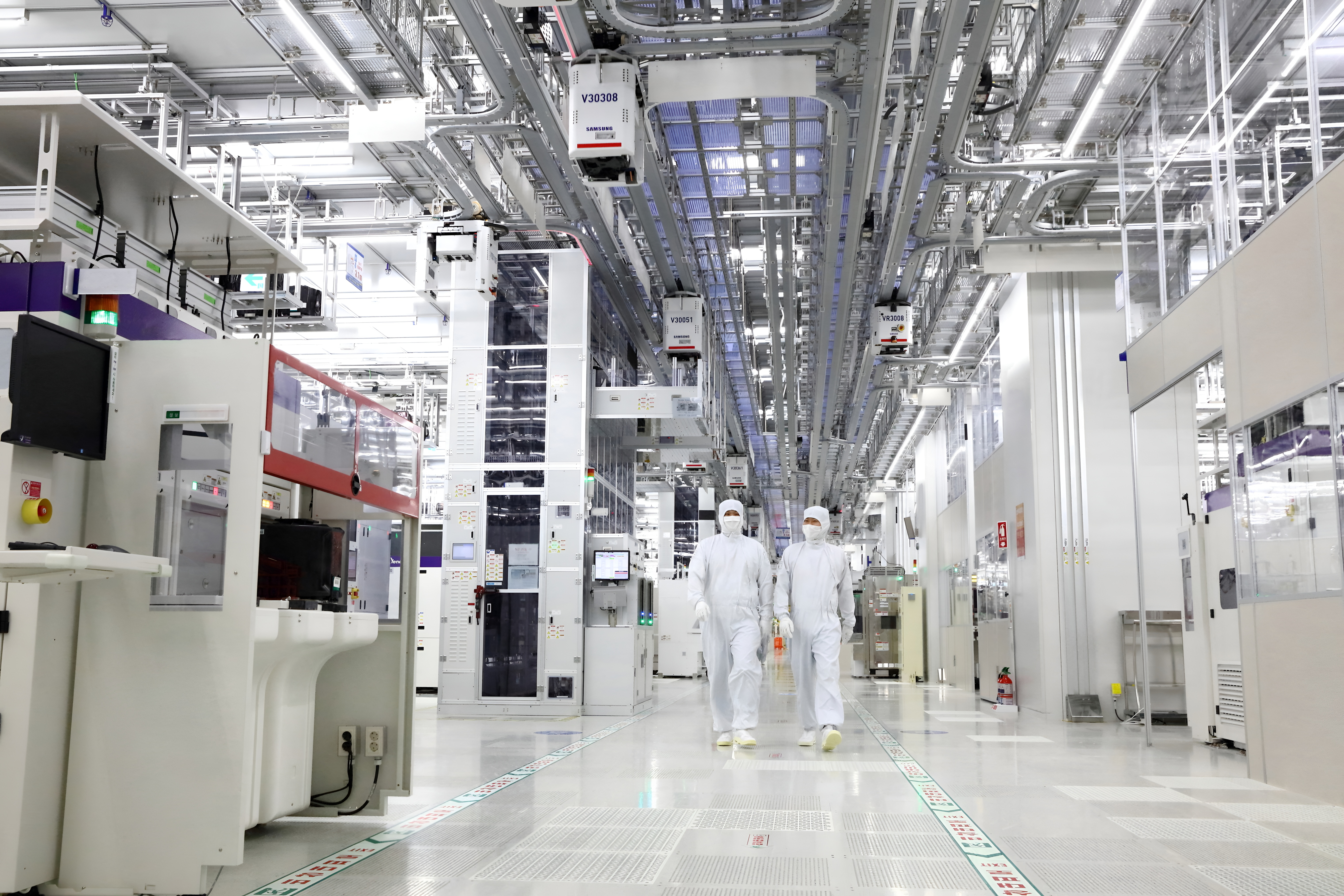
Samsung’s Delayed Texas Chip Plant Nears Trials, Production Remains a 2027 Target
Samsung’s semiconductor plant in Taylor, Texas, may be approaching its first trial operations, but the reported December milestone is not the start of commercial chip production. The factory is running about two years behind its original schedule, and volume manufacturing with Samsung’s 2-nanometer process remains targeted for 2027.
A Korea Herald report cited by SammyGuru places the possible trial start in mid-to-late December 2026. Samsung has reportedly installed manufacturing equipment, established production lines and conducted performance checks at the site. Trials would move the facility beyond construction and installation into coordinated testing of its tools and manufacturing processes.
That is tangible progress for a project Samsung began building in 2022 with an estimated investment of $17 billion. The company originally aimed to begin operations in the second half of 2024. The revised sequence now points to trials near the end of 2026 and possible mass production in 2027.
What the trial stage must establish
A semiconductor factory is not production-ready merely because its major tools have been installed. Lithography, deposition, etching, inspection and other process steps must operate as one tightly controlled manufacturing system. Trial operations allow engineers to check equipment performance, material movement, process repeatability and the interaction among successive stages of wafer fabrication.
The distinction is similar to the difference between powering up a complex assembly line and demonstrating that it can repeatedly deliver conforming products at the required rate. Individual machines may pass performance checks while the complete line still needs tuning. Process conditions, inspection data and equipment behavior must remain stable across many manufacturing cycles before a factory can support dependable customer output.
Samsung has reportedly begun prototype production of Tesla AI5 chips at Taylor. The plant is also expected to manufacture Tesla AI6 chips under a reported $16.5 billion contract. Prototype work can help validate designs and processes, but it does not by itself establish the throughput, consistency or economics required for high-volume production.
Yield is the critical bridge to volume
The most consequential unresolved measurement is yield the proportion of manufactured dies that satisfy required specifications. Samsung’s first-generation 2-nanometer process, known as SF2, reportedly has a yield of about 60%, although that figure has not been presented as an official Taylor production result.
Yield affects more than technical quality. It influences the number of usable chips obtained from each wafer, the effective cost of production and the factory’s ability to meet customer schedules. A process can produce functioning prototypes while still requiring substantial refinement before it becomes commercially sustainable at scale.
The reported production objective illustrates the size of that transition. An earlier account placed Taylor’s target at 20,000 2-nanometer wafers per month in the second half of 2027. Reaching that level would require more than a successful December trial: Samsung would need to qualify the process, improve and stabilize yield, complete customer validation and then raise wafer starts without losing process control.
People are part of the production system
The ramp also depends on trained operators, maintenance technicians and engineers. Samsung says it invested nearly $18 million from 2023 through 2026 in Central Texas semiconductor workforce programs, including training partnerships for technicians and engineers. Those capabilities become increasingly important as a plant shifts from equipment commissioning to round-the-clock production, when maintenance response and process discipline directly affect availability and yield.
Texas semiconductor employers are competing for the same specialized labor pool. Austin Community College representatives have said the state’s more than 200 semiconductor plants need additional workers, while national estimates project a substantial gap between semiconductor labor demand and supply by 2030. For Taylor, staffing is therefore an operating requirement rather than a secondary community-development issue.
The proposed December trials would mark the plant’s clearest movement yet from a delayed construction project toward an operating factory. The more demanding proof will come afterward: stable 2-nanometer yield and a controlled ramp toward 20,000 wafers per month in the second half of 2027.
| More aerospace and engineering stories, right in your MSN feed. Follow AMI on MSN |
By Thomas Caldwell — AMI’s senior editor for mechanical and mobility engineering, covering vehicle electronics, systems integration, electrification, chassis systems, propulsion, and safety policy.