Uber Eats Robots Kicked and Blocked, Exposing Sidewalk Access Risks
Uber Eats delivery robots have been kicked, knocked over and deliberately blocked while moving through U.S. cities. The incidents present an awkward constraint for autonomous delivery: a machine may navigate an ordinary route correctly yet still fail its mission when people interfere with it or when the fleet itself obstructs the public space it depends on.
In Philadelphia, an Uber Eats robot was reportedly kicked twice in late March 2026. The second kick overturned it near a parking garage, although the people involved eventually put it back on its wheels. On October 14, police arrested retired University of Pennsylvania professor Carolyn Marvin after she repeatedly blocked another Uber Eats robot and refused instructions to move. Marvin said she was protesting the replacement of human delivery workers by machines.
That stated motive helps explain one confrontation, but it cannot be assigned to every person who has kicked or overturned a robot. The broader engineering issue is that public deployment introduces intentional interference, uncertainty and social conflict that cameras, obstacle detection and route planning cannot eliminate.
Navigation is only one part of sidewalk autonomy
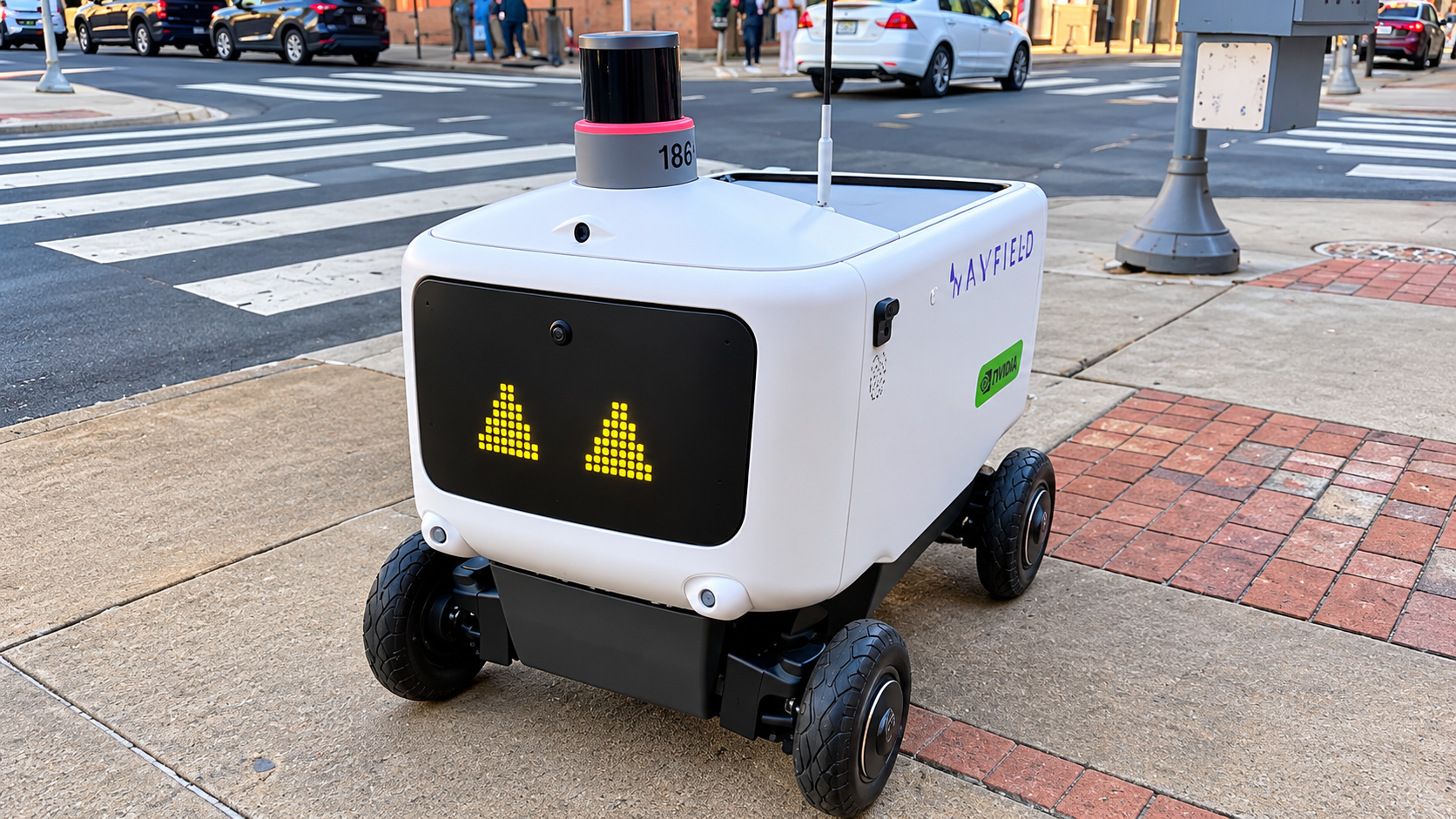
Delivery robots generally use cameras and other sensors to identify obstacles and travel along sidewalks. Customers track the order through an app and unlock the cargo compartment when it arrives. That operating loop works when pedestrians and infrastructure behave within anticipated limits. A person deliberately standing in the way turns a navigation problem into a policy and human-interaction problem.
The robot must avoid contact without creating a prolonged blockage, entering the road or trapping other pedestrians. If it is overturned, the operator also needs a recovery process. Remote monitoring may help diagnose the situation, but intervention still consumes staff time and can interrupt a delivery. A machine that cannot right itself remains dependent on a passerby or a dispatched worker.
Available company data indicate that deliberate mistreatment is uncommon rather than routine. Serve Robotics CEO Ali Kashani said in April that it occurred on fewer than 1% of approximately 100,000 Serve trips. Serve, which works with Uber Eats and DoorDash, reported having deployed 2,000 robots by the end of 2025. Even a low incident rate becomes operationally significant as trip volumes and fleet sizes rise, particularly if each event demands remote supervision or physical recovery.
A fleet can become its own obstacle
Human interference is only half of the deployment problem. In September, at least a dozen Coco delivery robots clustered on a sidewalk near Chicago’s Lincoln Park. Coco attributed the incident to a deployment error that caused several machines to reroute simultaneously. The company said it cleared the problem within minutes and added safeguards intended to prevent a recurrence.
That episode shows why fleet coordination matters as much as individual navigation. Each robot may choose a locally reasonable path while the group creates congestion at a shared bottleneck. Dispatch software therefore needs to account for sidewalk capacity, spacing and route diversity not merely the shortest available journey for each machine.
A separate incident in May involved a delivery robot that reportedly entered a crosswalk against a signal and was struck by a truck. The damaged machine reportedly continued moving afterward. Together, the crosswalk and clustering events underline the need for reliable traffic-state recognition, safe post-collision behavior and rapid operator control.
Pedestrian priority must be built into operations
Sidewalk congestion has a greater consequence for someone using a wheelchair, cane or other mobility aid. Pennsylvania classifies these machines as pedestrians, but state operating rules require personal delivery devices to yield to pedestrians and cyclists in pedestrian areas. Compliance depends on where a robot stops as well as whether it avoids a collision. A stationary machine can still block a curb cut or force someone toward an unsafe surface.
A 2023 accessibility study involving 10 people with motor disabilities identified concerns about scarce sidewalk space, curb-cut competition and unpredictable robot movements. Nine participants reacted negatively when shown multiple robots sharing a sidewalk. Participants also wanted practical ways to ask a robot to move or contact its operator when it malfunctioned.
Those requirements affect sensing, control and physical design. A smaller robot occupies less room but may be harder to see. Stopping to yield is useful only if the chosen stopping point clears the pedestrian’s path. Voice, buttons and app-based controls can support interaction, but each creates accessibility and reliability tradeoffs.
Cities are beginning to formalize the operating boundary. Glendale, California, approved a one-year pilot in September allowing up to two operators and requiring agreements with the city. Los Angeles called for a review of its rules in November 2025. Coco has also partnered with accessibility app BlindSquare to share information about sidewalk obstacles.
Scaling sidewalk delivery will therefore require more than adding robots and improving route accuracy. Operators must coordinate fleets, preserve pedestrian right-of-way, recover disabled machines and provide understandable ways for noncustomers to respond when a robot blocks the only usable path. The sidewalk is not a controlled test course; it is shared infrastructure, and the people who never ordered a robotic delivery still determine whether the system can operate there.
| More aerospace and engineering stories, right in your MSN feed. Follow AMI on MSN |
By Jonathan Barrett — Editor for AMI’s future mobility and autonomous systems section, with two decades covering robotics, e-mobility, drone-vehicle convergence, and transport mechanical systems.