Boeing 737 Lowered Into Derbyshire Garden for £4,000 Underground Room
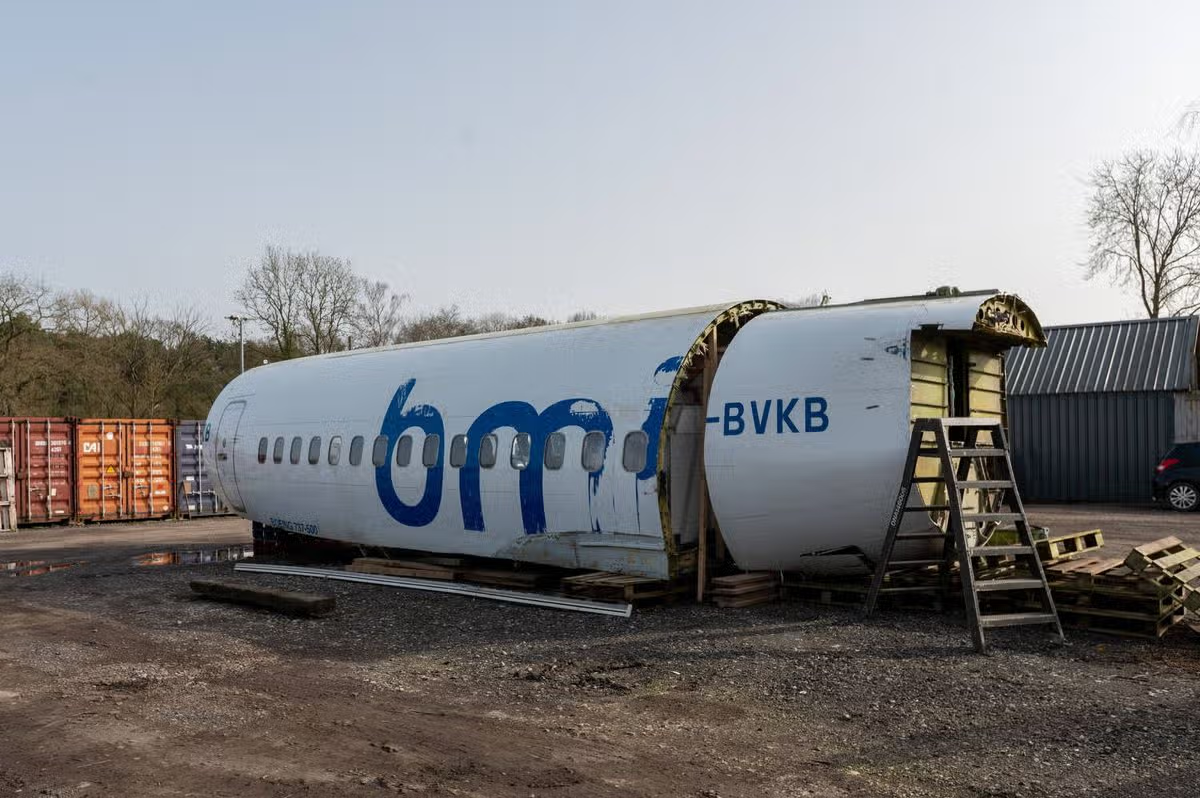
A retired Boeing 737 passenger cabin has been lowered by crane into a garden in Hilton, Derbyshire, where engineer Dave Billings plans to convert it into a bunker-style recreational room. The 45-year-old bought the former bmibaby fuselage section for just £4,000 through Facebook Marketplace before undertaking the unusual domestic installation.
On 20 October, a large crane positioned the aircraft section inside a prepared hole at Billings’ home. Five volunteers assisted alongside several crane operators, with the lift requiring substantial excavation, special foundations and careful positioning. The operation marked a major physical step in the project, but the cabin is not yet a completed underground room.
Billings recorded the lift from several viewpoints for his YouTube channel, Tornado Dave. His camera arrangement included an action camera attached to the crane jib while it was on the ground, providing another angle on the positioning operation.
The plan is to adapt the old passenger cabin into what Billings has described as a doomsday bunker and “man cave.” It will connect with an existing underground room beneath the garden, creating a larger recreational area rather than functioning as an isolated aircraft shell.
A scale model planned the connection
Before completing that connection, Billings produced a 3D-printed scale model showing how the fuselage and existing room are intended to meet. That model gives the project a defined spatial layout and helps explain why the aircraft section had to be lowered into a carefully selected position rather than merely placed in the excavation.
The cabin’s shape also imposes practical limits. Billings has considered installing games machines, but the available width will not accommodate a full-sized pool table. The curved fuselage provides a recognizable and enclosed interior, yet its usable floor area does not match that of a conventional rectangular room with similar overall dimensions.
The section came from Boeing 737-500 G-BVKB, an aircraft built in 1993. It first served with British Midland Airways and transferred to bmibaby in 2002. In that operation it carried as many as 131 passengers in an all-economy configuration and flew from East Midlands, Manchester and Cardiff.
After bmibaby closed in 2012, the aircraft was retired, stored at Norwich Airport and moved to Bruntingthorpe in 2013 for dismantling and parts recovery. Billings acquired part of its rear fuselage; the forward section was converted separately into a camper trailer. The garden installation therefore reuses only part of the former airliner, not a complete Boeing 737.
The lift is complete, but the conversion is not
Lowering the cabin into place resolves the immediate handling problem, but further construction remains before it can operate as a usable underground space. The prepared foundations provide the installed section with support, while the planned junction with the existing room still has to turn two separate structures into one accessible interior.
An underground conversion also leaves structural protection and drainage among the practical design issues to be resolved as work continues. The available project details do not specify the final treatment around the fuselage or how water will be managed once the installation is completed. Those elements will determine how successfully the aircraft shell can be incorporated into the surrounding ground over time.
There is also an unfinished approval process. Billings intends to apply to the local authority for retrospective planning permission, meaning the crane installation has taken place before that permission has been secured. He hopes to complete the project by February 2027, leaving the interior conversion, connection work and planning decision as the next milestones for a cabin that once held 131 airline passengers and is now becoming one private underground room.
| More aerospace and engineering stories, right in your MSN feed. Follow AMI on MSN |
By Jonathan Barrett — Editor for AMI’s future mobility and autonomous systems section, with two decades covering robotics, e-mobility, drone-vehicle convergence, and transport mechanical systems.