BYD Demonstrates Abu Dhabi Robot Charging From 10% to 70% in Five Minutes
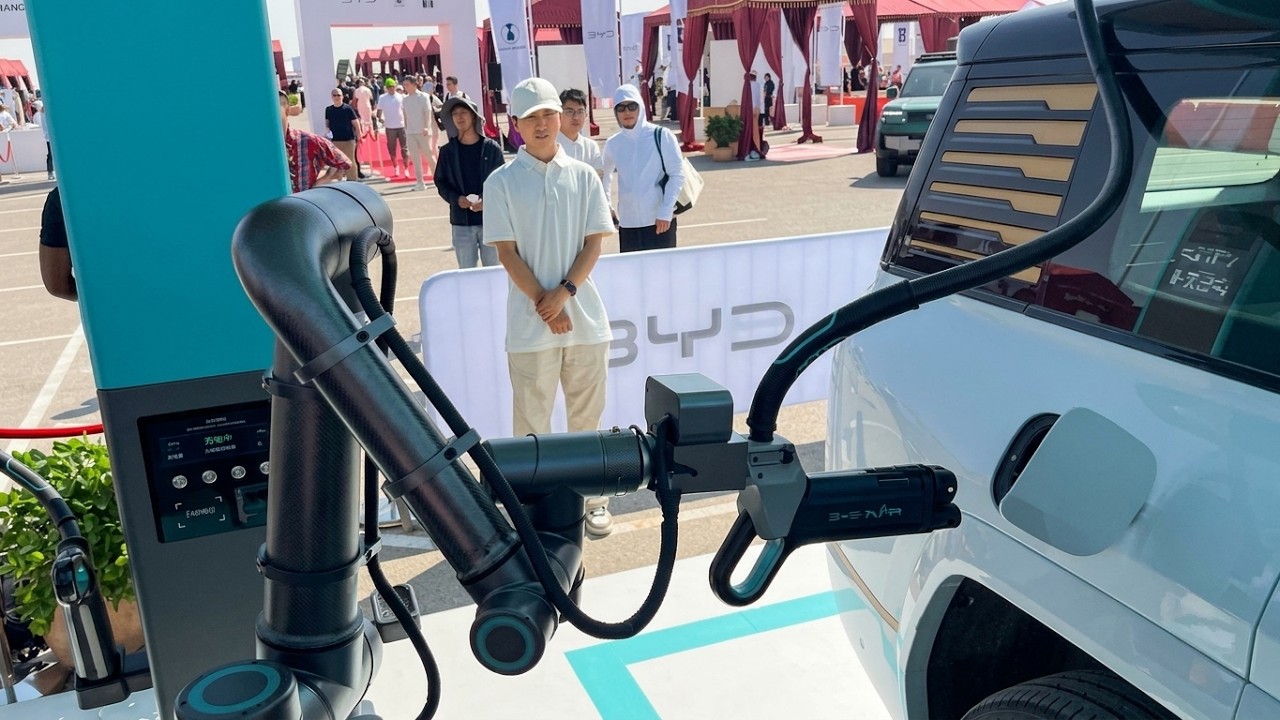
The charging sequence begins before a cable moves. After the driver leaves and locks a compatible BYD vehicle, its automated valet-parking system takes the car to a designated bay. Cameras then guide a robotic arm to the charging inlet, force-feedback sensors help align the connector, and the arm inserts the plug without the driver handling it.
BYD demonstrated that sequence in Abu Dhabi as part of an installation combining solar panels, stationary battery storage, robotic connection and its FLASH ultra-fast charging technology. The company says compatible vehicles equipped with its latest battery and charging hardware can move from 10% to 70% charge in five minutes, or from 10% to 97% in nine minutes. The arm can disconnect the cable when charging is complete.
The demonstration automates two distinct tasks: positioning the vehicle and making the electrical connection. Parking accuracy brings the charging inlet within the robot’s working area. The cameras identify its location, while force feedback lets the arm correct alignment instead of driving the connector into the inlet. Vehicle, parking controller, robot and charger therefore have to operate as one coordinated system.
That coordination becomes more consequential at very high charging power. BYD says FLASH Charging supports up to 1,500 kilowatts through one connector. CarNewsChina reported that the Abu Dhabi demonstration reached 1,000 kilowatts, although BYD did not specify the installation’s maximum output.
A one-megawatt charging event places a large, abrupt demand on the power source. Solar panels may generate energy over many hours, but they cannot necessarily provide the required power at the exact moment a vehicle arrives. The stationary batteries act as a buffer: solar generation can charge them over time, and they can release stored energy rapidly during the short charging session.
BYD says the combined installation can operate independently of the electricity grid. The company has not disclosed the site’s solar-generation capacity, stationary-storage capacity or number of consecutive off-grid fast-charging sessions. Those missing figures determine whether the installation can repeatedly serve vehicles or only deliver isolated high-power sessions before its batteries need time to recover.
The five-minute claim also applies only to vehicles designed to accept the power. A charger’s rating does not override the limits of a car’s battery, charging electronics or thermal-management system. Older BYD vehicles remain constrained by their own hardware even if they connect to compatible higher-powered infrastructure.
Robotics removes a growing physical burden
Automatic connection could have value beyond convenience. High-power charging cables can be thick and heavy, and short cables require the vehicle inlet to stop close to the charger. The U.S. Access Board’s design recommendations for accessible EV charging stations identify automatic connection devices as one way to improve access by eliminating the need to manipulate a connector physically.
That benefit depends on dependable operation across repeated arrivals. A commercial robot would need to locate the inlet, open its flap, align the connector and complete the connection consistently. The parking system must also place each compatible vehicle within the arm’s usable range. The Abu Dhabi demonstration showed the full control chain working, but BYD has not released reliability data, operating costs or maintenance requirements.
BYD’s claimed distinction is also narrower than being first to show an automated charging arm. Huawei demonstrated one in January 2025. BYD describes its installation as the first to integrate robotic charging with solar generation, stationary storage and FLASH Charging.
The company is targeting 6,000 FLASH Charging stations worldwide by the end of 2027, but it has not said that every planned station will receive a robotic arm. Nor has it announced the robot’s commercial availability, price or deployment schedule.
The Abu Dhabi installation consequently establishes a working demonstration rather than a retail-ready charging format. It shows how automated parking, machine vision, force-controlled actuation, energy storage and high-power electronics can remove the driver from the plug-in process. The next meaningful milestone is sustained operation: multiple compatible vehicles, repeated megawatt-scale sessions and disclosed energy capacity showing how long the system can remain independent of the grid.
| More aerospace and engineering stories, right in your MSN feed. Follow AMI on MSN |
By Jonathan Barrett — Editor for AMI’s future mobility and autonomous systems section, with two decades covering robotics, e-mobility, drone-vehicle convergence, and transport mechanical systems.