SS United States Sunk Off Florida as World’s Largest Artificial Reef
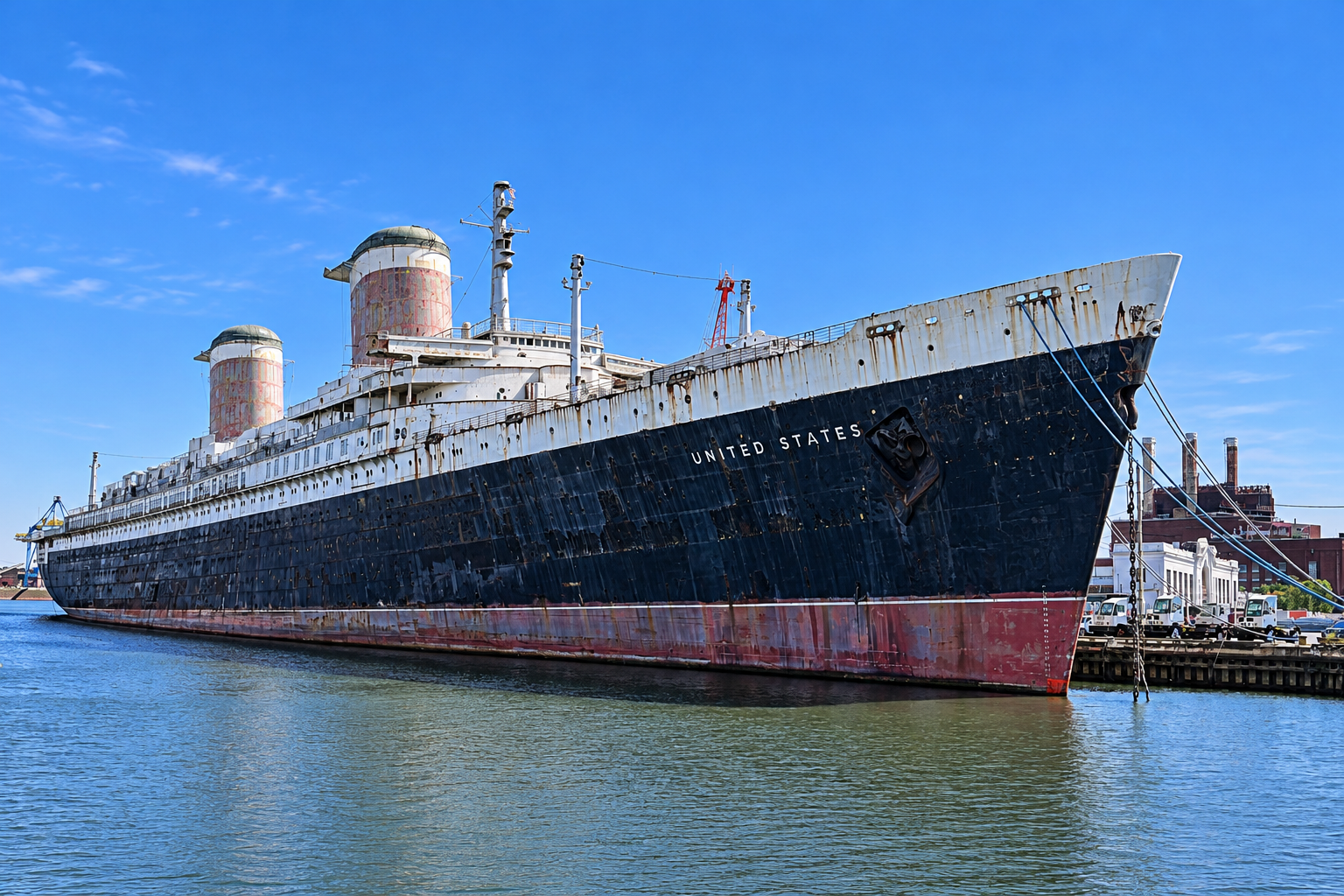
The 990-foot SS United States was deliberately sunk off Florida on Wednesday evening, November 11, completing a $13.5 million conversion into what is intended to be the world’s largest artificial reef. The record-setting ocean liner went beneath the Gulf of Mexico around 9 p.m. after a controlled, non-explosive sinking that took longer than organizers expected.
The ship is expected to rest in approximately 180 feet of water about 25 miles southwest of Destin, between Panama City and Pensacola. Its upper deck is planned to sit about 60 feet below the surface, placing part of the structure within reach of less-experienced divers while leaving the full hull available to more advanced visitors.
The final descent followed more than a year of preparation under environmental and vessel-reefing standards detailed in Okaloosa County’s SS United States project guidance. Inclement-weather concerns prompted officials to move the sinking forward by one day, but the operation itself still proceeded more slowly than anticipated. County spokesperson Nick Tomecek said it “took longer than we thought,” adding: “She’s a big ship.” The vessel eventually tilted to one side and then went under quickly.
Controlled flooding replaced explosives
Federal environmental and explosives rules precluded the county and its contractor from using explosives. Instead, the conversion relied on controlled flooding, prepared flow paths and careful distribution of water inside the ship.
Crews filled 128 fuel and lubricant tanks with water to help balance the vessel so it could settle evenly on the seabed. Workers also removed seawater-cooling tanks, cut 10-foot-square openings through the decks and took out more than 400 portholes. Those openings allowed water to move through the ship rather than remain trapped unpredictably within sealed spaces.
The method traded the rapid structural disruption of an explosive scuttling for a slower process governed by flooding rates, internal compartments and the vessel’s changing balance as it lost buoyancy. The extended descent demonstrated the scale of that task: crews were not filling a simple open hull, but managing water movement through a 990-foot ship designed to remain afloat while crossing the Atlantic.
The intended final position is important for both access and long-term function. A relatively level landing would preserve the planned depth of the upper deck and provide a large, stable structure around which diving and fishing activity can be organized. The SS United States is 108 feet longer than the Titanic and exceeds the 911-foot former aircraft carrier USS Oriskany, which was sunk off Pensacola in 2006 and had previously been described as the largest artificial reef.
A large structure does not guarantee a specific ecosystem
Okaloosa County intends the ship to attract divers and fishing visitors while creating habitat for species including tuna, marlin and swordfish. More than 500 artificial reefs are already located in nearby waters, giving the Florida Panhandle an established network of submerged structures.
Research summarized by the National Oceanic and Atmospheric Administration found that artificial and natural reefs can host similar amounts and varieties of fish compared with neighboring rocky or coral reefs. The agency also emphasizes that performance is location-specific: siting, material and local conditions influence how effectively an artificial reef functions. The ship’s record-setting length therefore defines its physical scale, not a guaranteed ecological result.
The sinking completes an irreversible form of preservation for a vessel that otherwise faced being scrapped. Built in Virginia by more than 3,000 workers during 1950 and 1951, the SS United States entered service in 1952, averaged almost 41 mph on its maiden Atlantic crossing and surpassed a speed record previously held by the RMS Queen Mary. It completed more than 800 Atlantic crossings before being decommissioned in 1969 and remained docked in Philadelphia from 1996 until its recent move.
Not every recognizable part went to the seabed. The ship’s two 65-foot smokestacks were removed before the sinking and are planned as anchors for a museum celebrating the liner. The hull now begins a second life underwater, while those preserved structures will retain a visible connection to the ship that set the record.
| More aerospace and engineering stories, right in your MSN feed. Follow AMI on MSN |
By Thomas Caldwell — AMI’s senior editor for mechanical and mobility engineering, covering vehicle electronics, systems integration, electrification, chassis systems, propulsion, and safety policy.