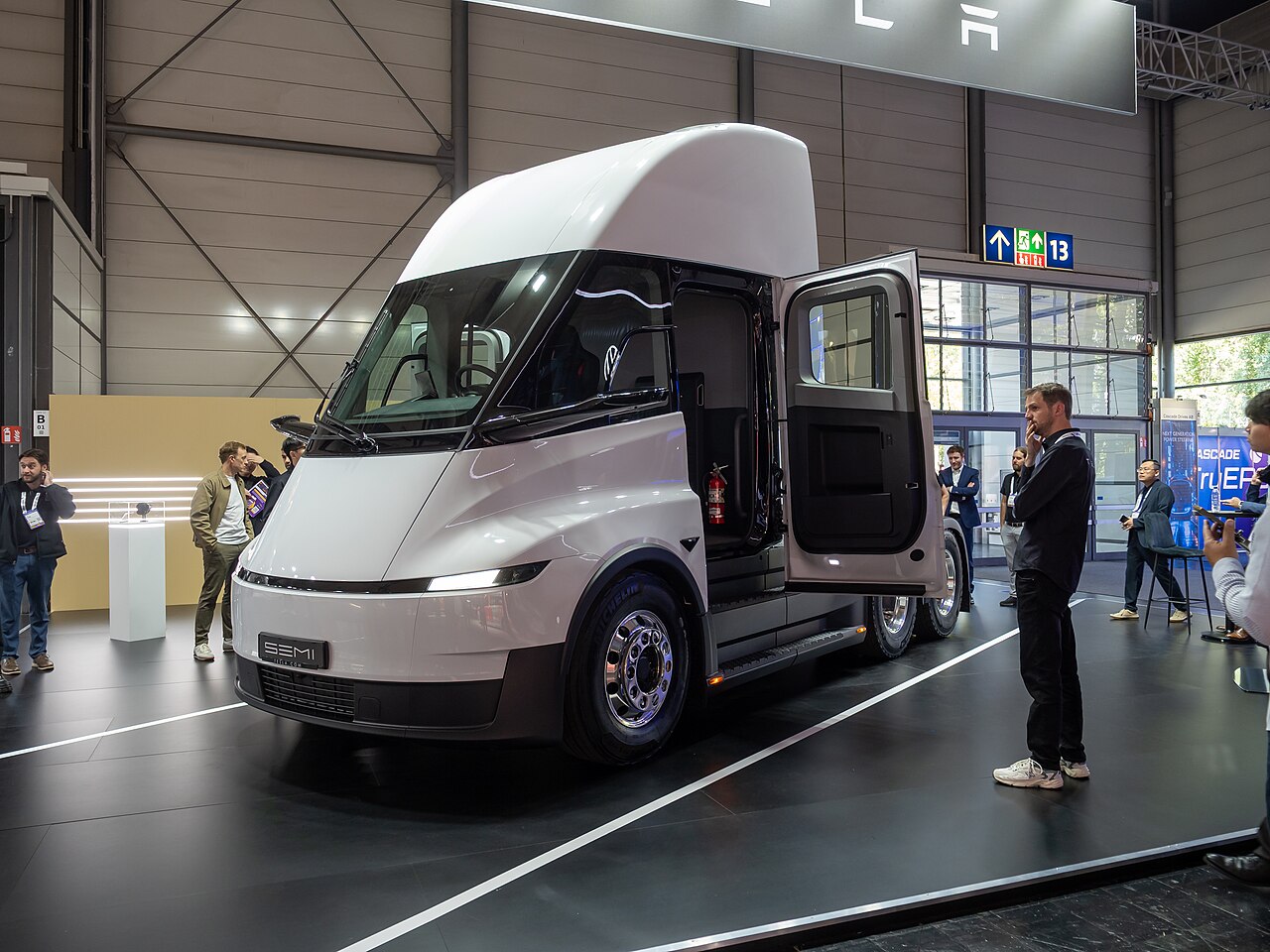
Tesla Sends 50 Semis Toward Chicago, Announces Six Charging Stalls
Tesla says 50 Semi trucks are heading to the Chicago region for delivery, giving its electric heavy-truck expansion a specific and potentially consequential scale. The company announced the shipment on November 11, one day after announcing six Semi Megacharger stalls in Hodgkins, Illinois, southwest of Chicago.

The paired announcements bring trucks and high-power charging infrastructure toward the same freight market. They do not yet represent an operating fleet: Tesla described the trucks as “en route for delivery” and has not confirmed their arrival, customer assignment or entry into commercial service.
Those unresolved details will determine whether Chicago becomes a meaningful regional deployment or remains, for now, an infrastructure and delivery announcement. A group of 50 battery-electric Class 8 trucks is large enough to put charging schedules, route planning and maintenance support under sustained operational demand once the vehicles begin carrying freight.
The customer has not been identified
HMD Trucking is one possible recipient, but Tesla has not connected the shipment to that company. HMD owner Henry Malukas told MotorTrend in September that he was buying 50 Tesla Semis for roughly $15 million. The carrier operates nearly 700 diesel trucks across Illinois and Indiana, and Malukas said it was installing chargers in Chicago.
The matching order and shipment counts are notable, but they are not confirmation. Tesla has not said whether the 50 trucks are going to HMD, another fleet or multiple customers. Malukas identified lower maintenance requirements as a major reason for HMD’s planned purchase, an advantage that would have to be measured against charging logistics and vehicle availability in daily service.
Tesla began its Semi customer rollout with PepsiCo in December 2022. Other trucks have since reached documented customer operations. DHL Supply Chain confirmed its first Semi delivery in December 2025 and said the vehicle was operating in Central California following a pilot. Hight Logistics showcased a Semi during a customer-container delivery in March 2026, while IMC Logistics said its truck had arrived and was already operating on the road.
Chicago would add a larger regional batch to those deployments if all 50 trucks are delivered and activated. That distinction is important because moving vehicles toward a market is only the first stage; commercial performance begins when fleets assign routes, load the trucks, schedule charging and keep them available through normal maintenance cycles.
Six stalls create a concentrated charging test
Tesla says its truck chargers can supply up to 1.2 megawatts and restore as much as 60% of a Semi’s range in 30 minutes, depending on charging conditions. The company rates the top Semi variant for 500 miles at an 82,000-pound gross combination weight, with energy consumption of 1.7 kilowatt-hours per mile.
Those specifications make the six-stall Hodgkins announcement operationally relevant, but charger count alone does not establish fleet throughput. Actual capacity will depend on site power, simultaneous charging behavior, truck arrival patterns and how long each vehicle occupies a stall. A fleet may also combine high-power charging with slower depot charging during longer parked periods.
Research involving the National Renewable Energy Laboratory has found that predictable short-haul operations can be well suited to depot charging. Nearly 80% of heavy-duty trucks primarily operate within a 200-mile range, according to Census Bureau data cited in a summary of the research. In the fleets studied, charging needs could often be met at 100 kilowatts per vehicle or less by using parked time effectively. Megawatt-class charging serves a different role: recovering substantial range quickly when schedules cannot accommodate long charging sessions.
Tesla has also said volume Semi production has begun in Nevada and listed installed annual factory capacity of 25,000 trucks in its third-quarter update. That figure describes the production capability installed at the plant, not current output or completed deliveries. The 50-truck Chicago shipment is therefore a more concrete near-term measure of regional expansion than the factory’s stated annual capacity.
The next meaningful milestone is confirmation that the trucks have reached their customer or customers and entered freight service. Only then will the Chicago deployment begin testing whether 50 electric Semis and six nearby high-power charging stalls can be coordinated around real routes, loading windows, driver schedules and maintenance demands.
| More aerospace and engineering stories, right in your MSN feed. Follow AMI on MSN |
By Thomas Caldwell — AMI’s senior editor for mechanical and mobility engineering, covering vehicle electronics, systems integration, electrification, chassis systems, propulsion, and safety policy.