Toyota and Subaru Double U.S. EV Sales With $35,000 Electric SUVs
Toyota and Subaru more than doubled their combined U.S. electric-vehicle sales through the first nine months of 2026, reaching nearly 50,000 vehicles as most competing brands recorded year-over-year declines. The growth coincided with the arrival of six related electric SUVs whose starting prices range from roughly $35,000 to $45,000 well below the cited record average of $51,109 for a new U.S. vehicle in October.
The contrast is unusually sharp. Toyota sold nearly 35,000 EVs through the third quarter, an increase of 183.4% from the same period in 2025. Subaru sold 14,630, up 46.7%. Outside Rivian, Toyota and Subaru were the only brands with year-over-year U.S. EV sales growth through the third quarter. Lexus, Toyota’s luxury division, separately sold 12,676 EVs, a 137.4% increase.
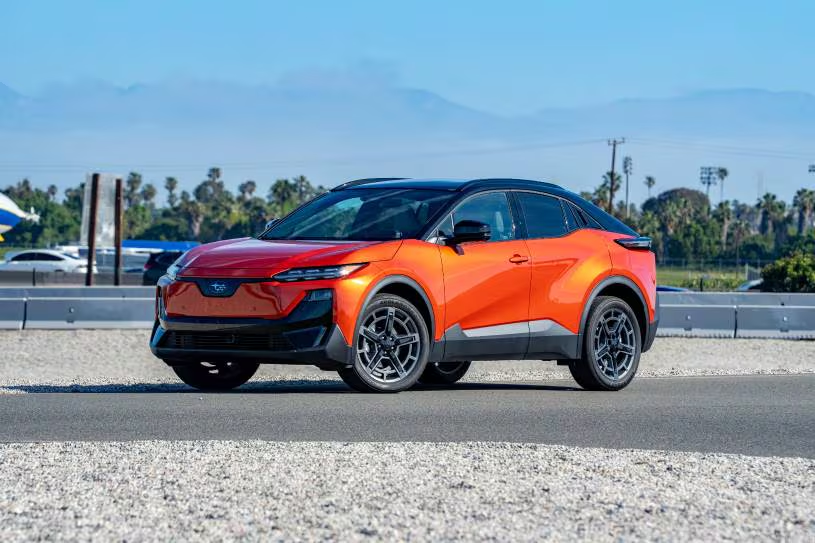
Toyota’s updated bZ provided the clearest volume result. Introduced in late 2025 as the substantially revised successor to the bZ4X, it became the fourth best selling EV in the United States through the third quarter, trailing only the Hyundai IONIQ 5, Tesla Model 3 and Tesla Model Y. Its base price is $35,000, while the $37,980 front wheel drive Plus version offers up to 314 miles of range.
Six SUVs from one technical foundation
The product strategy is broader than one successful model. Toyota offers the bZ, C-HR and bZ Woodland, while Subaru sells the Uncharted, Solterra and Trailseeker. All six use shared platform technology, but the companies package it into different sizes and use cases. Entry prices remain in a relatively narrow band: the Subaru Uncharted begins at $34,995, the Toyota C-HR at $37,080, the Subaru Solterra at $38,495, the Subaru Trailseeker at $39,995 and the Toyota bZ Woodland at $45,380.
Platform sharing gives the two automakers a common engineering base across several vehicles rather than requiring an entirely separate architecture for every nameplate. Subaru spokesperson Dominick Infante attributed the company’s affordable EV pricing mainly to its Toyota partnership and said, “We do believe there’s an EV future.” Cox Automotive industry-insights director Stephanie Valdez Streaty described the roughly $35,000 to $45,000 band as the market’s “sweet spot.”
The structure offers an important systems-level advantage: common technology can support more body styles and brand identities while concentrating development effort. That does not make the vehicles identical, nor does the available sales data isolate platform sharing or price as the cause of the increase. Product availability, model updates, brand demand and the unusually distorted 2025 comparison all potentially contributed.
A stronger quarter inside a weaker yearly comparison
The broader EV market improved from one quarter to the next but remained difficult when measured against the prior year. Kelley Blue Book estimated that Americans bought 262,649 EVs in the third quarter of 2026, up 6.1% from the second quarter and the strongest quarterly result of the year.
Year-over-year figures faced a tougher benchmark because buyers accelerated purchases before the federal incentive ended. The $7,500 federal new clean-vehicle credit was unavailable for vehicles acquired after September 30, 2025. That pulled demand forward into the comparison period and left most automakers reporting lower EV sales a year later. Toyota and Subaru expanded despite that market reset.
Their sticker prices also require context. Starting below the $51,109 average transaction price for all new vehicles makes these SUVs relatively accessible within today’s new-car market, but it does not establish lower total ownership cost. Insurance, charging access, electricity rates, registration fees, tire wear and depreciation can materially change the calculation. Kelley Blue Book reported that the average new EV still cost nearly $5,000 more than the average new gasoline vehicle in August 2026.
For Toyota and Subaru, the next test is whether the same shared-system approach can extend beyond compact and midsize SUVs without losing its pricing advantage. Both automakers are expected to add three-row electric models next year the Toyota Highlander EV and Subaru Getaway. Those larger vehicles will show whether a platform strategy that helped support six relatively affordable SUVs can scale into a heavier, more demanding family-vehicle segment.
| More aerospace and engineering stories, right in your MSN feed. Follow AMI on MSN |
By Thomas Caldwell — AMI’s senior editor for mechanical and mobility engineering, covering vehicle electronics, systems integration, electrification, chassis systems, propulsion, and safety policy.