Alto Targets 2029 Construction Readiness Despite $113 Billion Cost Estimate
Canada is advancing Alto’s proposed Toronto-Quebec City high-speed railway toward construction readiness in 2029, but the project’s financial and political foundations remain unsettled. The Parliamentary Budget Officer estimates the approximately 1,000-kilometre system could cost C$75 billion to C$113 billion, excluding a possible Kingston stop. Alto’s preliminary range is lower, at C$60 billion to C$90 billion.
The difference is consequential because Alto is still in development, not construction. It plans to submit a full business case to the federal government next year, while Quebec’s newly elected Parti Québécois government has said it will not support the project. Transport Canada says the federal government remains committed to advancing Alto at this stage. If approval and planning remain on schedule, work on the Montreal–Ottawa section is expected to begin in 2029-30, followed by an estimated 12-year buildout of the full network.
A dedicated railway would change more than train speed
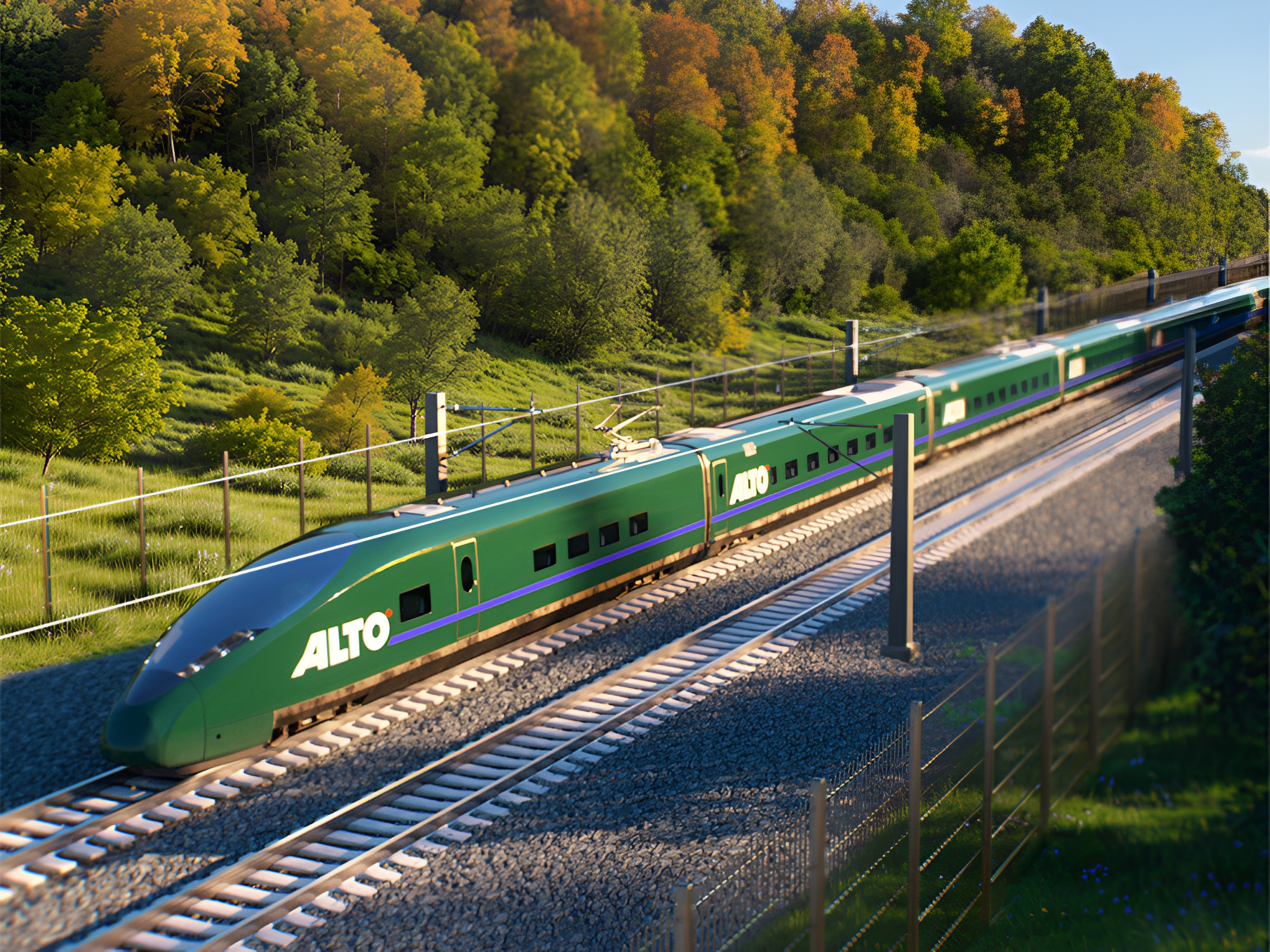
Alto’s main engineering advantage would come from separation. Its electric trains would operate at more than 300 kilometres per hour, primarily on dedicated tracks rather than railway corridors shared with freight traffic. That arrangement is intended to reduce the conflicts that contribute to delays on existing VIA Rail services and support a projected Toronto–Montreal journey of about three hours.
The proposed route would connect Toronto and Quebec City through Peterborough, Ottawa, Laval, Montreal and Trois-Rivières. Kingston remains under consideration. For passengers, the practical promise is therefore a combination of shorter journeys, more predictable schedules and service between several large metropolitan areas not speed as an isolated performance figure.
Dedicated infrastructure also accounts for much of the project’s difficulty. A railway designed for more than 300 kilometres per hour needs long, smooth alignments with gentle curves. Grade separation requires bridges or underpasses where the line intersects roads and other routes. Stations, electric power distribution, signaling, maintenance facilities and access to urban centres must function as one system.
Those requirements also constrain route selection. Farmers, landowners and environmental groups have raised concerns about property effects and areas including the Prescott-Russell Trail. Alto has begun measuring existing sound and ground vibration before selecting a final alignment. Its noise and vibration work covers sensitive locations such as homes, schools, hospitals, daycare centres and seniors’ residences, where the eventual route and mitigation measures could materially affect local acceptance and cost.
The cost gap cannot be resolved by a simple benchmark
The Parliamentary Budget Officer’s upper estimate exceeds Alto’s upper figure by C$23 billion, while both ranges omit a potential Kingston stop. Until the full business case defines the alignment, structures, stations, property requirements, risk allowances and delivery sequence, a single per-kilometre comparison cannot establish which estimate is more realistic.
International experience nevertheless shows why alignment decisions matter. A 2018 European Court of Auditors review of ten high-speed lines found an average cost of €25 million per kilometre, excluding more expensive tunnelling. Newer projects in its sample exceeded €40 million per kilometre. The auditors identified urban crossings, scarce land, viaducts, tunnels and higher design speeds as major cost pressures.
Those European figures are not a forecast for Alto: geography, project scope, regulations and price years differ. The more relevant comparison is schedule exposure. The audited European lines took about 16 years on average to progress from the start of construction to service, excluding planning, and half encountered delays exceeding a decade. Alto itself estimates that every year of delay before construction could add as much as C$3.4 billion.
The 300-kilometre-per-hour target also needs route-specific justification. The European audit found that trains on the reviewed lines averaged roughly 45% of their routes’ design speeds, with none averaging above 250 kilometres per hour. Urban approaches, intermediate stops and slower sections can reduce the time advantage purchased by the fastest infrastructure. Alto’s business case will therefore need to show where maximum speed creates substantial passenger value and where a less demanding alignment could control cost without undermining the three-hour Toronto–Montreal objective.
Public support depends on what the final system costs
The federal government has committed C$3.9 billion to design and development. Alto employs more than 200 people and has a 2026-27 budget just under C$700 million, demonstrating that significant public spending precedes any construction decision. Federal projections include as many as 51,000 jobs over a decade, 24 million annual passengers by 2055 and yearly emissions reductions of 2.2 million tonnes, but those remain forecasts tied to delivery and ridership assumptions.
Cost already affects public acceptance. One survey of 1,300 Canadians found 61% support and 19% opposition, while a separate June survey of 1,051 people produced an even split after respondents were told Alto could cost C$60 billion to C$90 billion: 38% called it a high priority and 38% a low priority.
Reaching construction readiness in 2029 will require more than completing a design. Alto must present a credible cost range, secure route and environmental approvals, address effects on corridor communities and maintain federal-provincial cooperation through a project expected to span well beyond one term of government. The full business case due next year is the point at which the promise of a three-hour Toronto-Montreal trip must be reconciled with a potential C$113 billion public bill.
| More aerospace and engineering stories, right in your MSN feed. Follow AMI on MSN |
By Thomas Caldwell — AMI’s senior editor for mechanical and mobility engineering, covering vehicle electronics, systems integration, electrification, chassis systems, propulsion, and safety policy.