NASA Pauses Perseverance and Odyssey Science as Orbiter Faces Fuel Limit
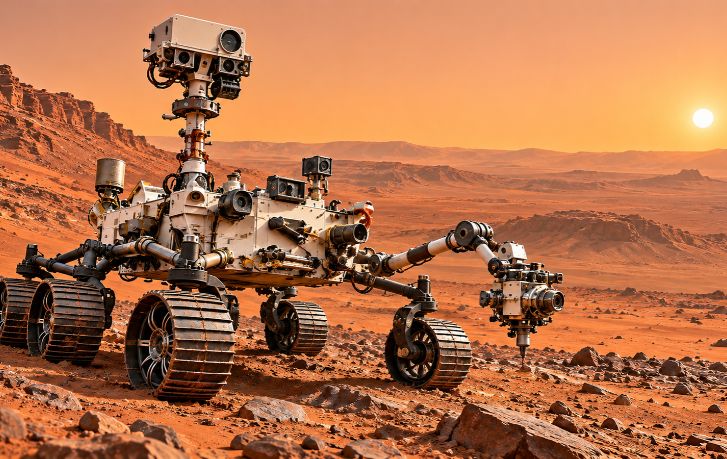
NASA announced on Nov. 19 that its Perseverance rover and Mars Odyssey orbiter had both stood down from science work after separate hardware glitches. According to the agency’s technical status update, Perseverance is dealing with radio trouble that has restricted its communications path, while Odyssey has lost the use of a reaction wheel needed to control its orientation. NASA hoped to return both spacecraft to work by the end of November.
The immediate result is the same: instruments are offline while engineers troubleshoot. The risks are considerably different. Perseverance remains stable and can communicate directly with Earth through its high-gain antenna, although at a lower data rate. Odyssey can fall back on thrusters if its wheel cannot be recovered, but NASA estimates that operating that way would exhaust the orbiter’s remaining hydrazine in roughly one or two months.
Perseverance has contact, but not its normal data pipeline
Perseverance’s problem began Oct. 30, when its primary ultra-high-frequency radio stopped sending routine electronic heartbeat signals to the rover’s main computer. After 25 missed heartbeats about 100 seconds of silence the rover’s fault-protection software shut down the unresponsive unit, switched to a redundant radio and placed the vehicle in safe mode.
That response shows the value of redundancy: the initial radio fault did not sever contact or leave the rover waiting for intervention from Earth. But redundancy only preserves capability when the backup performs properly. Once engineers brought Perseverance out of safe mode, they found that the second radio was transmitting at about half its expected power. The team stopped using both ultra-high-frequency radios while it investigates them.
Those radios normally send large volumes of rover data to spacecraft orbiting Mars, which then relay it to Earth. The arrangement allows surface vehicles to use nearby orbiters with larger antennas and more available electrical power instead of carrying heavier, more power-hungry long-distance communications equipment themselves.
Perseverance still has another route. It is talking directly to NASA’s Deep Space Network over an X-band connection using its high-gain antenna. That link is sufficient for commands, spacecraft health information and diagnostic data, but its lower throughput has forced the team to ration bandwidth. Science and instrument work, including new camera observations, has therefore been suspended while engineers concentrate on the radio problem.
The rover landed in Jezero Crater in February 2021. Its work has helped establish that the crater once contained a potentially habitable lake, and it has detected complex organic compounds in Martian rock. Determining whether any such material could be associated with ancient life will likely require analysis of returned samples. For now, the rover’s science value remains intact; the constraint is moving enough data through the available communications link to operate productively.
Odyssey’s backup consumes a limited resource
Mars Odyssey entered safe mode on Nov. 4 after one of its reaction wheels stopped spinning. The spacecraft left safe mode on Nov. 6, but its science instruments and Mars relay service remained offline while engineers tested the wheel.
Reaction wheels change speed to generate torque, allowing a spacecraft to turn and hold its orientation without continuously firing thrusters. Odyssey carries four wheels and needs three functioning units for normal orientation control. One wheel already failed in 2013, so the latest malfunction leaves the orbiter below that requirement.
Engineers were able to make the balky wheel move on command, offering a possible recovery path, but further testing was needed to determine whether it could reliably return to service. If it cannot, Odyssey must orient itself solely with hydrazine thrusters. Unlike an electrical reaction wheel, that fallback consumes propellant that cannot be replenished at Mars.
This makes Odyssey’s redundancy fundamentally different from Perseverance’s. The rover’s direct-to-Earth fallback purchases continued control and communications at the cost of data rate. Odyssey’s thruster fallback purchases orientation control by spending a finite fuel reserve, with NASA estimating only one or two months of operation in that configuration.
Odyssey arrived at Mars in October 2001 and has operated there longer than any other spacecraft. It produced the first global maps detailing the composition of the Martian surface and has served as part of the relay network carrying data from surface missions. Its loss would remove a long-serving science and communications asset, although Mars has other relay orbiters in operation.
NASA’s near-term goal was to restore Odyssey’s science and relay work after testing during the final week of November, while the Perseverance team planned to address the backup radio before turning its attention back to the primary unit. Perseverance’s slower link gives engineers time. For Odyssey, recovering one wheel could determine whether a 25-year Mars mission continues or begins consuming its final months of fuel.
| More aerospace and engineering stories, right in your MSN feed. Follow AMI on MSN |
By David Whitaker — Associate editor for AMI’s aerospace and drone systems desk, translating flight systems, aircraft programs, spaceflight, and UAV developments into accessible technical stories.