BepiColombo X-Ray Telescope Passes Eight-Year Test Before Mapping Mercury’s Chemistry
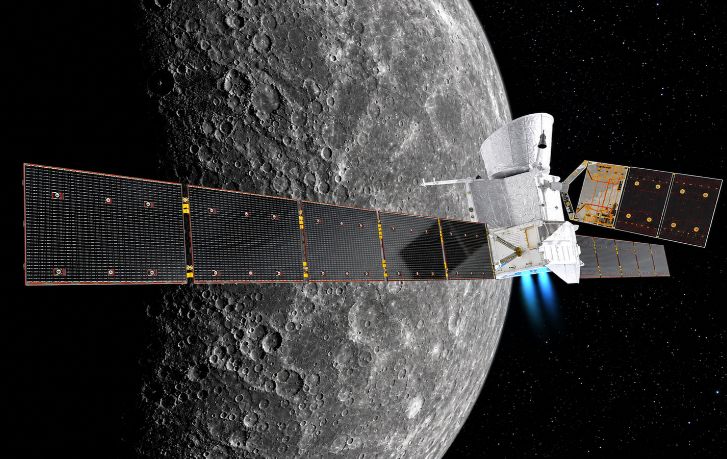
After eight years in space and 10 billion kilometers of travel, BepiColombo’s UK-built X-ray telescope has finally looked into open space and performed slightly better than it did before launch. The Mercury Imaging X-ray Spectrometer, or MIXS, detected X-rays from the Crab Nebula, giving engineers their first unobstructed astronomical test of the instrument that will map elements in Mercury’s surface.
The result closes a long period in which the telescope could be monitored but could not use its optics as intended. The Mercury Transfer Module, which propelled the European Space Agency and Japan Aerospace Exploration Agency mission through its interplanetary cruise, obstructed MIXS’s view until it separated from the two connected science orbiters in September.
Scientists at the University of Leicester selected the Crab Nebula because it is one of the brightest and best-characterized X-ray sources in the sky. Located about 6,500 light-years from Earth, it provided a predictable target against which the team could compare MIXS with laboratory measurements made in 2015.
A 39-hour test after years without a clear view
The main observing campaign took place on September 11 and 12. BepiColombo completed 55 controlled orientation changes over 39 hours, moving the Crab Nebula through different parts of the telescope’s field of view. Measuring how the source spread across the detector allowed the team to assess angular resolution the instrument’s ability to separate nearby surface features when it reaches Mercury.
The initial measurements showed slightly sharper angular resolution than MIXS achieved during its 2015 laboratory testing. The detector also showed no apparent radiation damage after eight years in space, and the images contained no effects attributed to unwanted optical light entering the instrument.
Galactic cosmic rays remain visible in the data, but their effects are understood and can be filtered. The team is also studying self-fluorescence that appears when sunlight illuminates the telescope optics. Scientists do not expect that behavior to interfere with dayside observations of Mercury, although MIXS will undergo further optimization during commissioning.
The last time we could see through this telescope it was in the basement under the School of Physics and Astronomy in Leicester, but after a rocket launch, eight years in space and 10 billion kilometers traveled it looks just the same, MIXS instrument scientist Adrian Martindale said.
Why an X-ray telescope is going to Mercury
MIXS is the first imaging X-ray telescope intended to operate on a planetary science mission. Its job is not to photograph Mercury in visible light. Instead, it will measure fluorescent X-rays emitted when solar X-rays strike atoms in the planet’s rocks.
Different elements produce characteristic X-ray signatures, allowing scientists to identify materials in the uppermost surface and build a global composition map. A companion instrument, the Solar Intensity X-ray and Particle Spectrometer, will measure the changing solar radiation reaching Mercury. That reference is necessary because the Sun acts as the illumination source, and its X-ray output varies.
The instrument has two complementary channels. One is designed to gather broad coverage for global mapping, while the telescope channel can examine smaller areas. According to the instrument’s technical description, the broader channel was designed for surface scales of roughly 50 to 100 kilometers, while the telescope could resolve features smaller than 10 kilometers under favorable solar or charged-particle conditions. That finer performance is conditional rather than a routine global resolution.
MIXS will also observe nighttime X-ray emissions produced when charged particles associated with Mercury’s magnetic environment strike the surface. Those measurements can help connect the planet’s surrounding space environment with the material at its surface.
The chemical map is intended to sharpen questions left by NASA’s MESSENGER mission, which found substantial compositional variation across Mercury. Higher-resolution measurements could help researchers investigate how the planet’s crust evolved and why the smallest planet has an unusual composition and oversized core. The Crab observations are calibration data, not Mercury science, but they show that the instrument needed for that work survived launch and the full cruise without an obvious loss of imaging performance.
BepiColombo’s connected orbiters were scheduled to enter Mercury orbit on November 21 and separate on December 9–10, according to ESA’s arrival schedule. Commissioning and optimization still stand between this first clear view and operational mapping, with the primary science phase scheduled to begin in April 2027.
| More aerospace and engineering stories, right in your MSN feed. Follow AMI on MSN |
By David Whitaker — Associate editor for AMI’s aerospace and drone systems desk, translating flight systems, aircraft programs, spaceflight, and UAV developments into accessible technical stories.