Tesla Model Y Gains 27 Miles of Range at Same $39,990
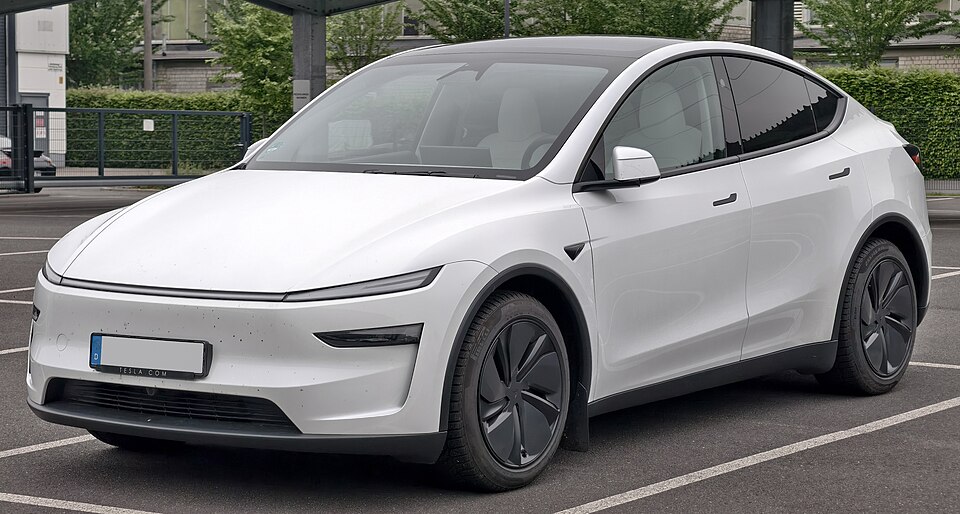
Tesla has made its least-expensive Model Y more capable on paper without making it more expensive. The rear-wheel-drive crossover is now listed with 348 miles of EPA-estimated range, up from 321 miles, while its price remains $39,990. That 27-mile increase works out to approximately 8.5%.

The tension is that the longer-range Model Y retains the equipment reductions used to reach its entry price, and it is now the only entry-level version available to order. Tesla has stopped accepting orders for the lower-priced, 294-mile all-wheel-drive Model Y, leaving customers who want all-wheel drive to move up to a Premium trim starting at $45,990.
A larger range number with no stated hardware change
Tesla’s website reflects the new 348-mile estimate, but the company has not explained what enabled the increase. The other stated specifications remain unchanged: a 69-kilowatt-hour battery, acceleration from zero to 60 mph in 6.8 seconds and a top speed of 125 mph.
Without further technical information, the higher figure cannot be confidently assigned to a battery change, software revision, efficiency improvement or testing-related adjustment. The confirmed change is the published range estimate itself. Tesla has not identified a corresponding alteration to the battery capacity or performance specifications.
An EPA estimate is a standardized comparison figure rather than a guarantee that every driver will travel that distance. Under the agency’s electric-vehicle range-testing process, vehicles are run on laboratory dynamometers over defined driving cycles. Manufacturers generally conduct the tests and submit their data, while the EPA audits the submissions and performs confirmation testing on some vehicles.
The city and highway results are adjusted for conditions that laboratory cycles do not fully represent and then combined into the number used for labeling. Weather, cabin heating or cooling, speed and driving behavior can still move real-world range above or below the listed figure. The 27-mile revision is therefore most useful as a standardized change in the Model Y’s rated capability, not a promise of an identical improvement in every trip or climate.
The base trim keeps its equipment cuts
The $39,990 version continues to separate itself from Premium models through its cabin and exterior specification. Its seats combine textile and vegan leather, only the front seats are heated, and seat adjustments are controlled through the central touchscreen. It also lacks a rear screen and uses an open center console plus a seven-speaker audio system without a subwoofer.
The glass roof comes with a fabric headliner. Outside, the entry model omits the light bars and matrix LED headlights offered elsewhere in the range, while its mirrors fold manually. Those omissions remain part of the price-versus-equipment calculation despite the improved range rating.
Some core systems do carry over. The rear-wheel-drive model includes the same heat pump and Full Self-Driving hardware as the higher trims. A heat pump is particularly relevant to an electric vehicle because cabin heating can impose a substantial energy demand in cold conditions, although the presence of the shared system does not explain the new rating.
More range, but a narrower entry-level lineup
The rear-wheel-drive vehicle originally arrived as the Model Y Standard. Tesla dropped the Standard designation in February when it introduced a $41,990 all-wheel-drive version. That 294-mile all-wheel-drive model is no longer accepting orders, and Tesla has not said why it was removed or whether it will return.
The result is a sharper split in the current lineup. The $39,990 Model Y now offers 348 miles of listed range and rear-wheel drive, while all-wheel drive requires stepping into the Premium range at $45,990 or more. New Premium orders are listed for delivery in early 2027.
Tesla has therefore improved the headline range per dollar figure of its least-expensive Model Y while leaving its equipment strategy intact. The unresolved engineering detail is how a vehicle still described with a 69-kilowatt-hour battery and unchanged performance figures acquired 27 additional miles in its EPA estimate.
| More aerospace and engineering stories, right in your MSN feed. Follow AMI on MSN |
By Thomas Caldwell — AMI’s senior editor for mechanical and mobility engineering, covering vehicle electronics, systems integration, electrification, chassis systems, propulsion, and safety policy.