Hera Photographs Dimorphos’ Shadow Crossing Didymos From 195 Million Kilometers Away
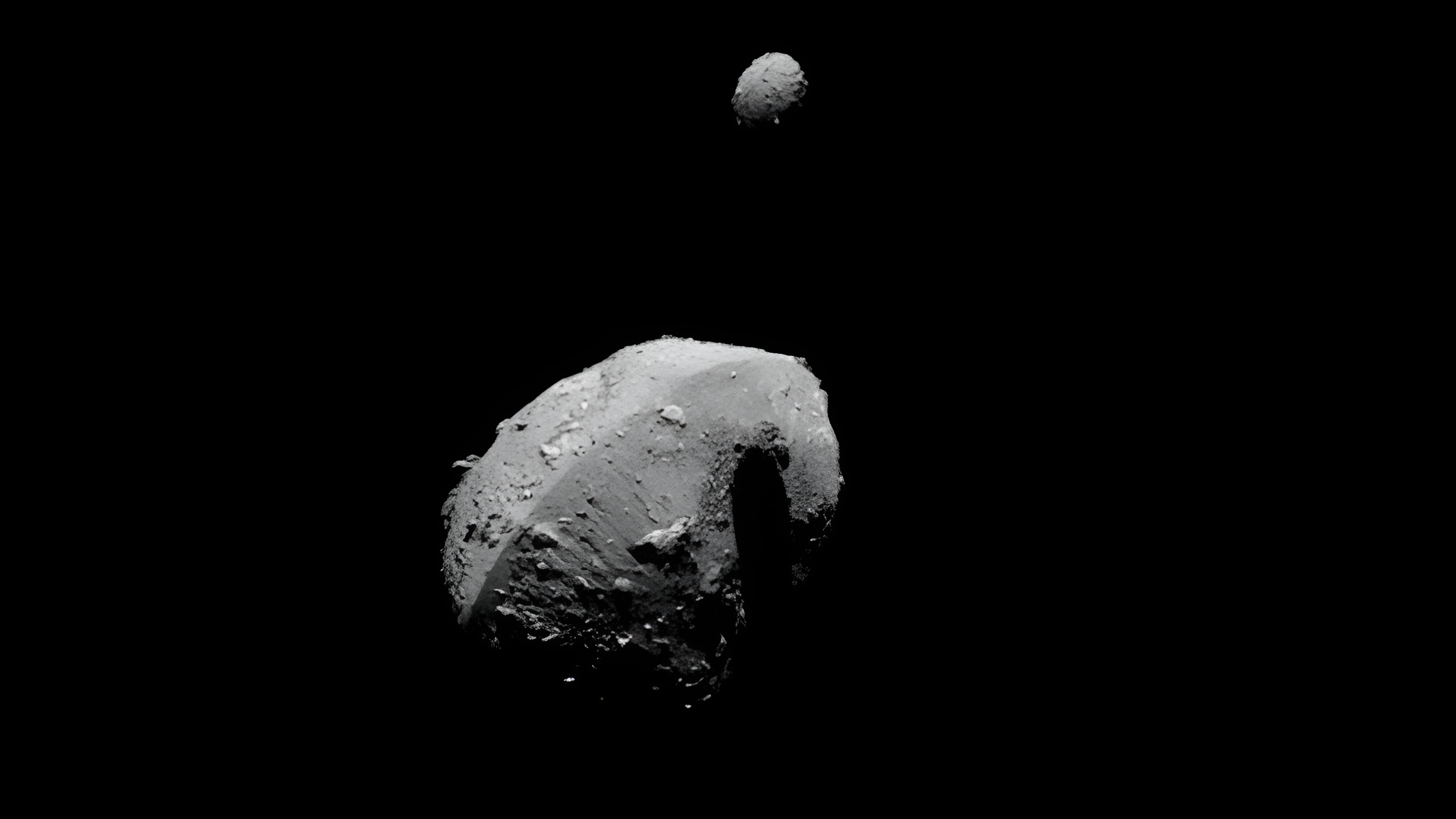
The European Space Agency’s Hera spacecraft has photographed the smaller asteroid Dimorphos casting its shadow across Didymos, its larger companion. Hera captured the unusual asteroid-on-asteroid eclipse while approximately 195 million kilometers, or 121 million miles, from Earth.
The dim shadow is more than a striking deep-space image. It previews Hera’s close investigation of the binary asteroid system that NASA deliberately altered in 2022. According to the German Aerospace Center’s mission update, the European spacecraft has now reached the asteroid pair and is beginning an extended examination of both bodies.
The distant frame already resolves irregular rocks and boulders across Didymos and Dimorphos. Those rough surfaces are central to the mission’s work because Didymos is described as a “rubble pile”: a loose collection of boulders, gravel, dust and other material held together primarily by gravity rather than forming one solid mass.
A quiet eclipse follows a violent experiment
Dimorphos became the target of NASA’s Double Asteroid Redirect Test in September 2022. The DART spacecraft was deliberately driven into the moonlet at high speed to test a kinetic-impact method of changing an asteroid’s motion. Instead of attempting to move the entire binary system by a large, immediately visible amount, the experiment measured how the collision changed Dimorphos’ orbit around Didymos.
Ground-based light curves, radar observations and navigation-camera measurements later established that the impact shortened Dimorphos’ orbital period by 33.0 minutes, with an uncertainty of plus or minus one minute. That result is documented in a peer-reviewed orbital analysis combining several types of observations.
The eclipse image itself is not a new measurement of that orbital change, nor does it determine how the impact produced it. Its importance is positional and operational: Hera can now observe the altered system directly rather than relying exclusively on remote measurements from Earth and the final images returned by DART before impact.
Why the rubble matters
A kinetic impactor transfers momentum when the spacecraft strikes its target. Material blasted away from the surface can provide an additional push in the opposite direction, meaning the result depends partly on how the target is assembled. Strength, porosity, boulder distribution and the properties of material near the impact point can all influence the crater and the amount of momentum transferred.
That makes a rubble-pile asteroid a more complicated engineering target than a uniform block of rock. Numerical simulations of impacts into rubble-pile structures have found that local boulder arrangements can affect deflection efficiency and crater shape. Those models also show why close observations are needed: measurements of the orbital change alone cannot fully separate the effects of surface structure, material strength and impactor geometry.
Hera’s role is therefore comparable to a post-test inspection. Its cameras will map the surfaces and support three-dimensional models, while the broader instrument package will examine the shape, surface properties and internal structure of the asteroid pair. The investigation is intended to show what physical conditions produced DART’s measured orbital change and help make future kinetic-impact predictions more reliable.
The spacecraft’s early close views have already shown large boulders, craters, smoother areas and a pronounced equatorial ridge on Didymos. Hera is also carrying two small CubeSats that are planned to conduct still closer examinations, extending the mission beyond what can be learned from conventional approach photography alone.
The immediate progression is unusually clear: first came DART’s deliberate collision, then years of Earth-based measurement, and now the inspecting spacecraft has arrived. The quiet passage of Dimorphos’ shadow across Didymos marks the transition from watching the system at a distance to examining how a real asteroid responded when humanity deliberately struck it.
| More aerospace and engineering stories, right in your MSN feed. Follow AMI on MSN |
By David Whitaker — Associate editor for AMI’s aerospace and drone systems desk, translating flight systems, aircraft programs, spaceflight, and UAV developments into accessible technical stories.