Ilovik-Paržine 1 Shipwreck Reveals Waterproofing and Multiple Ancient Repairs
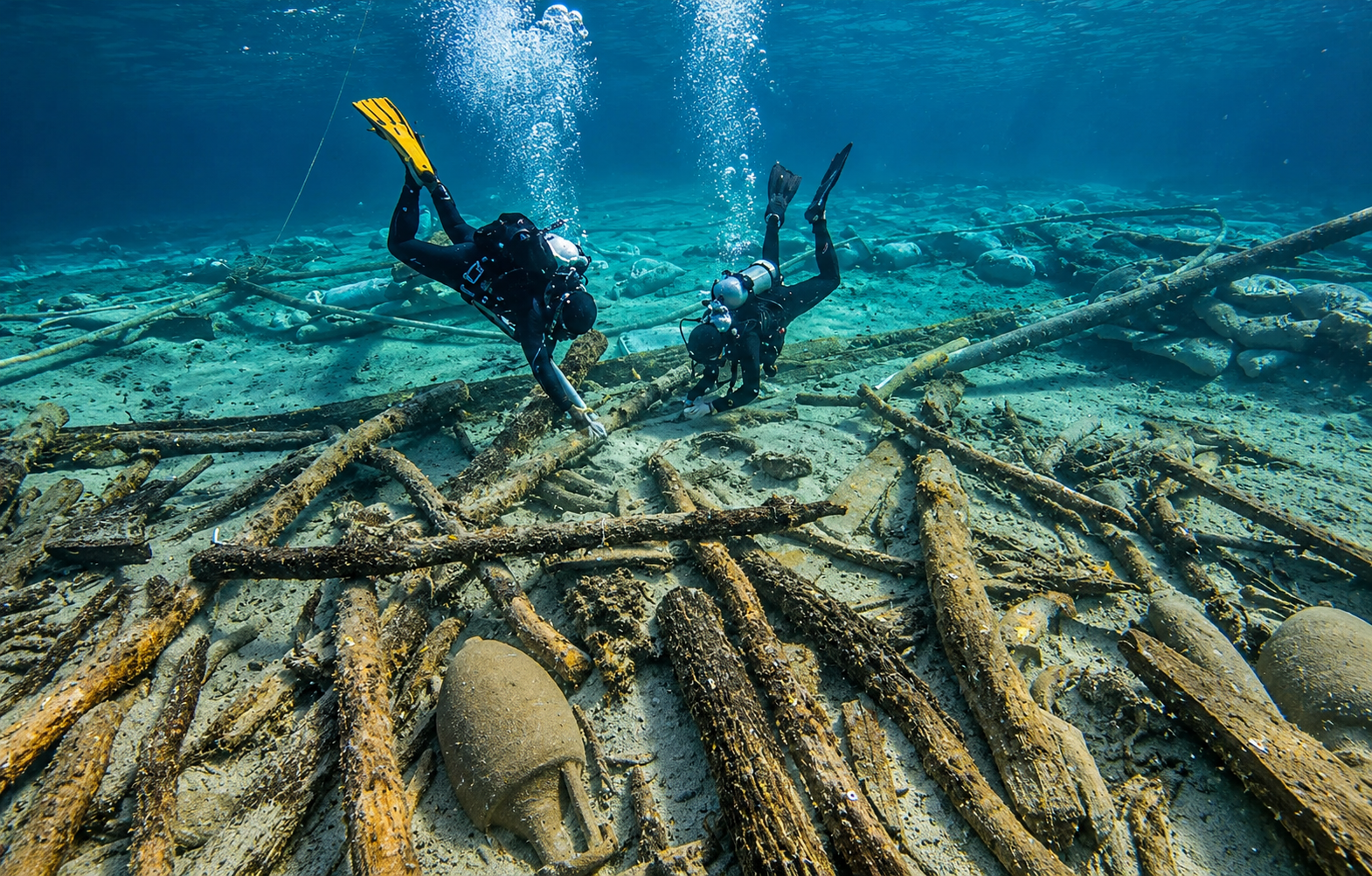
Two waterproofing compounds survived on the Ilovik-Paržine 1 shipwreck for roughly 2,200 years: pine tar and a modified mixture of pine tar and beeswax. Yet the more revealing difference appeared at microscopic scale. Pollen trapped in coatings that otherwise looked chemically similar indicates that the Roman Republic vessel probably received four or five separate batches during construction, refitting or repair.
The study published in Frontiers in Materials examined 10 coating samples from the wreck, which sank off the coast of modern Croatia. Researchers from France and Croatia combined structural and molecular analysis with pollen identification, treating the coating as both an engineered material and a record of the environment in which it was prepared or applied.
One base material, two recipes
Chemical signatures associated with pine appeared throughout the samples. The main waterproofing material was pitch produced by strongly heating conifer resin or wood-derived tar. Applied to the inside and outside of a timber hull, this hydrophobic, adhesive material could impregnate and anchor within the wood’s pores, helping to restrict water penetration while protecting the structure from marine exposure.
One sample differed. Alongside the pine-derived compounds, researchers identified wax esters characteristic of beeswax. The resulting pine-tar-and-beeswax mixture was known to Greek shipbuilders as zopissa, and its presence on this Roman Republic wreck reveals a deliberate modification of the base coating rather than reliance on pitch alone.
The additive addressed a practical handling and durability problem. Pine pitch tends to become brittle when cold, while beeswax can make the compound more flexible. It also reduces viscosity when the mixture is hot, making the coating easier to spread across timber. Greater flexibility would have been useful on a hull whose planks and joints moved under wave loading and changing conditions. The Ilovik-Paržine 1 work identified the recipe; it did not directly test the surviving coating’s mechanical performance after two millennia underwater.
The molecular investigation relied on infrared spectroscopy and gas chromatography with mass spectrometry. These methods allowed the team to identify families of compounds and diagnostic molecular markers despite substantial degradation. Heat-derived pine markers established that the coatings came from intensely processed conifer material, while the beeswax markers isolated the exceptional mixed sample.
Pollen separated otherwise similar coatings
Chemistry alone could not reconstruct the entire maintenance sequence. Several coatings had effectively identical molecular profiles because they used the same general pine-based material and manufacturing approach. Their pollen populations, however, differed in both variety and abundance.
Sticky pitch captures airborne pollen during production and application. Once embedded, those grains can remain protected inside the coating. The samples contained pollen associated with Mediterranean and Adriatic coastal vegetation, shrubland, wet river or shoreline environments and mountainous areas. Researchers compared those assemblages statistically to separate the samples into probable coating batches.
The resulting distribution points to four or five treatments. Coatings from the stern and central part of the vessel were comparatively homogeneous, while three distinct batches were identified at the bow. That zoning is consistent with successive work on different hull sections or with batches obtained from separate sources during construction and later maintenance. It provides evidence of multiple treatments, although pollen cannot assign every application to an exact repair yard.
Earlier analysis of the ship’s ballast identified ancient Brundisium modern Brindisi in southeastern Italy as its likely construction site. Several coating samples contained pollen assemblages compatible with environments in that region, suggesting that some material may have been produced or applied near the shipyard. Other samples, particularly from the bow, may reflect work undertaken along the northeastern Adriatic coast as the vessel travelled.
This is where the pollen adds information that conventional coating analysis could not. Pine pitch was the common technical foundation, so similar molecular signatures did not necessarily mean a single production run or application. Microscopic plant remains exposed variation within that apparent uniformity: one hull, two material recipes and as many as five coating batches. Routine maintenance left a record inside the sealant itself, preserved long after the wooden vessel sank.
| More aerospace and engineering stories, right in your MSN feed. Follow AMI on MSN |
By Edward Collins — Senior editor for AMI’s performance systems and mechanical design coverage, focused on powertrains, drivetrain systems, manufacturing precision, materials, and high-performance engineering.