


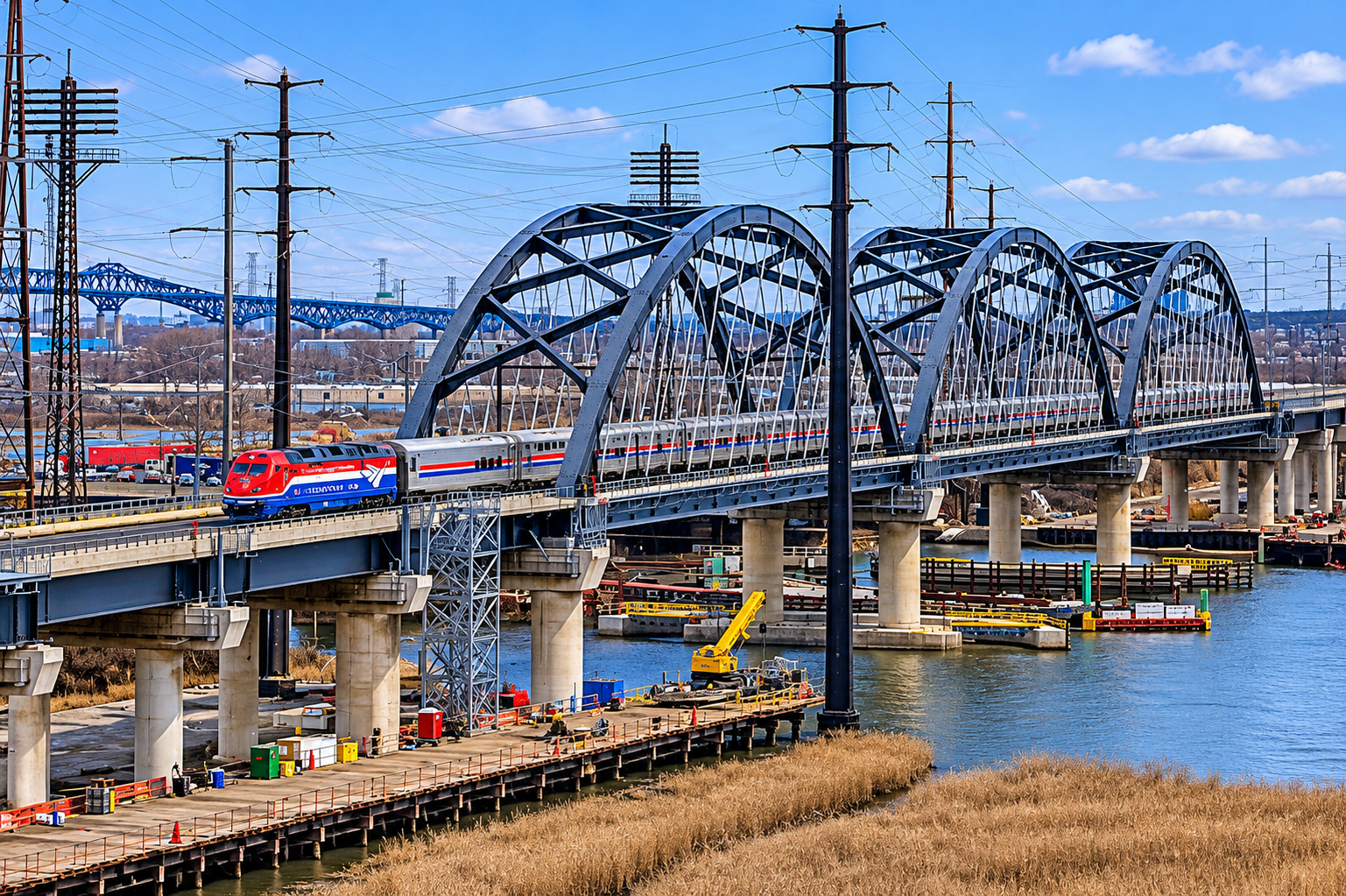
Portal North Bridge Opens Both Tracks, Retiring 116-Year-Old Delay-Prone Span
NJ Transit and Amtrak have placed both tracks of the Portal North Bridge into service in Kearny, New Jersey, completing the rail cutover from a 116-year-old swing bridge over the Hackensack River. The fixed-span replacement removes a movable crossing that had been cited as a major source of delays for Northeast Corridor passengers.
The transition reached its final operating milestone on Nov. 16 after a five-week second-stage cutover. Regular service resumed Nov. 15, ending temporary diversions and service reductions required while crews transferred the remaining track and associated rail systems to the new structure.
The first stage began Feb. 13 and ended March 15, when trains started using the new bridge’s initial track while the old Portal Bridge remained operational. Work on the second and final track started Oct. 9. Dividing the transfer into two stages allowed rail service to continue while crews shifted track, overhead electrical equipment, signaling and other operating systems from one structure to the other.
A fixed bridge removes a mechanical constraint
The central engineering change is straightforward: Portal North Bridge does not move. Its two-track span rises 50 feet above the river, twice the clearance of the former crossing, allowing marine traffic to pass underneath without requiring an opening.
The old bridge, in service from 1910 through October 2026, had to rotate for vessels. Each opening interrupted rail traffic, and a failure to return the movable structure to its correct position could prevent trains from proceeding. Replacing it with a fixed span removes the opening cycle, its mechanical equipment and the associated need to coordinate train movements with bridge operations.
That does not eliminate every potential delay on the Northeast Corridor. Trains remain dependent on interconnected track, power, signaling and station infrastructure. It does, however, remove a recurring failure point at a location shared by Amtrak and NJ Transit. The new crossing also has a 90 mph speed limit, compared with 60 mph on the old span, reducing the local operating restriction when surrounding traffic conditions permit.
Before the final track entered service, the installation underwent a Positive Train Control test. That step illustrates why a bridge cutover involves more than completing its concrete and steel structure: train detection, signal authority, communications, electric traction equipment and safety controls must function as an integrated railway before regular operations can transfer.
A $1.56 billion construction contract
The replacement was delivered through a $1,559,993,000 construction contract that NJ Transit approved in October 2021 for the Skanska/Traylor Bros PNB Joint Venture. NJ Transit described it as the largest single construction award in the agency’s history. A January 2021 Full Funding Grant Agreement secured $766.5 million from the Federal Transit Administration, with additional project support from the U.S. Department of Transportation, New Jersey, New York and Amtrak.
The work extends beyond the bridge itself, covering 2.44 miles of the Northeast Corridor. Its scope includes retaining walls, deep foundations, concrete piers, structural-steel spans and rail systems. Those approach and systems elements are essential because a higher fixed span requires trains to reach the new crossing on compatible alignments while maintaining the geometry, electrical supply and signaling needed for passenger service.
Portal North Bridge is also the first of the Gateway Program’s 11 projects to be completed, according to U.S. Sen. Cory Booker. Its immediate value, however, is narrower and measurable at the river crossing: two active tracks now carry trains over the Hackensack without stopping for bridge openings or depending on a century-old swing mechanism.
Work around the site is not entirely finished. Amtrak is expected to construct a new viaduct and install additional infrastructure on the project’s east side, while the retired Portal Bridge is scheduled to be dismantled in 2027. Officials have said that remaining work will not affect rail service, leaving the old movable span’s removal as the next visible milestone.
| More aerospace and engineering stories, right in your MSN feed. Follow AMI on MSN |
By Thomas Caldwell — AMI’s senior editor for mechanical and mobility engineering, covering vehicle electronics, systems integration, electrification, chassis systems, propulsion, and safety policy.



