

Hyundai Motor Group’s Path to Scaled, Human-Centered AI Robotics
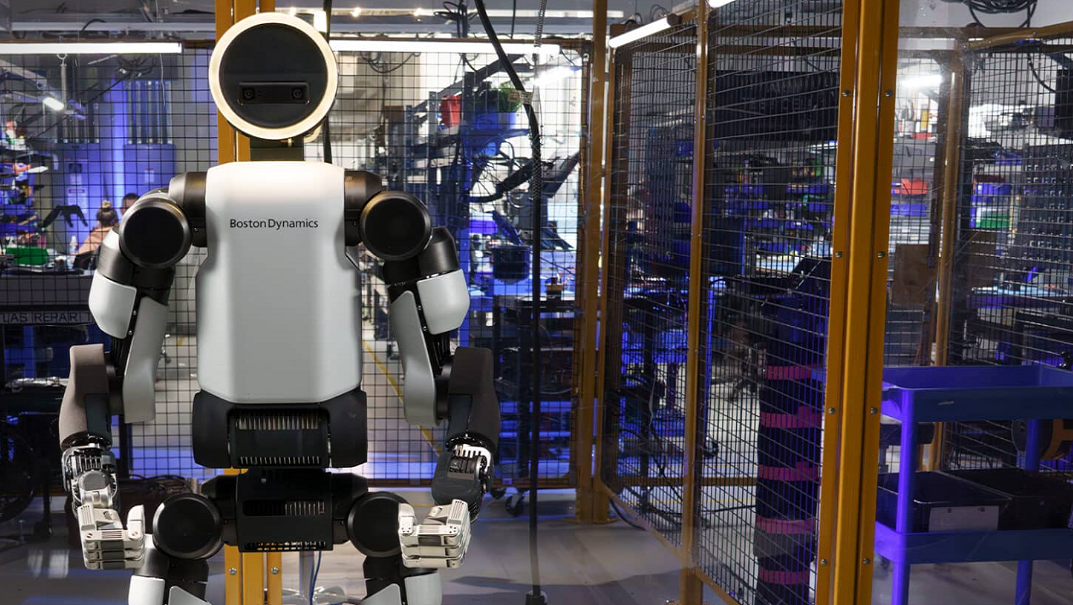
To be able to boast fifty-six degrees of freedom, self-swapping batteries, and weigh 50kg is an accomplishment in itself in terms of technology, but it also holds an even greater goal of introducing intelligent and collaborative robots into industry. Boston Dynamics’s collaboration with the Hyundai Motor Group and Google’s DeepMind represents the aspiration for achieving this reality.

At the vanguard of the project is the Atlas robot, which is a fully electric humanoid robot designed by Boston Dynamics. Atlas is designed to work in conjunction with humans, especially where there could be a threat or in heavy labor work. It can directly communicate with the MES and WMS systems. It can also perform one operation in other systems without the need for human intervention. All these are done at the rate of mass production in the HMG manufacturing environment.
Arguably, the success of HMG can be attributed to its ability to leverage its mass production capabilities and value chain on a global scale. Its affiliates, namely Hyundai Motor Company, Kia, possess production scale and process ownership capabilities, whereas Hyundai Mobis concentrates on high-performance actuators in production, and Hyundai Glovis takes care of logistics. Synergies developed between this cluster of firms help HMG to offer its customers a ‘robotics-as-a-service’ or RaaS offering that encompasses design and assembly, as well as post-delivery services and monitoring. As HMG begins to adopt robotics for the very first time within its organization, it ensures that its offerings are proven within its most challenging applications, prior to being provided to its customers.
All these trainings and developments of the robots will be done at the future Robot Metaplant Application Center as well as at the Software-Defined Factory paradigm of the Group. The SDF factories differ from other factories which are hardware-oriented because these factories will now include artificial intelligence in the form of software at their core. The Robot Metaplant Application Center will be a location where the robots will be able to train themselves based on experiences from the real world.
The collected information from this factory will be used for this training. Both safety and collaboration are factored in when designing the robot. This aligns with the world guidelines when it comes to using collaborative robots. Using collaborative robots means that there is an emphasis on speed control and force control. Apart from that, there is an emphasis on separation distances. Finally, there is an emphasis on human ergonomics in the workplace environment. By taking all these into consideration, these two companies are expected to develop a symbiotic relationship where humans and robots coexist in a workplace environment.
Looking at it from an intelligence perspective, Google DeepMind’s Gemini Robotics Foundation Models provide Atlas robots with vision, language, and action intelligence. This provides robots with an ability to respond to natural language commands, an ability to manipulate new objects, and an ability to do spatial reasoning accurately when it comes to manipulation. These are further enhanced by Gemini Robotics-ER, where there is an emphasis on an embodied reasoning system that provides an ability to do safe trajectory paths when it comes to complex manipulation using limited human example demonstrations.
By bringing all these together, Atlas robots are expected to do different applications in different industries, not limited by what it was originally intended, which was manufacturing. Already, different applications are being realized. When it comes to different applications in logistics, for example, Boston Dynamics’ Stretch robot shows that these robots are capable of making a difference in this industry in order to relieve workers of monotonous unloading jobs, processing at a rate of 700 cases in an hour for partners such as DHL.
These innovations will yield results when the concept of humanoid robots is also taken into account for this specific industry. When it pertains to its vision for its own plants for the future, HMG plans for scores of thousands of robots in its plants, Atlas robots doing sequencing in 2028, and complex assembly in 2030. Whether it is for the automotive, energy, construction, or facilities management sectors, there is one ultimate goal, and this is to apply human-centric AI robotics that are safe, reliable, and proficient in their respective domains. When it pertains to production volume, AI knowledge, and validation, Hyundai Motor Group finds itself ready to take center stage for this new partnership.