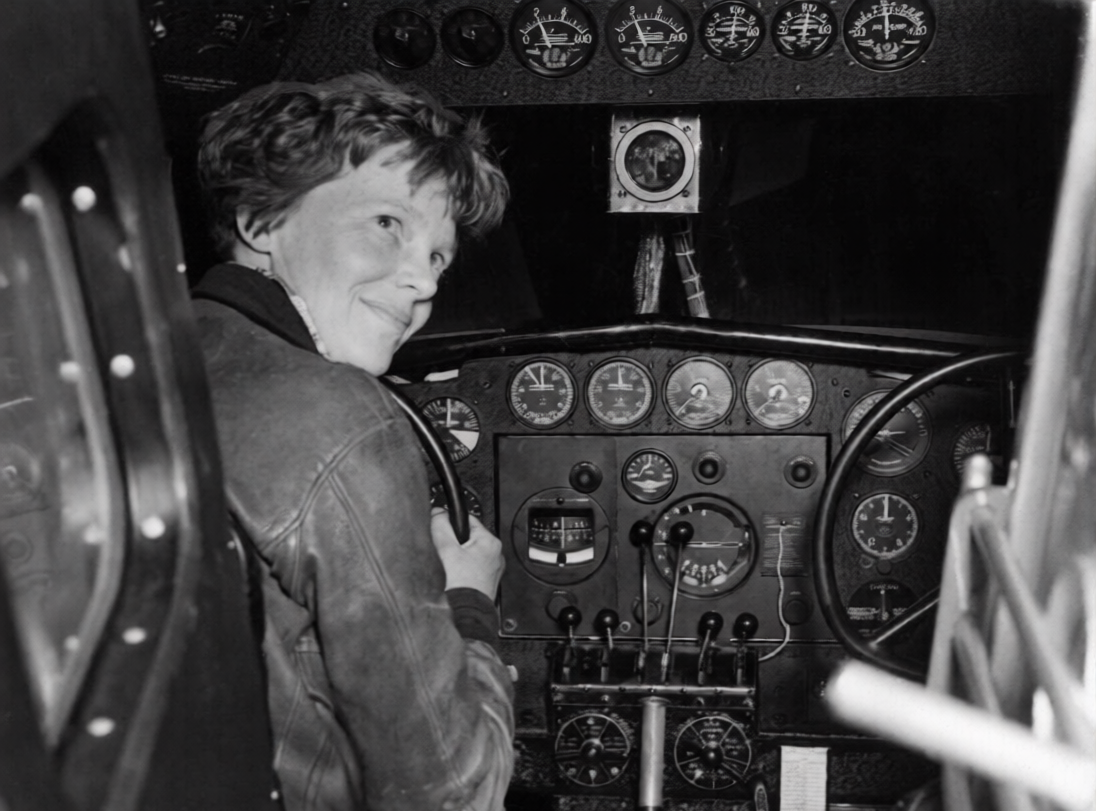
Restored 1937 Radios Narrow Amelia Earhart Search Planning
Over 90 years since the disappearance of Amelia Earhart and her navigator Fred Noonan while flying to Howland Island, one of the latest advances in search techniques is not a new sensor, nor a map. Rather, it is the recreation of the radio equipment they used back in 1937.

Deep sea exploration and historical research organization Nauticos, which has conducted extensive search operations west of Howland Island, claims that using restored vintage radio equipment helped it pinpoint the approximate location of Earhart’s Lockheed Electra L-10E around 8 a.m. on July 2, 1937. However, this does not mean that the aircraft has been found, and Nauticos has not yet made public its new coordinates and search zone as of June 2026. Nonetheless, it is a good example of how reconstructing legacy avionics can help refine a modern search approach.
The technical idea behind such searches is simple: vintage radio logs become even more useful when tested against equipment that operates as originally designed. In 2020, Nauticos acquired and restored the same equipment that was on board of the plane during its final flight, including Western Electric 13C aircraft transmitter and Bendix Model RA-1A aircraft receiver. According to the organization, in 2025 it managed to pinpoint the probable location of the Electra based on its tests using that equipment.
Why does it matter? Earhart’s last communication with USCG cutter Itasca is full of details about their relative positions, but lacks exact geographic location. For instance, she said on 7:42 a.m. (according to radio log), “We must be on you, but we cannot see you.” Fuel is running low. Been unable to reach you by radio. We are flying at 1,000 feet. Around 8 a.m., she asked for bearings. Finally, in her last message she stated she was on line 157-337 and running north and south at 8:43 a.m.
Those messages have always been central for theories regarding Earhart’s disappearance. What Nauticos provides is an attempt to use this information to define a more limited search area through using restored radio equipment that performed on 3105 kHz. The company’s tests used two platforms: one flying in the air and one sailing on water. An aircraft Miss Amelia was equipped with Bendix receiver and Western Electric transmitter. The boat Nellie Crocket was equipped with the same model of RCA receiver Model CGR-32-1 as Itasca, and its mast was elevated to the same height.
This aspect is not only historical accuracy. Geometry matters in radio business. Making sure that the boat antenna height is the same makes the signal strength and radio direction finding comparison more accurate, because received performance depends not only on frequency and transmitter power, but also on the equipment installation, elevation, and relations between airframe and receiving station. If the goal is to re-interprete weak and inconsistent radio transmissions from 1937, then installation precision becomes as important as having correct equipment labels.
According to Nauticos, it has done Radio Direction Finding and Range vs. Signal Strength tests on 3105 kHz trying to recreate the final flight conditions as accurately as possible. All the results were collected in an 88-page report entitled Statistical Analysis for Highest Probability Areas. This title says it all: it is a probabilistic narrowing task, not an attempt at precise reconstruction.
It is important for people who might want to interpret any new development about Earhart’s case as a final solution. Vintage radio systems were highly dependent on installation and operating conditions. Numerous technical analyses of the Earhart’s radio fit have always mentioned the importance of antenna configuration, tuning, receiver limitations, and operator procedure. In practical terms, it means that reconstructive tests can refine the search box, but not turn a 1937 message into a modern GPS fix.
Still, narrowing down a search area matters in deep ocean operations a lot. Search economics, vessel time, sensor coverage, and mission sequencing all become more efficient when a large historical uncertainty can be narrowed to a smaller, high-probability area. Nauticos has organized previous Earhart missions in 2002, 2006, and 2017. The latter one found some cables, but not the plane. The company now says that radio-based analysis significantly reduced the area for its future search.
During the interview for WBUR in February 27, 2026, Nauticos’ president Dave Jourdan said that his team has defined roughly where the plane was around 8 a.m., but this data has not yet been made public. Also, he mentioned that the company was looking for $6-10 million and planned to organize another expedition as soon as 2026.
For aviation and systems readers, the main lesson goes beyond a single historical case. This project demonstrates how avionics archaeology, rigorous tests, and statistical analysis can turn vintage communication logs into practically useful search planning. The point is not that a vintage radio can miraculously pinpoint a wreck site. The point is that restoring legacy equipment can narrow uncertainty enough to make a modern search more technically justified.
By Thomas Caldwell — AMI’s senior editor for mechanical and mobility engineering, covering vehicle electronics, systems integration, electrification, chassis systems, propulsion, and safety policy.