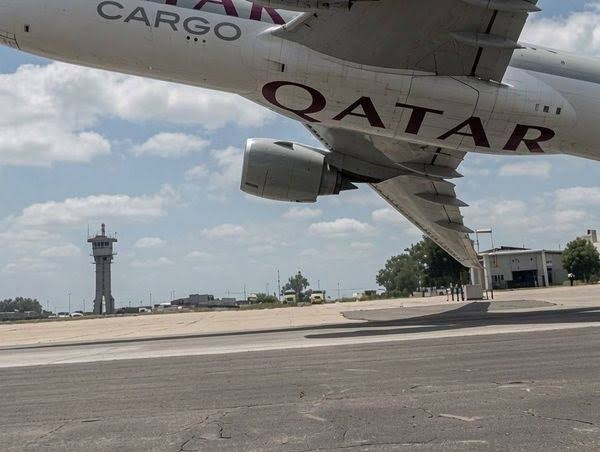
Low Texas 777 Pass Puts Freighter Test Discipline Under Scrutiny
The extremely low flyby of a Boeing 777 freighter over Texas that has caused great attention on the Internet not only because of the spectacle but because of the strict regulation of such flights, especially in case of converted freighter delivery. So far, the available facts are rather scarce. To start with, it was the aircraft belonging to Delta Air Lines with a registration number N705DN, which was flying from Indiana to Dallas-Fort-Worth on Wednesday. On that flight, the aircraft made a low flyby over Horseshoe Bay Resort Jet Center, situated close to Austin. The data obtained from Flightradar24, taking into account correction for local pressure and elevation of airfield, show that the lowest altitude was between 0 and 25 feet.
As the Federal Aviation Administration reported, it was aware of the event and is carrying out the investigation of it. This fact is very important since regardless of the classification of the flight as test or pre-delivery one, FAA supervision of the flight is intact. In general, according to FAA guidance on airport operations, low pass or low approach are regarded as operationally sensitive maneuvers, and the pilots are recommended to pay special attention since in the area near the airport traffic density, climbing and descending and cockpit workload increase the risk of accidents.
For large and turbine aircraft, FAA gives helpful recommendations too: traffic pattern entry altitude for such type of aircraft is not lower than 1,500 feet above ground level or 500 feet above established pattern altitude. This is not the conclusion based on this flight and does not imply anything concerning approval for this low pass. However, it helps to explain why low pass of the widebody freighter draws attention of regulatory bodies.
The issue of ownership and role of the aircraft is very important as well. As it was said above, the flight was carried out by a Boeing 777 aircraft registered in name of Delta Air Lines. According to the statement released by Jetran LLC, which is a US company engaged in aircraft leasing and passenger-to-freighter conversion, the maneuver was carried out as part of the test flight prior to aircraft delivery to Qatar Airways Cargo. Also, they added that the aircraft did not belong to Qatar Airways and that their pilots were not operating it. In the same press-release, Jetran stated that the maneuver “not reflect operational standards” of the company and expects that the relevant parties and authorities conduct investigation into the event.
Mammoth Freighters, the company that performed the 777 conversion, also claimed that it was not involved in the flight. This fact is important in the field of freighter conversion since the company performing the structural and system modification is not always the company performing test, ferry or delivery flight of the aircraft. In the present case, the fact which can be considered confirmed is that Mammoth Freighters performed conversion of the aircraft, Jetran LLC owned it and FAA is conducting investigation of the low pass.
How is it important in the context of US aerospace industry? The reason is that conversion of widebody freighters is not just a question of painting the aircraft. Passenger 777 to freighter conversion is the process requiring major modifications, certification, maintenance planning, flight testing and readiness for delivery. An incident that casts doubts on the operational decision-making of the pilots will affect reputation of the program among the customers and industry partners.
Also, the aircraft type raises concerns. As it was mentioned, retired Delta captain Mark Stephens notes that the 777 wingspan is 200 feet long. Such maneuver on this particular jet cannot be just the subject for discussion for the test or demonstration pilots since low pass on the widebody and heavy platform near the airport and low above the ground leaves almost no margin for mistakes.
The particular incident takes place at the very sensitive time for 777 freighter market. Boeing has decided to terminate the production of 777F aircraft by 2027 due to the fact that its engines do not satisfy emission requirements, and the focus is made on conversion programs, which is the way to maintain large freighter capability. Thus, the quality of execution becomes increasingly important for maintaining the market of converted aircrafts.
At present, there are still many facts which have not been disclosed publicly yet. FAA has not announced any conclusions from their investigation. No measures regarding enforcement have been taken so far. The National Transportation Safety Board is not conducting any investigation regarding this event. There is no information about any approvals which could have been given for the maneuver.
All these uncertainties are important, and this is exactly why the most cautious interpretation of the situation is appropriate: the extremely low pass was made, the aircraft was performing pre-delivery tests, the owner has dissociated itself from the maneuver, the conversion company states that it is not connected with this particular flight and FAA is conducting investigation of it.
This is exactly the message for the US conversion market. While engineering is making the aircraft ready for delivery in large freighter programs, the flight operations discipline is needed for maintaining the credibility of the program after the aircraft is out of the hangar.
By Robert McKinney — Editor-in-Chief for AMI’s automotive and mobility coverage, with a mechanical engineering background and a decade reporting on powertrain systems, EV innovation, and global vehicle manufacturing.