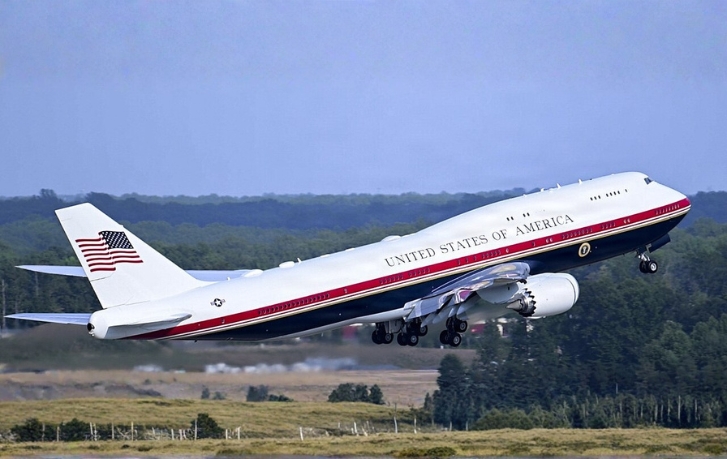
Air Force One Bridge Jet Starts Final Flights Before Presidential Use
The U.S. Air Force said Friday that its interim Boeing 747-8 presidential aircraft, known as the VC-25B Bridge aircraft, has been delivered to the Presidential Airlift Group at Joint Base Andrews and has started initial commissioning flights, the last validation phase before it can be officially added to the executive airlift fleet and used for presidential travel. In the service’s announcement, the Air Force said the jet had received a new red, white and blue livery and final government modifications before beginning the flights that White House officials will use to validate mission capability and complete protocols for safe and secure presidential transportation.

This matters because the Bridge aircraft is not a ceremonial extra. It is a fleet-relief measure for a mission that already runs on aging hardware. Joint Base Andrews’ 89th Airlift Wing handles the president’s broader executive-airlift mission, and the current top-end fleet includes two VC-25A aircraft alongside C-32s. The Bridge jet is meant to reduce pressure on that lineup until Boeing finishes the long-delayed next-generation VC-25B replacements.
The commissioning phase is the practical handoff from modification work to operational use. In plain terms, this is where a heavily customized aircraft stops being a conversion project and starts proving it can support the mission day to day. The Air Force did not say how many flights are required, and it did not say when the president would first use the aircraft. It did say the jet will not be officially commissioned into active service until those flights are complete.
That distinction matters on a presidential aircraft more than it would on a normal VIP transport. The platform has to function as secure transport, protected communications node, and continuity asset under tight procedures, not just as a long-range airliner with a government paint scheme. The Air Force said only that the aircraft underwent security modifications, used a disciplined engineering approach, and prioritized rigorous safety requirements. It did not disclose the specific systems that were added or changed, and that restraint is normal for this mission set.
What is clearer from the public record is the trade space. The Bridge aircraft is designed to provide near-term availability, not to duplicate every feature planned for the two purpose-built long-term VC-25B aircraft. That is the central operational compromise behind the program. The service has described the aircraft as suitable for secure presidential transport, but it is also using an accelerated path specifically because the main replacement effort slipped badly.
The original timeline for Boeing’s long-term Air Force One replacement was 2024. That has moved to 2028, with the delay tied to a shortage of properly cleared workers and supply-chain problems. Boeing has also had to absorb major overruns on the fixed-price program. Aviation Week reported that the company is still targeting 2028 for the first delivery and that the Air Force’s cumulative spending on the program has risen with additional contract actions and acceleration work, while Boeing continues to fund significant extra internal costs to keep the schedule moving.
The Bridge aircraft therefore solves a schedule problem more than a technology problem. It gives the Air Force another presidential-capable 747-8 sooner, even if the long-term fleet standard remains years away. That helps readiness, maintenance rotation, and mission coverage. It does not erase the fact that the permanent recapitalization plan is still unfinished.
Cost is the other reason this aircraft has drawn so much attention. Secretary of the Air Force Troy Meink told lawmakers in June 2025 that modifying the aircraft would cost less than $400 million. For an interim aircraft, that is a substantial public bill, but it also needs to be read against the mission requirement: this is not a cosmetic interior refresh. Presidential transport demands specialized communications, security integration, airworthiness work after modification, crew training, sustainment planning, and procedural validation before the airplane can be trusted with the country’s highest-profile mobility mission.
The Air Force’s training pipeline shows how much support work sits behind that public milestone. Pilots and maintainers began training last October using a leased Atlas Air 747-8F and later a purchased Lufthansa 747-8i as full-time crew-training resources. A three-dimensional mock-up of the Bridge aircraft interior was also delivered to the White House in January so staff could familiarize themselves with the cabin and workflow. Those steps matter because bringing a one-off aircraft into a mission fleet is as much about people, procedures, and maintainability as it is about hardware installation.
The politics around the aircraft are loud, but the cleaner engineering story is simpler: the Air Force needed a usable bridge because the purpose-built replacement program slipped four years. Gen. Ken Wilsbach said the service executed the effort on an accelerated timeline and delivered a secure, reliable airborne command post. That claim now moves into its most important public test phase. If commissioning flights finish cleanly, the Air Force gets near-term presidential-airlift margin. If they do not, the pressure stays on the aging VC-25A fleet and on Boeing’s 2028 deadline.
The bigger takeaway is that this aircraft is a readiness patch, not the end state. Starting commissioning flights is a meaningful milestone, because it turns an expensive conversion into a near-operational asset. But it also underlines the real issue behind the rush: the United States is still waiting for the full Air Force One replacement it expected years ago.
By David Whitaker — Associate editor for AMI’s aerospace and drone systems desk, translating flight systems, aircraft programs, spaceflight, and UAV developments into accessible technical stories.