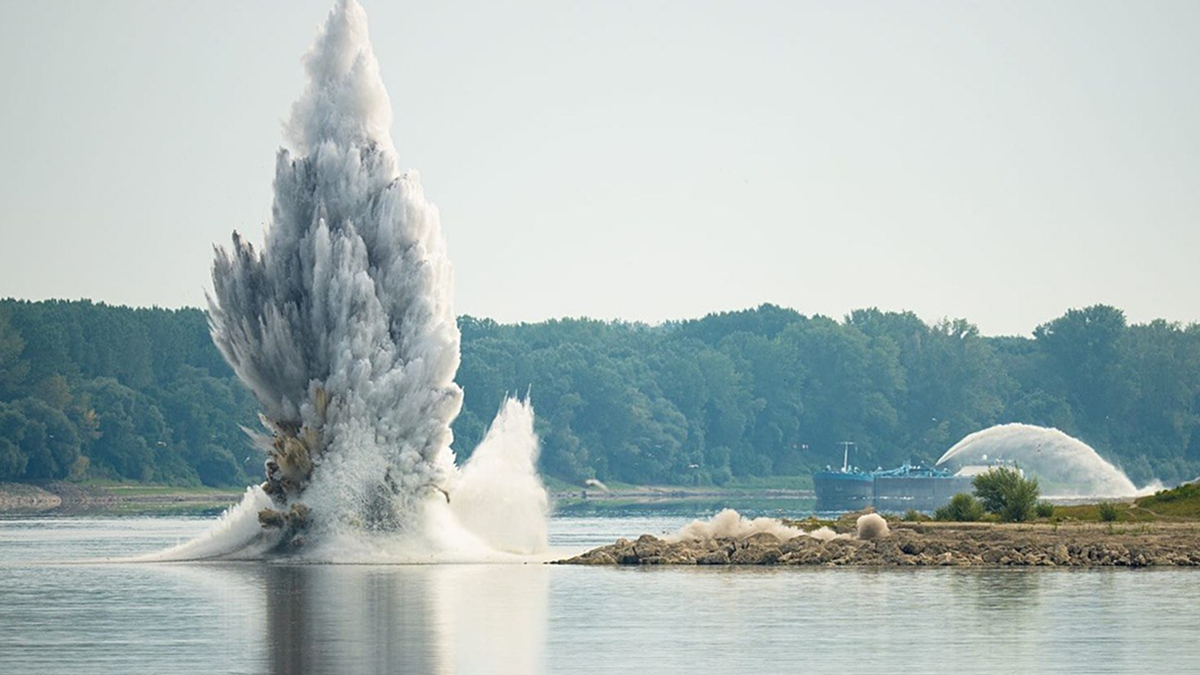
Romania Blasts Danube Rocks to Keep Cernavoda Reactor Supplied With Cooling Water
Romania conducted a controlled blast on August 3 to remove a rock outcrop and help keep cooling water flowing toward the last operating reactor at the Cernavoda nuclear plant. The civil-engineering intervention on the drought-depleted Danube is intended to support construction of a temporary dam that will direct more water into the channel serving the reactor.
The explosion itself does not provide the cooling-water supply. Its function was to clear an obstruction so crews could alter the limited river flow. Romania’s navy said the redirection work was scheduled for completion Wednesday, making water delivery not the successful blast the critical engineering result still to be confirmed.
Cernavoda normally supplies about one-fifth of Romania’s electricity. State-owned operator Nuclearelectrica had already shut one of the plant’s two reactors early the previous week as low Danube flow restricted the cooling-water supply. Keeping the second unit operating would preserve a substantial block of domestic generation while heat is raising electricity demand.
A river constraint becomes a grid constraint
The emergency work illustrates a basic systems-integration problem for water-dependent generation. A nuclear unit can have available fuel, functioning generating equipment and grid demand for its output, yet still be constrained by the condition of the external water source supporting heat removal. When river flow falls far enough, the limiting component is no longer inside the plant boundary.
The temporary dam is intended to concentrate more of the remaining Danube flow into Cernavoda’s intake channel. That may extend operation, but its benefit remains prospective until the work is completed and authorities verify that the redirected water is sufficient. The intervention manages the location of scarce water; it does not end the underlying drought or restore the river’s total flow.
Romania’s defense minister, Radu Miruta, said every additional operating day beyond Wednesday or Thursday would be a gain. He also claimed that one day of reactor operation would be three times more efficient than the operation’s cost, although no supporting calculation was provided. The more firmly established benefit is operational: each day of domestic nuclear production reduces immediate pressure to replace that electricity through imports or further demand cuts.
Hungary shows the scale of the same limitation
Upstream, Hungary’s 2-gigawatt Paks nuclear plant was operating at just over 10% capacity after the Danube reached a record low. Paks normally produces about half of Hungary’s electricity, but its last operating turbine was generating only 240 megawatts. Authorities said reduced operation might continue until Monday or Tuesday, after an earlier warning that a complete shutdown could be required as soon as Sunday.
That narrow extension matters because reduced river flow and high temperatures are affecting supply and demand at the same time. Nuclear output has fallen just as heatwave conditions have increased electricity consumption, leaving Romania and Hungary more dependent on expensive imported power. Paks therefore demonstrates the broader boundary on Romania’s river work: local channel engineering may buy time for one plant, but it cannot resolve a regional hydrological shortage.
Factories and consumers become part of the response
The power-system consequences have already moved beyond generating stations. Dacia and Ford vehicle plants in Romania temporarily suspended production until August 19, cutting electricity consumption by about 200 megawatts. The closures show how an external cooling-water limit can propagate through the grid and into industrial scheduling.
Hungary reported that voluntary reductions by households and companies lowered Sunday demand by 700 megawatts. Drugmaker Richter said it would cut its electricity consumption by more than 50% for three weeks and offer 4 megawatts per day from its solar-energy park. These measures effectively treat flexible demand as an emergency grid resource when normal generation is unavailable.
The immediate test now is whether the cleared channel and temporary dam deliver enough water to extend Cernavoda’s remaining reactor operation. Until that performance is verified, the blast is a completed enabling step not proof that the cooling constraint has been solved.
By Thomas Caldwell — AMI’s senior editor for mechanical and mobility engineering, covering vehicle electronics, systems integration, electrification, chassis systems, propulsion, and safety policy.