SwissDrones Plans U.S. Infrastructure Inspections, but Each Program Needs Federal Approval
SwissDrones and Xplorate Pacific have an aircraft, sensor package and operating model for long-range infrastructure inspection, but not a blanket authorization to deploy it across the United States. The companies announced August 7 that prospective U.S. operations will be introduced program by program under applicable Federal Aviation Administration approvals.
That distinction defines the opportunity and the constraint. Pipelines, powerlines and transportation corridors can extend far beyond a pilot’s direct view, making beyond-visual-line-of-sight operations central to the proposed service. The FAA identifies these flights as advanced operations that may require additional approval, rather than an automatic privilege attached to the aircraft or operator.
An inspection system extending beyond the aircraft
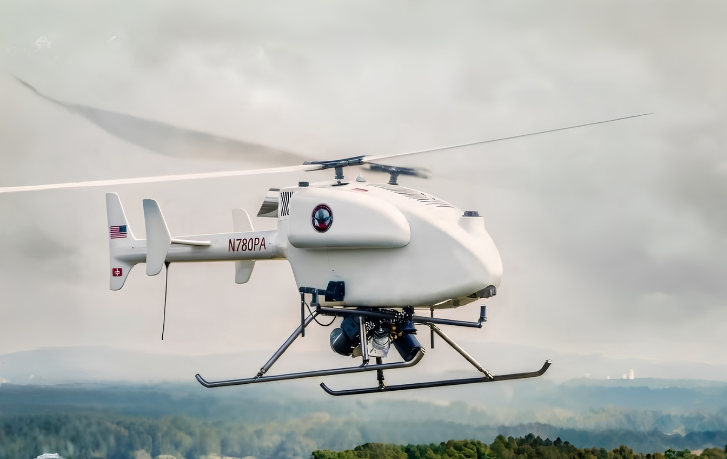
The proposed offering combines SwissDrones’ turbine-powered SDO 50 uncrewed helicopter with Xplorate’s operating personnel, regulatory experience, safety cases, sensor integration, analytics and data-delivery workflows. This aircraft-to-analytics structure matters because an infrastructure owner ultimately needs usable information about asset condition, emissions or damage not simply aerial access.
The commercially available SDO 50 can carry light detection and ranging, conventional color cameras, multispectral equipment and other industrial sensors. Methane detection is also identified as a potential application. Information gathered during a mission can be georeferenced, processed and delivered to engineering, asset-integrity, environmental and compliance teams.
That workflow places several systems inside one operating case. The aircraft must carry the required payload, while communications, trained crews, procedures and data handling must support the specific route and customer requirement. Satellite-enabled command and control may help where terrestrial communications are limited, but its use would still depend on mission-specific approvals and safety requirements.
Industrial customers need more than an aircraft. They need a complete operating capability that combines aircraft performance, regulatory approvals, trained personnel, sensor integration, and data delivery, Group CEO Larry Berkin said. He added that the companies will approach the U.S. market program by program, with safety, regulatory compliance and customer requirements determining each operating model.
Australian operations establish experience, not U.S. permission
Xplorate already operates the SDO 50 on recurring commercial missions along a 550-kilometer pipeline corridor in Queensland, Australia. It also holds an authorization covering roughly 58,000 square kilometers of Queensland’s Surat Basin. Subject to its operating conditions, that authorization permits day and night flights beyond visual line of sight around pipelines, powerlines, well sites, processing facilities and other remote assets.
That record demonstrates experience with long corridors, industrial payloads and broad-area operations. It does not transfer Australian operating authority into U.S. airspace. Any American deployment would need to fit the FAA pathway applicable to its aircraft, location, airspace, operating concept and risk controls.
The FAA’s own integration work illustrates why that boundary matters. Phase 1 of its BEYOND program recorded 70,563 flights, including 48,383 beyond visual line of sight. Phase 2 began in 2025 and runs through 2029. The program is intended to collect operational data, develop performance-based standards and help move suitable operations from individual waivers toward established rules. Those totals show substantial U.S. flight activity, but they do not create universal operating authority for a new entrant.
A larger aircraft is being developed for more demanding operations
SwissDrones is separately developing the SD120 with increased payload, endurance, redundancy and system assurance. Chief Technology Officer Lukas Obrist said the larger aircraft builds on the operating experience and engineering foundation of the SDO 50, with the objective of supporting more demanding regulatory and customer requirements.
The SD120 is being engineered to support operations targeting SAIL IV under Europe’s Specific Operations Risk Assessment framework. SAIL IV is an operational-risk target, not aircraft certification, and SwissDrones has not disclosed a commercial-availability or certification date for the model. The SDO 50 therefore remains the commercially available platform behind the current U.S. plan.
SwissDrones and Xplorate also intend to establish customer-support capabilities closer to North American operators. That local support could become important for training, payload integration, maintenance coordination and consistent data delivery. Before those functions can underpin recurring long-range inspections, however, each proposed U.S. program must connect its aircraft, communications, crew, sensors and safety case to the specific federal approvals governing the operation.
By Stephen Wallace — Editor for AMI’s aerospace integration and unmanned mobility coverage, focused on drone manufacturing, VTOL systems, autonomous networks, and air-ground mobility links.