Toyota expands U.S. safety research after 100 projects, ties studies to design changes
Toyota’s safety model in Michigan starts with a systems-engineering premise: use detailed simulation to narrow the problem, maintain tightly controlled physical test hardware to validate it, and bring outside researchers in where biomechanics, sensing, or human behavior data can sharpen the result. That approach is now expanding in the U.S. after the company’s Collaborative Safety Research Center completed its 100th project last year and announced 10 new projects with universities and research firms.
At Toyota’s North American Research and Development Headquarters in York Township, the company is presenting that workflow as more than a research showcase. The 180,000-square-foot site, described as a $187 million facility in 2007 dollars, combines crash infrastructure, dummy calibration, simulation, and partner-led studies under one roof. Jason Hallman, the center’s senior manager, said most of the work is aimed at accident prevention and injury mitigation, with the stated goal of understanding crashes through holistic, evidence-based research.
The mechanism matters because Toyota is not claiming that every collaboration directly becomes a production change. In the examples it highlighted, some projects have already informed a response, while others remain investigative. That distinction is important for readers trying to separate implemented engineering action from longer-horizon safety science.
The clearest implemented example involves pedestrian automatic emergency braking. A cited study found a 32% reduction in pedestrian crashes during the day and on roads with streetlights, but no reduction on dark roads. Toyota said it responded by adding millimeter-wave radar and higher-resolution cameras to Toyota Safety Sense to improve pedestrian detection in low- and no-light conditions. In engineering terms, that is a direct chain from field performance limits to sensor-suite revision, not a generic statement that safety is a priority.
The next layer is how Toyota develops and checks those changes. Zhaonan Sun, a principal scientist at the center, said much of the work now happens in simulation rather than through nonstop physical testing, saving time, material, and money. For front-end pedestrian protection work, Sun said engineers simulated stiff versus more flexible materials before confirming the design with real-world testing. The company uses the Toyota Human Model for Safety as its virtual body model, which lets engineers study injury mechanisms before committing to repeated hardware builds.
That simulation-first workflow does not reduce the importance of physical validation; it raises the bar for test control. Toyota’s crash hall captures tests at up to 2,000 frames per second and uses lighting that can generate 20,000 lux so deformation and occupant motion can be resolved clearly. A camera aimed upward through the floor sits below 8 inches of acrylic for protection. Those details are not cosmetic. If a team is trying to correlate simulation, structural deformation, and injury metrics, image quality and sensor repeatability become part of the measurement system, not just documentation.
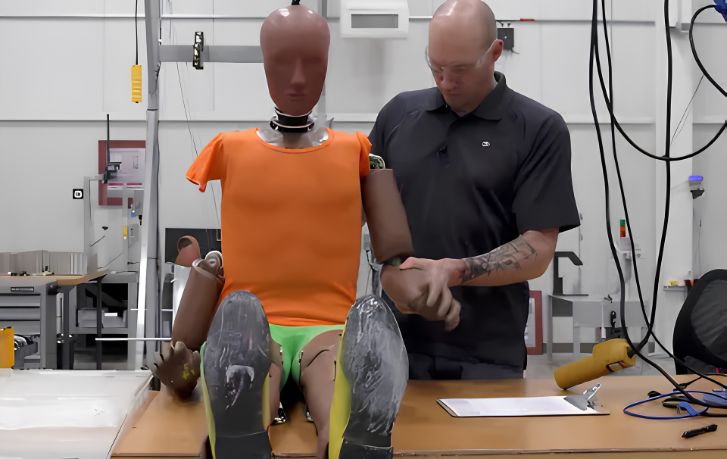
The same is true in the dummy lab. Toyota keeps more than a dozen crash-test dummies at the site, with each unit described at roughly $1.5 million to $1.6 million and built by Humanetics. Maintaining them is a full-time calibration task. The room is humidity-controlled, dummy skin has a defined service life, and each dummy must stay within specification for neck flexion, rib deformation, head response, shoulder rotation, lumbar behavior, and femur performance. Hallman said developing those standards took extended collaboration with government and other stakeholders, a reminder that safety research only scales into regulation and benchmarking if the test articles themselves are controlled and comparable.
Some of the newly announced work shows where Toyota still sees open problems rather than settled answers. A Purdue University project will study whether micro-Doppler radar paired with novel artificial intelligence models can improve vulnerable road user detection. Touchstone Evaluations will analyze real-world driving data on how a driver’s speed relative to surrounding traffic influences the behavior of other drivers. A University of Michigan-Dearborn collaboration will examine whether vehicle-to-network communication can provide earlier hazard warnings using existing national and international data and crash records.
The University of Virginia work shows the same discipline around uncertainty. Researchers there examined a major injury disparity in some frontal crashes, where female drivers faced up to three times the likelihood of injury in the context studied. One tested explanation did not hold: footwear was not the factor behind the difference. That is scientifically useful even without an immediate product change, because ruling out an intuitive but unsupported explanation helps keep future countermeasures focused on the actual injury mechanism. The next Virginia project will examine how foot posture affects ankle injury risk prediction, with attention to footwell designs that could reduce injuries.
Toyota’s physical infrastructure also reflects a broader safety-management issue now affecting the industry: electrified-vehicle testing changes emergency planning inside the lab itself. For electric-vehicle crash work, engineers developed a method to move a burning vehicle and its fumes outside quickly using a forklift with a boom that extends 14 feet while lifting 10,000 pounds, paired with a fast-opening garage door. That aligns with a wider industry reality that EV incident response is still evolving; the U.S. Fire Administration notes that credible, universally accepted response guidance remains limited as battery designs and hazards vary.
The practical takeaway is not that collaboration alone makes vehicles safer. It is that Toyota is building a repeatable U.S. process for turning outside research into internal models, calibrated test methods, and, in at least some cases, specific sensing or injury-mitigation changes. After 100 completed projects and 10 more now underway, the harder question is no longer whether that pipeline exists. It is how many future studies will produce the same kind of traceable path from research finding to validated design response.
By Thomas Caldwell — AMI’s senior editor for mechanical and mobility engineering, covering vehicle electronics, systems integration, electrification, chassis systems, propulsion, and safety policy.