Airbus and Boeing Test Faster Composite Curing, but Assembly Remains the Bottleneck
Removing the autoclave will not, by itself, make composite airframes suitable for single-aisle production. Airbus and Boeing are evaluating lower-infrastructure curing methods, but the harder industrial problem extends across material deposition, joining, trimming, drilling, inspection and process control. Every stage must repeatedly produce acceptable parts without allowing labor, rework or factory equipment to grow in proportion to output.
The rate disparity explains the urgency. Current widebody composite methods support production on the order of five to 10 aircraft per month. A future narrowbody program could demand 70 to 100 aircraft monthly. Neither manufacturer has demonstrated or publicly committed to that output for a new composite single-aisle aircraft, and neither has selected a single out-of-autoclave material or process.
Why the proven autoclave route is difficult to scale
An autoclave cures resin-impregnated carbon-fiber layups under tightly controlled heat and pressure. The process has a strong aerospace service record, but its industrial footprint is substantial. Additional capacity means more pressure vessels, building space, pressurization equipment and thermal-management infrastructure. Cure cycles also occupy a large, expensive machine for a defined period, limiting how easily a factory can add throughput.
Boeing chief technology officer Lane Ballard has framed the target as first-pass quality at very high rates without the extensive infrastructure traditionally associated with composites. Boeing is researching both autoclave and out-of-autoclave routes, and has not announced a firm timetable for a new single-aisle aircraft. That distinction matters for the U.S. aerospace manufacturing base: the work is technology maturation, not confirmation of a new Boeing airplane or its production system.
Three alternatives move pressure, heat and labor differently
Thermoplastic composites replace the permanently cured resin behavior of conventional thermosets with a matrix that softens when heated and hardens as it cools. That enables reheating and potentially welding completed structures. Induction, ultrasonic and resistance welding are among the joining methods under evaluation. If industrialized, welded joints could reduce drilling and the number of mechanical fasteners, shortening assembly while removing some sources of part count and weight.
The tradeoff is that welding must deliver controlled heat, pressure and joint quality across production-scale structures. A rapid joining process is valuable only if its bond can be inspected, repeated and documented with the consistency required for certification.
Resin transfer molding uses dry carbon-fiber preforms placed inside a closed mold. Resin is then injected under pressure. This separates fiber placement from resin introduction and can support more integrated shapes, but manufacturing control must extend to resin flow and consistent impregnation throughout the part.
Out-of-autoclave prepregs retain resin-impregnated reinforcement but cure in conventional ovens at lower pressure. They can reduce dependence on large pressure vessels, although oven curing does not eliminate tooling, thermal control or the need to verify that completed laminates meet structural and quality requirements.
Automation cannot stop after tape placement
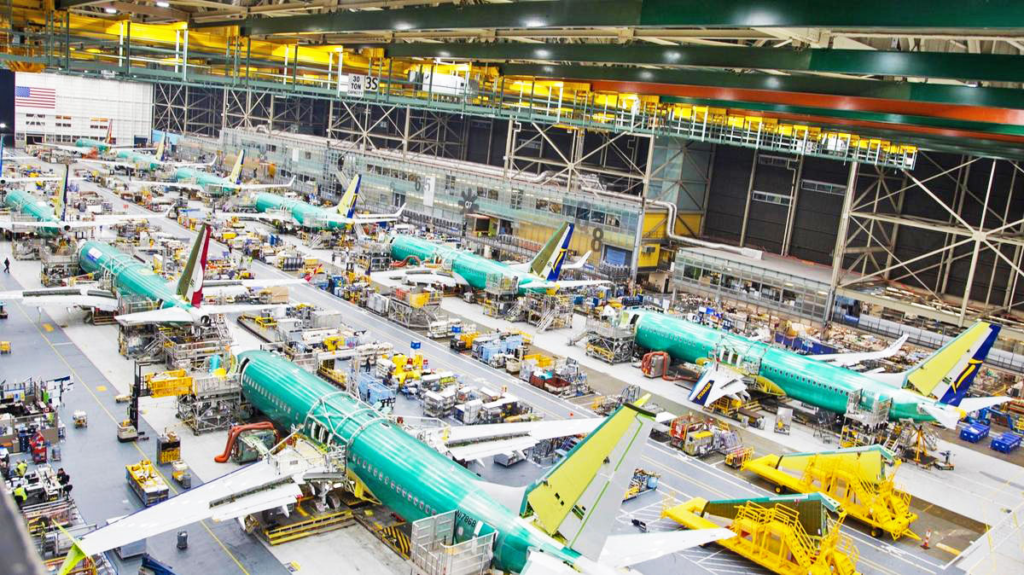
Automated fiber placement already deposits composite tape, but downstream operations remain a rate constraint. Trimming, drilling and nondestructive inspection still consume significant labor. At 70 to 100 aircraft per month, a process that merely accelerates layup could transfer the queue to machining, assembly or inspection rather than increase completed-aircraft output.
Airbus is developing these connected capabilities through Wing of Tomorrow. According to the Aerospace Technology Institute’s program update, the work has integrated more than 100 technology elements through three full-size, 17-meter wing demonstrators. The program combines high-rate out-of-autoclave structures with automated assembly, digital manufacturing and build concepts intended to reduce cycle time and complexity. Those demonstrators establish meaningful physical scale, but they do not prove monthly production of 70 to 100 aircraft.
Material suppliers are another part of the production system. Toray, Hexcel and Solvay provide carbon-fiber and resin-system expertise relevant to future processes. Whichever route advances will require material behavior, storage, handling and cure or consolidation characteristics compatible with high-rate factory operations not merely strong laboratory coupons.
For U.S. manufacturers and suppliers tied to Boeing, the unresolved decision is therefore broader than autoclave versus oven, mold or thermoplastic welding. A viable process must connect fast layup to repeatable joining, efficient inspection and certifiable first-pass quality. Until that complete chain works at the intended cadence, eliminating the pressure vessel only removes one bottleneck from the factory.
By Edward Collins — Senior editor for AMI’s performance systems and mechanical design coverage, focused on powertrains, drivetrain systems, manufacturing precision, materials, and high-performance engineering.