EU Motors Plans Florida Stator Automation to Tighten Drone Motor Quality Control
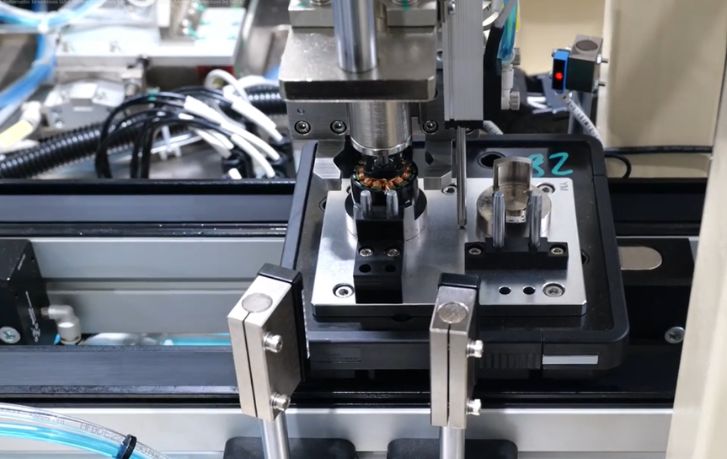
The stator is the stationary electromagnetic core of a brushless drone motor, and its construction directly shapes how consistently that motor can be manufactured. EU Motors plans to bring stator production and company-built robotic assembly together at its Hallandale Beach, Florida, facility in the fourth quarter of 2026. If executed as described, the combination could give the company tighter control over a critical propulsion component, assembly repeatability and production traceability under one U.S. roof.
The plan would unite three elements in Florida: EU Motors’ proprietary motor designs, custom automation and stator manufacturing. The company already operates automated production facilities in Hallandale Beach and Krakow, Poland, producing brushless direct-current propulsion systems for commercial and defense unmanned aircraft.
Bringing those operations together can shorten the feedback loop between motor engineering and manufacturing. When a stator design, winding process or assembly step changes, an integrated factory can potentially move the revision into production without coordinating across an outside component supplier. Robotic assembly can also support more repeatable process control at higher volumes. Those are potential manufacturing benefits, however, not proof that the finished motors will deliver better efficiency, durability or flight performance.
Capacity claims need operating data
EU Motors says it is on track to manufacture more than 350,000 motors during 2026 and has a confirmed production pipeline exceeding one million units for 2027. It also reports installed automated capacity of 100,000 motors per month, equivalent to 1.2 million units over 12 months if the equipment ran at that rate continuously.
Those figures describe different things. A production target is not completed output, a pipeline is not necessarily delivered volume, and installed capacity does not reveal utilization or yield. EU Motors has not disclosed current factory utilization, contract terms, customer identities or how production is divided between Florida and Poland. It also says its existing floor space could accommodate a rapid doubling of output, but has not provided the equipment, staffing or capital requirements behind that projection.
That missing information matters to drone manufacturers qualifying propulsion suppliers. Nominal monthly capacity establishes a useful ceiling, but production readiness also depends on acceptable yields, process stability, component availability and the ability to maintain consistent output across batches. Customers would need validation data before treating the planned Florida line as demonstrated million-unit production capability.
Localization reaches beyond final assembly
The industrial significance is that EU Motors proposes to localize more than final motor assembly. Producing the stator and building the robotic cells internally could reduce reliance on outside manufacturing stages while giving the company direct responsibility for the tooling and process used to assemble its motors.
This approach reflects a broader effort to localize drone propulsion. In France, automotive supplier Valeo plans to begin producing a drone motor for Harmattan AI in early 2027. Valeo says that design can operate without heavy rare earths, addressing a different part of propulsion supply-chain dependence. The comparison shows that local assembly, stator production and magnet-material strategy are separate engineering and sourcing questions.
EU Motors identifies the fifth generation of its 3115 motor as its flagship design and reports serving more than 105 commercial and defense customers across over 20 countries. It also says it is an NCAGE-coded supplier. Neither customer count nor supplier coding independently establishes domestic content, motor performance or production quality.
Claims that EU Motors is the only Western drone-motor producer manufacturing its own stators, that its motors outperform alternatives and that the Florida expansion will enable wholly American production remain unverified. The last claim would require visibility into the origin of magnets, copper, bearings, electronics and other inputs, not only the location of stator fabrication and final assembly.
The company expects the expansion to create skilled South Florida manufacturing jobs beginning in the fourth quarter, but it has not disclosed a job count, investment figure or commissioning schedule. The decisive milestone will therefore be the Florida line entering operation with documented output, yield and component traceability not the one-million-unit pipeline alone.
By Stephen Wallace — Editor for AMI’s aerospace integration and unmanned mobility coverage, focused on drone manufacturing, VTOL systems, autonomous networks, and air-ground mobility links.