James Webb Finds Three Feeding Black Holes in One Young Galaxy
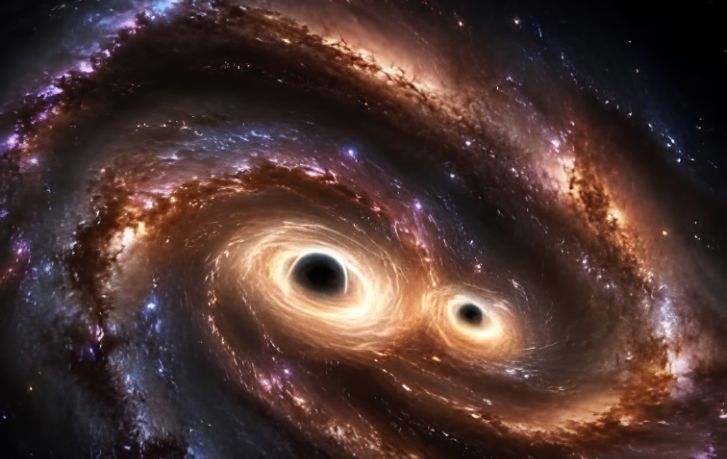
The James Webb Space Telescope has identified three actively feeding supermassive black holes in a single galaxy seen roughly 1.2 billion years after the Big Bang. The international team led by the Max Planck Institute for Extraterrestrial Physics describes the observation as the first evidence of three active black holes sharing one galaxy in the distant universe.
The striking comparison is not simply three against one. At the center of galaxy J0148-4214, an estimated 80-million-solar-mass black hole is accreting material more slowly than a companion with only about 600,000 times the Sun’s mass. That smaller member is feeding at an exceptionally high rate above the maximum predicted by basic black-hole growth theories even though its larger neighbor outweighs it by more than 130 to one.
Three black holes, three different positions
J0148-4214 lies more than 12.5 billion light-years from Earth. Because its light took that long to arrive, Webb is observing the galaxy during an early period of cosmic development rather than as it exists today.
The largest and smallest black holes occupy the galaxy’s central region, with a projected separation of about 620 light-years. Researchers expect that pair to merge within the next few hundred million years. That is comparatively fast on a galactic timescale, but it is not an imminent event by human standards.
The third active black hole has an estimated mass of 2 million Suns and sits about 5,500 light-years from the galactic center. It may eventually join the central system, but its outlook is less certain. Researchers have proposed that it could be moving inward, could be left over from an earlier merger or could have been displaced from the center during a previous gravitational interaction. Its direction of motion has not been established, so a three-stage merger cannot yet be treated as a confirmed outcome.
Webb separated signals that would otherwise look like one source
Webb did not resolve the two central black holes as distinct point-like objects. Instead, its spatially resolved spectroscopy detected spectral fingerprints from hydrogen moving rapidly within the black holes’ gravitational environments.
The central spectrum contained a complex structure best explained by two nearby active black holes. The team then used spectro-astrometry, which measures small positional shifts in line emission, to separate the central sources and determine their locations. A third signature appeared farther from the center.
That measurement capability is central to the result. According to the researchers, observations without the spatial information supplied by Webb’s near-infrared spectrograph would likely have identified only one of the three black holes. In practical terms, the telescope turned what could have appeared to be a single active galactic nucleus into a mapped multiple-black-hole system.
A contrast between growth by feeding and growth by merging
The trio places two black-hole growth mechanisms in the same early galaxy. All three are gaining mass through accretion, while the close central pair is also expected to combine through a merger. The unusually rapid feeding of the 600,000-solar-mass member shows that present mass alone does not determine which black hole is growing fastest at a given moment.
The observations support but do not settle the interpretation that galaxy interactions helped massive black holes gather and grow efficiently in the early universe. Lead author Hannah Übler said the system could be setting the stage for the kinds of massive-black-hole mergers that future gravitational-wave observatories are intended to detect.
For now, the firm result is narrower and unusually concrete: one young galaxy contains three active black holes with estimated masses of 80 million, 2 million and 600,000 Suns. The central pair is expected to merge, while the fate of the outer member remains the decisive unanswered part of the system.
| More aerospace and engineering stories, right in your MSN feed. Follow AMI on MSN |
By David Whitaker — Associate editor for AMI’s aerospace and drone systems desk, translating flight systems, aircraft programs, spaceflight, and UAV developments into accessible technical stories.