Chinese State Firm Reportedly Sent Russia Material for Hundreds of Drones
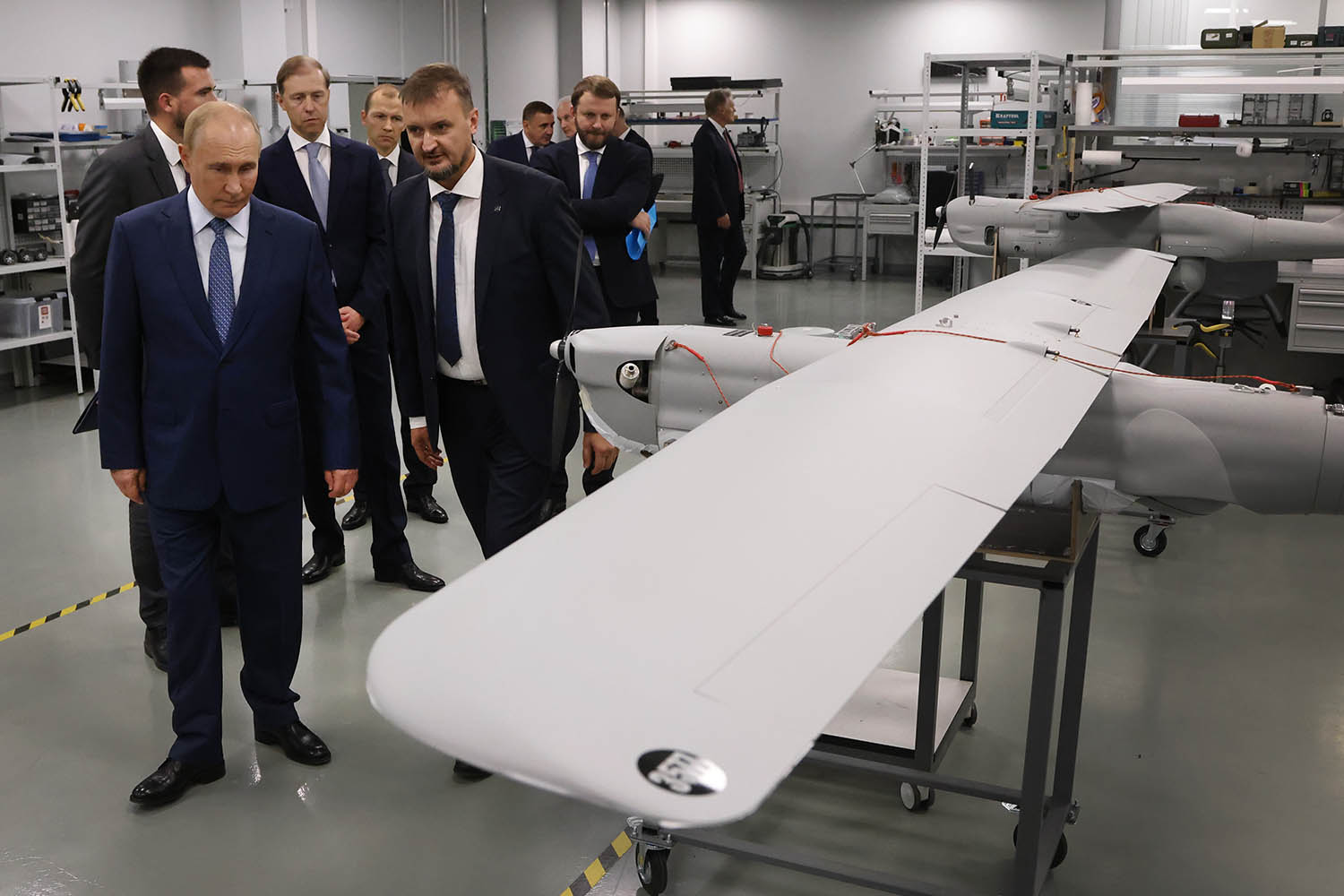
Internal shipping and customs records reportedly document a 46-ton shipment of carbon-fiber precursor chemicals from China’s state-owned Jilin Chemical Fiber Group to Russia. An expert who has studied drone production at the receiving industrial complex estimated that the material could yield enough carbon fiber for as many as 1,300 one-way attack drones turning what looks like a bulk industrial order into a potentially significant input for Russia’s Shahed-derived production system.

The records reportedly trace a direct shipment from Jilin’s warehouse to Alabuga-Volokno, a subsidiary of Russian state nuclear corporation Rosatom, while using a customs code associated with civilian synthetic fibers such as nylon and polyester. That combination state ownership, a named state-linked recipient, bulk precursor material and alleged misclassification provides stronger evidence of upstream supply and potential sanctions evasion than earlier findings of Chinese components recovered from drone wreckage.
The documents were obtained by the Kyiv-based Ukrainian Security and Cooperation Centre and reviewed by POLITICO. According to the investigation, the U.S. House Select Committee on China reviewed them and determined they were legitimate, while a Ukrainian official said Ukraine’s government had confirmed their authenticity. Britain’s Foreign Office also reviewed the records without disputing the findings. Those assessments do not by themselves establish a final legal judgment about sanctions evasion, but they add weight to the underlying shipment record.
Rosatom rejected the allegations, saying its enterprises comply with applicable laws and regulatory requirements. Jilin Chemical Fiber Group did not respond to repeated requests for comment. China’s embassy in Washington said accusations of support for Russia’s weaponized-drone program “smear and scapegoat China,” adding that Beijing has not supplied lethal weapons to either side and strictly controls dual-use goods.
Why the material matters
The cargo was identified as polyacrylonitrile tow, commonly called PAN precursor. It is the feedstock used to make high-performance carbon fiber: a lightweight, stiff material suited to reinforced airframe structures. David Albright, president of the Institute for Science and International Security, said the material is critical to producing carbon fiber used to strengthen drone wings and internal structures, including areas around the fuel tank and engine.
The records describe two 40-foot containers carrying up to 46 tons for manufacturing purposes. Albright estimated that volume could support carbon-fiber production for as many as 1,300 drones. That figure is an expert estimate, not a confirmed count of completed aircraft, and actual output would depend on processing yield, part design, waste and how much material each airframe consumes. Even with those limits, the shipment’s scale is industrial rather than experimental.
This is also a different supply-chain problem from finding a foreign microchip or motor inside a recovered drone. Electronics can pass through distributors, intermediaries and shell companies, complicating attribution. Here, the records reportedly identify the warehouse addresses at both ends and name Alabuga-Volokno, part of Rosatom’s UMATEX advanced-materials division, as the recipient. Alabuga-Volokno supplies structural carbon fiber to Russian industry and has been subject to Western sanctions since 2023.
The customs classification is therefore central. PAN precursor can serve civilian as well as military manufacturing, but the investigation says the shipment used a code for nylon and polyester rather than the code that would identify PAN fiber as a dual-use item. Former U.S. Treasury official Kerri Bitsoff characterized that pattern as a controlled product moving under a plausible civilian cover category. Ukraine considers the documents evidence of potential sanctions evasion; no new sanctions decision was reported.
A production-chain issue, not just a parts issue
Chinese-origin engines, servomotors, gyroscopes and electronics have previously been identified in newer Russian Shahed-type drones. Some turbojet variants reportedly approach 300 mph, roughly three times the speed of older propeller-driven versions. Ukrainian officials have said that speed can exceed the capability of some lower-cost interceptor drones, potentially shifting engagements toward fighter aircraft or scarcer air-defense missiles.
That performance tension makes upstream materials consequential. A faster design still requires repeatable airframe production, quality control and a dependable flow of structural feedstock. Supplying PAN precursor does not prove that the exporter designed a drone or controlled its final use. It can, however, sustain the manufacturing layer beneath engines and electronics the less visible part of a production system that determines whether upgraded aircraft can be built in volume.
The Ukrainian center says it has tracked at least eight tenders for containerized PAN-precursor shipments from Jilin to Alabuga-Volokno since 2022. The newly disclosed 46-ton record is therefore important not merely because of one cargo load, but because it may indicate a recurring channel. The next consequential step is whether governments treat the documented routing and customs classification as sufficient grounds for enforcement against the supplier or associated intermediaries.
| More aerospace and engineering stories, right in your MSN feed. Follow AMI on MSN |
By Stephen Wallace — Editor for AMI’s aerospace integration and unmanned mobility coverage, focused on drone manufacturing, VTOL systems, autonomous networks, and air-ground mobility links.