




Five U.S. Military Runway Projects Range From $20.4 Million to Over $400 Million
Five U.S. military airfields are receiving runway projects ranging from $20.4 million to more than $400 million as deteriorated pavement, heavier aircraft, storm recovery and Pacific operating needs reshape aviation infrastructure. The work supports aircraft including the F-15EX, KC-46, B-21, F-35 and RQ-4B, but it also brings substantial public costs, temporary operational disruption and disputes involving land and wetlands.
The projects are not interchangeable. Selfridge Air National Guard Base in Michigan is changing its airfield geometry for larger incoming aircraft. Ellsworth Air Force Base in South Dakota rebuilt pavement and supporting systems ahead of a planned bomber transition. Tyndall Air Force Base in Florida is refurbishing two runways as one part of its recovery from Hurricane Michael. Grand Forks Air Force Base in North Dakota resurfaced weathered pavement, while North Field on Tinian is being restored after decades without regular airfield use.
Selfridge: New aircraft require a larger movement area
Michigan is funding a $152 million project to relocate and extend Selfridge’s existing 9,000-foot runway and add two connecting taxiways. The base is scheduled to begin receiving F-15EX fighters and KC-46 tankers in 2028, making aircraft size, weight and ground-movement geometry central design considerations rather than secondary upgrades.
The runway work sits within a broader Selfridge modernization package that includes nearly $1 billion in federal funding and grants, but that larger amount should not be treated as runway spending alone. The airfield project requires the relocation of Rosso Highway and local utility lines and is expected to affect between six and nine acres of wetlands. Funding responsibility, compensation for land and environmental effects have consequently become part of the infrastructure decision.
That combination illustrates why introducing an aircraft is not simply a matter of parking it at an existing base. Runway length is only one parameter. Taxiway connections, clear areas, utility placement, pavement loading and nearby transportation corridors can determine whether an established airfield can support a new fleet without major reconstruction.
Ellsworth: A $129.5 million rebuild for the B-21 transition
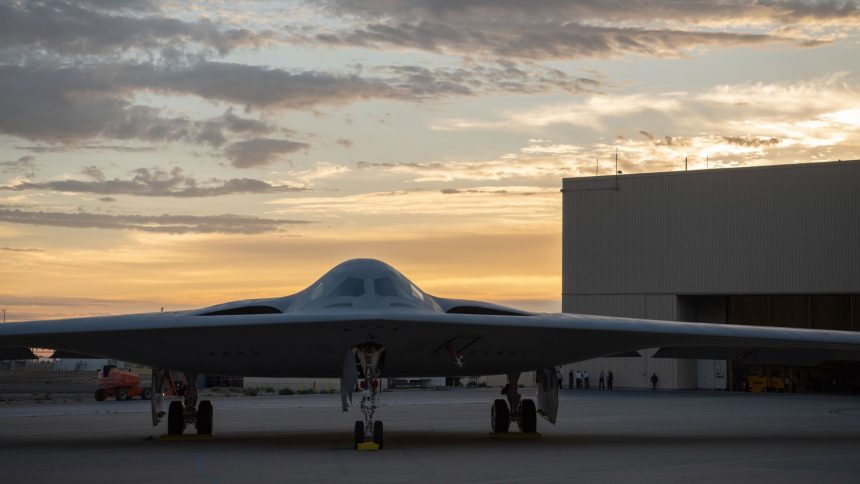
Ellsworth completed its $129.5 million reconstruction in December 2025, ten months after work began. The project upgraded the 13,497-foot runway in preparation for the anticipated arrival of the first operational B-21 in 2027. It replaced the upper 12 inches of the center keel, rebuilt both overruns, refurbished taxiways and installed upgraded lighting.
The material scale was substantial: 106,000 tons of concrete cement, 105 miles of joint sealing and 83 miles of electrical conduit. Those figures show that a runway rebuild is also an electrical, drainage, lighting and maintainability project. Concentrated loading along the center portion and repeated aircraft movements make pavement structure and joint condition essential to service life.
Construction also imposed an immediate readiness cost. Seventeen B-1B bombers and roughly 800 personnel were temporarily displaced to Grand Forks. Ellsworth therefore demonstrates the scheduling problem common to major airfield work: the infrastructure must be taken out of service to preserve its future utility, requiring aircraft, personnel and support functions to operate elsewhere.
Tyndall and Grand Forks: Resilience versus pavement life
Tyndall’s two-runway refurbishment belongs to a much wider $5 billion reconstruction following Hurricane Michael, which damaged 484 buildings in 2018 and generated 792,450 cubic yards of debris. The $5 billion figure covers the broader base rebuild not only its runways. Tyndall received its first F-35A in August 2023 and is planned to host three squadrons totaling more than 70 operational aircraft.
Here, the controlling requirement is resilience as much as aircraft compatibility. Rebuilding the base as an “Installation of the Future” links runway availability with hardened, modernized supporting infrastructure. The engineering challenge is system-wide: flight operations depend on power, communications, maintenance, access and buildings as well as usable pavement.
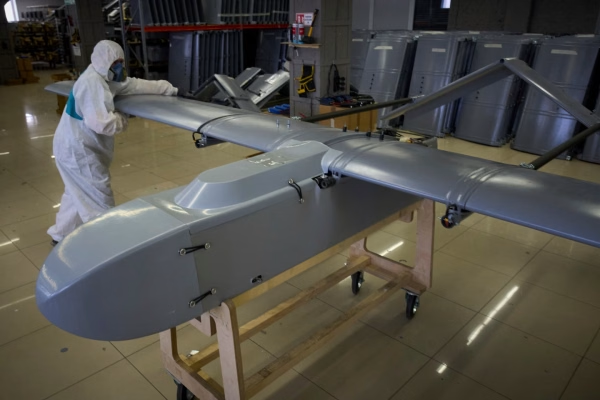
Grand Forks represents a narrower pavement-life problem. A $20.4 million project replaced 10,270 feet of surface on its 12,351-foot runway after cracking, weathering and rounded groove edges made resurfacing necessary. The runway reopened on September 9, 2026, almost two weeks ahead of schedule, although the return date for its temporarily relocated RQ-4B Global Hawks had not been determined. The previous surface lasted 21 years with extensive crack sealing, well beyond its original seven-to-10-year life expectancy.
Tinian: More than $400 million restores geographic options
North Field on Tinian had not operated as an airfield since 1946 before renewed military activity. More than $400 million was committed in 2024 to clear vegetation and repave movement areas, with two 7,874-foot runways expected to be fully refurbished by 2027. Initial flight operations began in late May 2026 for joint-force training, while restoration continued. A related $133 million construction effort documented by the Air Force includes runway-restoration support, shelters, debris clearance and other work across approximately 2,500 acres.
Tinian differs from the four stateside bases because the principal value is geographic flexibility rather than accommodating one named incoming aircraft. Restoring an abandoned airfield adds operating options, but remote construction increases the importance of labor, material delivery and sustained maintenance after the initial capital work is finished.
Across all five airfields, new aircraft are only part of the cost driver. Pavement age, storm resilience, taxiway geometry and location can be equally decisive. The unresolved policy question is not whether runways require maintenance, but how infrastructure benefits should be balanced against public cost, operational disruption, private-land effects and environmental impacts especially when a fleet decision creates construction obligations far beyond the aircraft purchase itself.
| More aerospace and engineering stories, right in your MSN feed. Follow AMI on MSN |
By Thomas Caldwell — AMI’s senior editor for mechanical and mobility engineering, covering vehicle electronics, systems integration, electrification, chassis systems, propulsion, and safety policy.


