





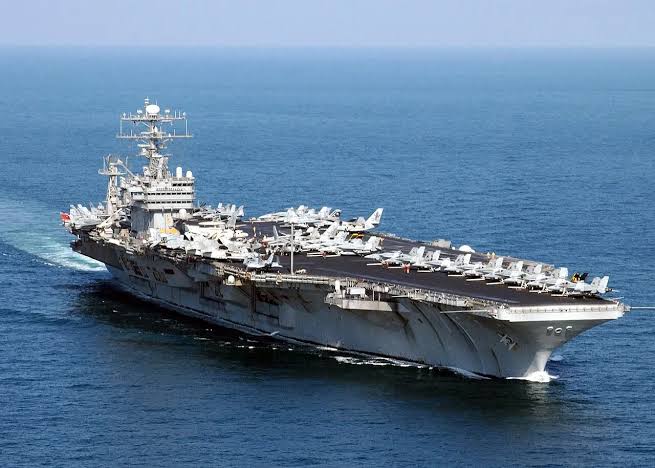
USS Abraham Lincoln’s Supply Network Now Reaches Diego Garcia
After losing access to previous Middle East logistics ports, the U.S. Navy is moving parts and supplies from as far away as Diego Garcia, a remote island in the central Indian Ocean. The longer supply chain has pushed the service to expand Military Sealift Command’s regional presence, a change that puts the logistics strain illustrated by USS Abraham Lincoln’s extended deployment into a broader fleet context.
Ships are also deploying with more spare parts and conducting more repairs at sea. Together, those changes show how the Navy is responding when established shore support is unavailable: it is adding sealift capacity, carrying more material aboard each warship and shifting some maintenance away from ports and shipyards. Lincoln’s nine-month deployment demonstrated why that matters even for a nuclear-powered carrier built to remain at sea for long periods.
Nuclear propulsion removes one major endurance constraint, but it does not make a carrier self-sufficient. Roughly 5,000 sailors and other personnel aboard Lincoln still depended on regular deliveries of food, hygiene products, aviation supplies, repair parts and other consumables. MS NOW reported prolonged shortages of toothpaste, deodorant and soap after normal access to regional logistics facilities was disrupted, although Defense Secretary Pete Hegseth disputed claims that the carrier had supply problems.
The Pentagon had not confirmed reported missile damage to the Navy base in Bahrain at the time of that account. Regional shipping restrictions reportedly compounded the disruption. The precise severity and duration of shortages aboard Lincoln therefore remain disputed, but the newly described Navy response confirms the larger operational problem: losing established logistics ports lengthens the chain between inventories ashore and ships at sea.
Distance consumes replenishment capacity
A supply ship’s value is not determined only by how much cargo it carries. Transit time, loading time, transfer windows and the return trip all determine how frequently it can support deployed vessels. When the shore end of that circuit moves much farther away, the same replenishment fleet completes fewer delivery cycles over a given period.
That effect creates a capacity problem rather than merely an inconvenience. More Military Sealift Command presence can add lift and reduce pressure on individual supply ships, but it also requires mariners, vessels, maintenance and coordination. According to an official Military Sealift Command account of its regional support, MSC draws on combat logistics ships, chartered vessels and a workforce that includes civil-service and contract mariners as well as shore and military personnel.
The Diego Garcia supply link adds geographic redundancy after access to closer ports was lost, but redundancy purchased through distance has a cost. Cargo spends more time in transit, ships and crews accumulate more operating hours, and planners must hold enough inventory to cover a longer and less predictable replenishment loop. That is why carrying additional spares aboard deployed warships is a direct response to the changed network rather than simply extra insurance.
More repairs at sea shift the maintenance burden
Extra spares are useful only if crews can identify faults and complete suitable repairs away from a yard. Navy officials say ships in the region are learning to perform more work at sea, while the service is developing sailors with higher repair skills and experimenting with new diagnostic and planning tools. This can keep equipment operating until more extensive work becomes available, but it cannot eliminate depot-level maintenance.
The constraint moves downstream. Extended deployments and deferred maintenance can preserve forward presence in the short term, yet ships eventually return with accumulated work. Fleet officials have warned of a coming maintenance wave at U.S. yards after deployments were extended and some planned maintenance periods shifted. Eighteen smaller maintenance periods were canceled amid operational demands and funding gaps, while major work for several ships was pushed into 2027.
That creates an industrial scheduling problem as well as a shipboard one. A yard cannot instantly add skilled tradespeople and facilities when several vessels arrive together, particularly after an earlier gap in work has threatened employment. The Navy is consequently moving toward a “maintenance continuum” intended to identify and address problems earlier instead of concentrating most repairs in long, major availabilities.
Lincoln departed the Middle East on August 21 after nine months and is returning to San Diego, with the trip reported to take four to five weeks. USS George Washington is replacing it. Those carrier movements are the visible milestones, but the more consequential change is underneath them: a regional disruption has forced the Navy to redesign how supplies and repair capacity reach deployed ships.
The adaptation buys operational flexibility, not independence from shore. More sealift, larger onboard inventories and expanded crew-level repair capability can bridge gaps in the network, but each transfers demands to cargo capacity, sailors and future shipyard schedules. Diego Garcia’s new importance makes that trade explicit: when nearby logistics access disappears, distance becomes a maintenance and readiness cost paid across the fleet.
| More aerospace and engineering stories, right in your MSN feed. Follow AMI on MSN |
By David Whitaker — Associate editor for AMI’s aerospace and drone systems desk, translating flight systems, aircraft programs, spaceflight, and UAV developments into accessible technical stories.


