Modern Skies Act Seeks $30 Billion After Northeast Flight Disruptions
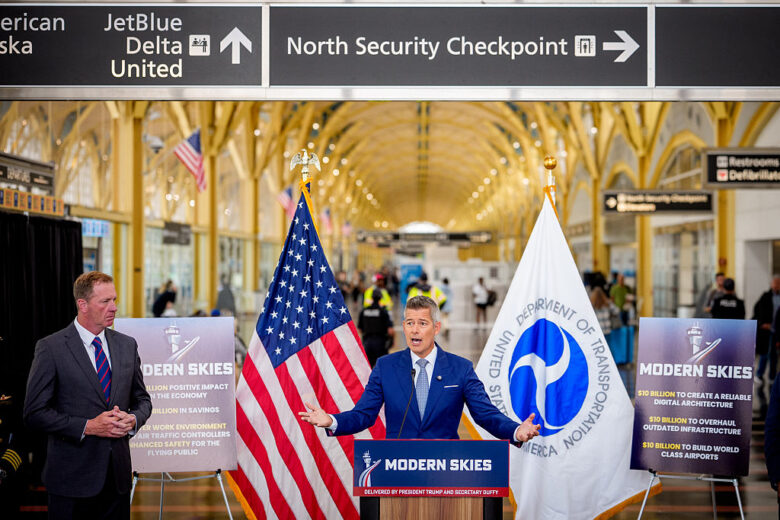
$30 billion is the new amount Congress is being asked to provide for the Federal Aviation Administration’s air traffic control systems and airport infrastructure. Introduced on September 28, the Modern Skies Act follows a two-link communications failure at an FAA facility in Philadelphia that disrupted thousands of Northeast flights. The proposal would come on top of $12.5 billion Congress previously approved for modernization.

The bill is not enacted funding. Transportation Secretary Sean Duffy has urged Congress to approve it, while the Department of Transportation’s outline divides the request into three equal sections:
$10 billion for digital architecture: This portion would replace aging telecommunications equipment and software, move operations away from analog and copper-based systems, and fund a more resilient network. It also covers common controller automation, traffic-flow management and data-driven planning tools.
$10 billion for airport infrastructure: The second section would support control towers, airport facilities, runways and taxiways. This recognizes that modernization is not exclusively a software project. Duffy has said some controllers work in towers dating from the 1960s and 1970s that can experience elevator, air-conditioning, roofing and plumbing failures.
$10 billion for midsize airports: The final section would create a pilot grant program for airports serving between 5 million and 25 million passengers annually. The policy argument is that these airports can have major capital needs without the same access to financing available to the largest hubs.
Replacing components is not the same as redesigning a system
The Philadelphia disruption illustrates the distinction. A primary communications line failed, and a backup fiber-optic line had been accidentally severed. Ground stops, delays and cancellations affected Newark, Philadelphia, LaGuardia and John F. Kennedy airports. That event does not establish that every FAA facility shares the same arrangement, but it demonstrates how nominal redundancy can still leave a consequential common failure point.
Resilience depends on more than substituting fiber for copper. Backup paths must be sufficiently independent, failover behavior must work as intended, operators must understand the transition, and supporting power, software and data interfaces must be treated as parts of one operational system. Duffy summarized the concern by saying, “We have redundant lines that go through a single point of failure.”
This is why the first $10 billion is the proposal’s most important systems-engineering element. Hardware replacement can improve reliability, but a network redesign determines whether one localized fault can still disable both the primary service and its backup. It also determines how communications, surveillance, weather, flight data and controller tools exchange information during normal operations and degraded conditions.
The FAA has already reported substantial progress from the initial funding. In congressional testimony, Administrator Bryan Bedford said that by September 1, 2026, the agency had replaced more than 64% of its copper-based time-division telecommunications network with modern equipment, shifted 21 towers from paper flight strips to electronic displays, converted more than 403 radio sites and installed 101 surface-awareness systems.
Those figures give Congress a measurable basis for reviewing the next request, but they do not by themselves establish the cost, completion criteria or operational performance of the wider architecture. Lawmakers must weigh the disruption risk of leaving old systems in place against the accountability required when adding $30 billion to a $12.5 billion initial appropriation.
Operators must shape the design
Air traffic controllers are another boundary condition. The National Air Traffic Controllers Association supports further investment but wants controllers directly involved in designing the replacement. Its president, Nick Daniels, said, “The best technology and system is technology and a system designed with the professionals who use it.”
That is not merely a labor preference. Control-room interfaces, alarm behavior, workload, training and fallback procedures are safety-relevant design inputs. A technically capable platform can still create integration risk if it adds display complexity, changes task sequencing or handles degraded operation in ways that do not match how controllers work. Operator involvement should therefore extend from requirements and simulation through acceptance testing and deployment.
The proposal also distributes benefits and costs unevenly. Travelers and airlines stand to gain from fewer infrastructure-driven disruptions, controllers from more dependable tools and facilities, and midsize airports from capital access. Taxpayers, however, would fund a package in which only one-third is expressly assigned to the digital air traffic architecture; the remainder addresses physical airport assets and a new airport grant category. Congress will have to judge those as distinct capital needs rather than treating the entire $30 billion as one communications repair bill.
The decisive next milestone is legislative, not technical. Until Congress acts, the Modern Skies Act remains a proposal—and the central question is whether another $30 billion will purchase an integrated, operator-informed architecture rather than a collection of newer components with old system-level dependencies.
| More aerospace and engineering stories, right in your MSN feed. Follow AMI on MSN |
By Thomas Caldwell — AMI’s senior editor for mechanical and mobility engineering, covering vehicle electronics, systems integration, electrification, chassis systems, propulsion, and safety policy.