Radio Astron Data Distinguish Jets From Two Supermassive Black Holes in OJ287
A 10-meter radio antenna traveling as far as roughly halfway to the Moon gave astronomers something Earth-bound observatories cannot provide: a receiving point far beyond the planet’s diameter. Researchers analyzing archived RadioAstron observations report that this enormous space-to-ground separation supplied enough angular resolution to distinguish radio jets associated with both supermassive black holes in OJ287.

The result does not mean the black holes themselves appear as visible disks. Black holes emit no light directly. Instead, the reported radio image identifies them through intense particle jets generated by material in their immediate environments. That distinction is central to understanding both the achievement and its limits: RadioAstron separated compact radio-emitting structures attributed to two objects rather than photographing two black surfaces.
A virtual telescope larger than Earth
RadioAstron worked through very long baseline interferometry, or VLBI. In this technique, widely separated antennas observe the same distant radio source and precisely compare when its wavefront reaches each station. As NASA’s explanation of VLBI notes, those timing measurements can locate distant radio sources with extremely high precision.
The effective resolution depends strongly on the distance between antennas, known as the baseline. A conventional global network is constrained by Earth’s dimensions. RadioAstron moved one element of the array into a highly elliptical orbit, while ground observatories formed the other elements. At an apogee of about 360,000 kilometers, or more than 220,000 miles, the spacecraft created a baseline much larger than Earth.
The antennas did not become a single physical dish, and the virtual telescope did not collect light exactly as one enormous reflector would. Instead, their separately recorded radio observations were combined interferometrically. RadioAstron’s orbital position purchased finer angular resolution, although using a moving space antenna also made orbital geometry, data handling and correlation essential parts of the observing system.
The space-ground array is described as reaching, at centimeter-to-decimeter radio wavelengths, resolution up to 1,000 times finer than the Hubble Space Telescope’s visible-light resolution. That comparison concerns angular detail, not overall image quality or sensitivity across different wavelengths. Hubble and RadioAstron detect different forms of radiation and examine different physical structures.
Two unequal objects in a distant blazar
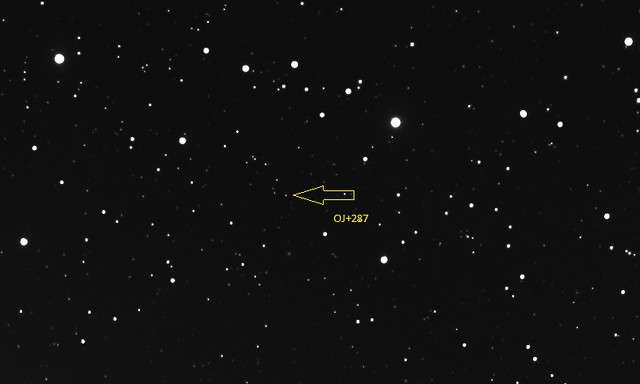
OJ287 is a blazar about 3.5 billion light-years from the Milky Way in the direction of the constellation Cancer. The reported binary is extremely uneven: the primary black hole is estimated at roughly 18 billion times the Sun’s mass, while the companion is about 150 million solar masses.
The smaller black hole is described as completing an orbit approximately every 12 years and crossing the primary’s accretion disk twice during each orbit. Those passages can produce outbursts that quadruple OJ287’s brightness for about 48 hours. Astronomers have recorded flashes from the object since 1888, but relativistic precession changes the orbit’s orientation, so the intervals between crossings can range from one to 10 years rather than following a simple clock.
Those recurring flashes and their timing have long supported the binary interpretation. The RadioAstron analysis adds a spatially resolved radio measurement: researchers say they can identify jets associated with both members. Mauri Valtonen described it as the first image of two black holes orbiting each other, while explicitly noting that the objects are detected through their particle jets or surrounding glowing gas.
A retired spacecraft still has a resolution advantage
RadioAstron launched from the Baikonur Cosmodrome in Kazakhstan and was already no longer operational when the latest analysis was announced. Its archival value comes from an engineering feature that cannot simply be reproduced by reprocessing newer ground-only observations: the physical length of its space-ground baseline.
Current ground arrays can deliver powerful radio observations, but their maximum separation remains limited to approximately Earth-scale distances. The archived RadioAstron measurements preserve observing geometry from a spacecraft that reached nearly lunar distance, allowing researchers to revisit targets with resolution unavailable from ground stations alone.
That makes the OJ287 result both an astrophysics claim and a mission-design demonstration. The decisive instrument was not merely RadioAstron’s 10-meter antenna, but the antenna’s placement hundreds of thousands of kilometers from synchronized observatories on Earth. Even after the spacecraft stopped operating, that Earth-exceeding baseline remained embedded in its data and offered a way to separate two distant jets that present ground-only arrays cannot resolve as sharply.
| More aerospace and engineering stories, right in your MSN feed. Follow AMI on MSN |
By David Whitaker — Associate editor for AMI’s aerospace and drone systems desk, translating flight systems, aircraft programs, spaceflight, and UAV developments into accessible technical stories.