California High-Speed Rail’s 2033 Schedule Faces Risk After Most Proposals Fail
Most legislation the California High-Speed Rail Authority considered necessary to protect the Merced-to-Bakersfield construction schedule failed to advance in 2026. Only Senate Bill 1425 became law, creating a mechanism for utilities, local governments and private developers to obtain permits for work on land controlled by the authority.

That outcome leaves a critical assumption behind the planned 2033 opening unresolved. A July review by the Office of Inspector General called the business plan’s expectation that lawmakers would approve the authority’s legislative priorities almost immediately “overly optimistic.” The setbacks could produce further delay, but neither the authority nor the inspector general has quantified how much.
One permit tool does not resolve the larger interface problem
Gov. Gavin Newsom included SB 1425 in his September 27 legislative update. The measure addresses a defined property-management issue: outside entities now have a formal route to secure authority approval before building on its operating right-of-way or other controlled land.
That can improve coordination and clarify who may perform work within the corridor. It does not, however, give the rail authority the power to order utilities to move existing power lines, pipes or other infrastructure, or to impose deadlines for completing those relocations. Chief Executive Ian Choudri said in August that some utilities identified as construction obstructions in 2017 remain in the project’s path.
This distinction matters because a megaproject schedule is not governed solely by the speed of its primary civil contractor. Track structures, railway systems and later testing can advance only when work sites are accessible and interfaces with existing infrastructure have been cleared. An unresolved utility conflict can therefore affect several dependent activities even when materials, designs and construction teams are otherwise ready.
The authority sought policy changes covering utility negotiations, faster environmental reviews for renewable-energy facilities, quicker resolution of property disputes and a sales-tax exemption for construction materials. Most remained concepts rather than enacted statutes. Authority spokesperson Micah Flores said the agency does not write legislation and that lawmakers may independently turn concepts into bills. Senator Dave Cortese, who authored SB 1425, argued that the authority and governor’s office had not given legislators enough assistance. Those are competing explanations for the legislative outcome, not findings that establish sole responsibility.
The schedule now carries an unpriced governance risk
From a systems-planning perspective, the central weakness is the gap between recognizing a constraint and assigning a reliable method and date for resolving it. If a published completion target assumes new legal authority, accelerated reviews or compulsory coordination, those dependencies need to be treated like other schedule inputs not as background expectations.
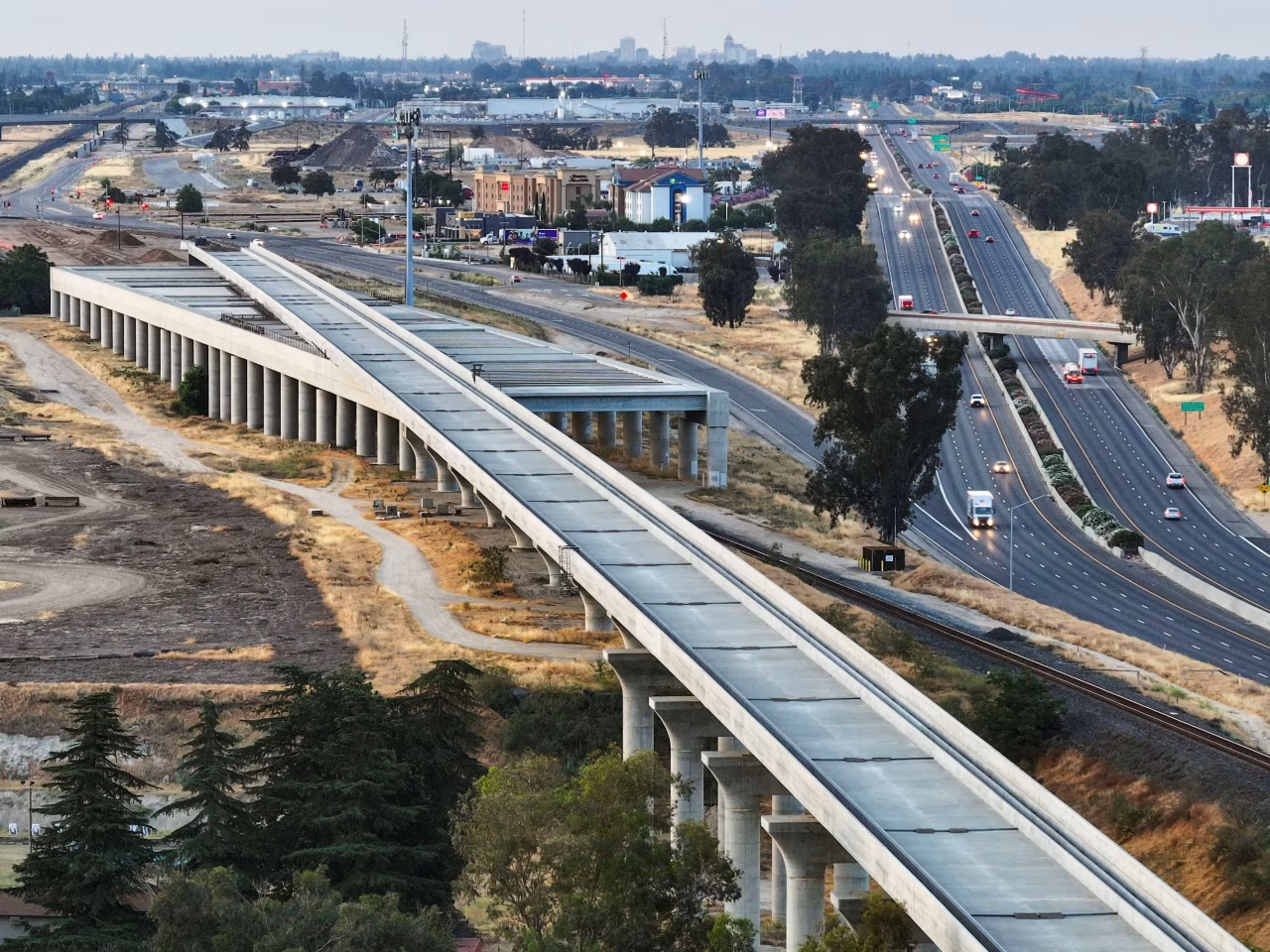
The 2033 target covers the planned 171-mile Merced-to-Bakersfield segment. Although SB 1425 closes one permitting gap, the failed or undeveloped proposals leave the authority without several tools it had identified as important to controlling time and cost. The resulting risk is real but currently unmeasured: failure to enact a proposal does not automatically translate into a specific number of months of delay, and existing administrative or contractual methods could still resolve some issues.
Funding adds another interface. The project is scheduled to receive $1 billion annually from California’s carbon-market auction proceeds through 2045, but new state climate rules could reduce that revenue by half. Senate Bill 1411 would have lifted a $500 million cap on specified climate-fund spending outside the Central Valley segment, potentially supporting design, engineering and land acquisition elsewhere. It was shelved in May, amid concern that broader spending could divert resources from Merced-to-Bakersfield.
A separate concept involving sales and property-tax revenue within a half-mile of the route exposed a direct fairness dispute. Eleven mayors warned that redirecting those receipts could reduce money available for local services and road repairs. Flores later said the authority was still consulting local governments and was not proposing to override local tax or land-use authority. The tradeoff remains unresolved: dependable corridor funding could support construction continuity, while capturing local revenue could shift part of the burden to communities hosting the infrastructure.
The statewide system is now estimated by the authority at $126 billion to $231 billion, making schedule assumptions consequential for taxpayers even before any additional delay is calculated. California voters approved the broader San Francisco-to-Los Angeles plan in 2008; that history provides the scale of the accountability issue, but it does not determine whether the current 2033 segment target will be missed.
The authority plans to revisit similar legislative concepts next year and issue updated cost and schedule information in March. That update will be the next opportunity to show whether the 2033 plan has been rebuilt around the laws and coordination powers that actually exist or still depends on policy changes that have not been secured.
| More aerospace and engineering stories, right in your MSN feed. Follow AMI on MSN |
By Thomas Caldwell — AMI’s senior editor for mechanical and mobility engineering, covering vehicle electronics, systems integration, electrification, chassis systems, propulsion, and safety policy.