DevDroid Adds Speakers to Listening Robots for Two-Way Battlefield Communication
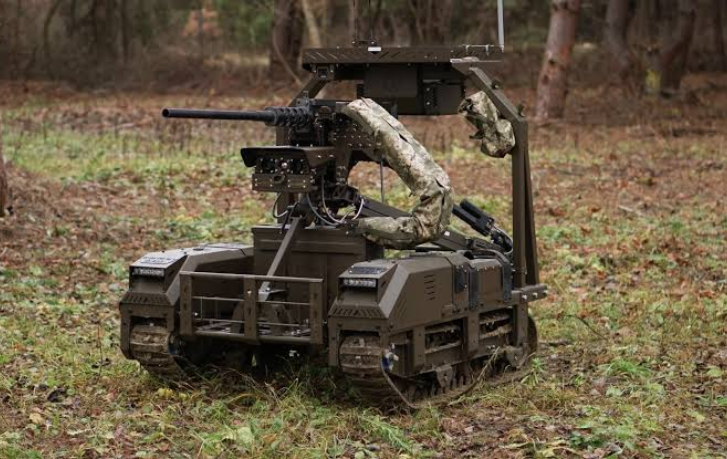
A camera can show only what falls within its lens and remains visible through grass, uneven ground or other obstructions. DevDroid is addressing that limit by combining streamed sound with speech: the Ukrainian developer says microphones are installed on all its remotely operated ground robots, and it has recently begun adding speakers capable of carrying live or prerecorded messages.
The result is more than an audiovisual upgrade. It turns a camera-equipped vehicle into a mobile sensing and communication node. Operators can listen to the environment beyond the camera’s field of view, while personnel near the robot can hear instructions, provide status information or communicate when an ordinary radio connection is unavailable.
Oleg Fedoryshyn, DevDroid’s director of research and development, said audio from the onboard microphones is streamed to remote operators. According to the company, ambient sound may indicate personnel, vehicles or other activity that cameras do not capture. That can be useful when terrain or tall vegetation blocks the visual feed.
This does not mean sound replaces vision. A microphone supplies directionally limited and potentially ambiguous information, while engine noise, movement and environmental conditions can complicate interpretation. Its value is as another sensor channel: an operator who cannot see past an obstruction may still receive an audible indication that something is happening nearby.
Speakers close the communication loop
Adding a speaker changes the information flow from one-way monitoring to two-way communication. DevDroid says the robots can carry live speech or stored recordings. Fedoryshyn described uses including requests for ammunition and status updates, while other accounts describe robots maintaining contact with trapped personnel or wounded troops during evacuation.
That function has a clear mechanical and operational logic. A mobile robot can bring a communication endpoint to a person without requiring another person to cross the same ground. During an evacuation, the speaker and microphone can also help an operator maintain contact with the person being transported, although the available information does not establish audio quality, range or reliability under different conditions.
Ukrainian companies and units have also described robots broadcasting surrender messages. Those examples illustrate another possible use of the speaker, but their battlefield effectiveness remains based on developer and unit accounts rather than independently established performance findings.
The broader shift is from robots built around a single transport or combat task toward adaptable platforms carrying several sensing and communication functions. Ukraine already uses remotely operated ground vehicles for logistics, casualty evacuation, attacks and mine laying. In a separate example of the expanding logistics role, an amphibious ground robot reportedly completed a supply mission of more than 40 kilometers across land and water after several months of testing and refinement with troops.
Software speed matters as much as hardware
Microphones and speakers are comparatively straightforward components, but deploying them effectively depends on integration with control software, data links and operator interfaces. Audio must be transmitted alongside video and vehicle-control data, while the operator needs a practical way to listen, speak or trigger recordings without becoming overloaded.
DevDroid says it maintains round-the-clock support chats with every unit using its systems and can resolve some technical problems remotely within minutes. Fedoryshyn also said the company can design an update, test it with a brigade and distribute it across deployed systems within a week, comparing the approach with updates for mobile phones or operating systems.
That claimed cycle shows why software-defined functions are important for fielded robots. A physical platform does not necessarily need to be returned to a factory each time an interface or control feature changes. Where the required hardware is already installed, remote software deployment can alter how sensors, speakers and operator controls work together.
The boundary is that rapid updates still require disciplined testing. A change that works on one configuration must remain compatible with deployed hardware, communications equipment and operator procedures. DevDroid’s one-week timeline is the company’s account of its process, not an independently measured standard for every update or vehicle.
Ukraine has expressed an ambition to move front-line logistics entirely to robots, but that goal has not yet been established as achieved. Audio will not remove limits imposed by terrain, communications coverage, payload or mechanical reliability. It does, however, give the same remotely operated machine another way to sense beyond its camera and keep a human connection open while taking on work considered too dangerous for people.
| More aerospace and engineering stories, right in your MSN feed. Follow AMI on MSN |
By Jonathan Barrett — Editor for AMI’s future mobility and autonomous systems section, with two decades covering robotics, e-mobility, drone-vehicle convergence, and transport mechanical systems.